Danger! Public School Classrooms Awash in Lawlessness
Fistfights, name calling, classroom chaos, and students disrespecting each other and their teachers are everyday occurrences in many, if not most, U.S. public schools. Yet these antics are overshadowed by the myriad other woes plaguing K-12 education, such as low test scores, illiteracy, bizarre math curricula, CRT, social emotional learning, and LGBT indoctrination. Preoccupation with students’ gender preferences, including their preferred pronouns, sexual proclivities, and the status of their feelings, rule the day in many schools.

But as former teacher and author Daniel Buck pointed out in National Review on August 2nd, the gravity of classroom violence has reached alarming proportions, surpassing all else. He observed that “the dramatic turn toward lawlessness post-pandemic is perhaps the most consequential story in education that receives little to no coverage. We bicker about phonics or whole-language instruction, which books to read or banish from library shelves, whether Texas teachers can include the Bible as literature in curriculum — all the while teachers cannot maintain basic control of their classrooms, and students crack skulls on pavement.”
Buck describes the results of his contact with “almost 200 teachers” at the end of last school year, most of whom he says expressed a sense of “persistent anxiety” over the chaotic atmosphere they face on a daily basis, and noting that “the public doesn’t understand the crisis we are in.”
One female teacher described the situation at her school as “spiraling out of control … students consider themselves to be the authority.” She claimed that in one year alone, she was called “more names” and had received “more threats than the previous twenty-six” years of her teaching career. Several teachers lamented that they didn’t know how their schools “would even function come September.”
Two surveys of teachers and other school staff, conducted in 2020-21 and one year later in 2022 by the American Psychological Association showed that while instances of violence and aggression were down during the COVID-19 restrictions, they quickly rose to pre-pandemic levels and higher after the restrictions were lifted. Reports of verbal abuse jumped from 65 percent before the pandemic to more than 80 percent, with 56 percent of respondents also reporting physical attacks.
Buck further notes: “Other representative surveys confirm that rates of violence directed at both students and teachers have doubled from pre-pandemic levels. Student behavior regularly tops the list of teacher concerns — over and above teacher pay — even on internal union surveys.”
‘Restorative justice’ to blame?
Proponents of traditional forms of discipline and those who favor leniency have been at odds for years. The Obama administration in 2014 threatened school districts with legal action if they disproportionately disciplined students by race, while some charter schools doubled down with a strict disciplinary philosophy called “No Excuses.”
Following the pandemic, most schools, including many charters, capitulated with progressives by adopting the “restorative practices” discipline method, also known as restorative justice. Vince Bielski of Real Clear Investigations described restorative justice in a 2022 article as intended “to curb suspensions and arrests that disproportionately affect students of color. It replaces punishment with discussions about the causes and harmful impact of misbehavior, from sassing teachers and smoking pot to fighting … serious offenses like gun possession are still referred to the police.”
However, Bielski demonstrated that not all teachers and administrators bought into the restorative justice philosophy. “In schools struggling with low test scores and overcrowded classrooms,” he observed, “it seems like another time-consuming educational fad. And students who are demoralized by school sometimes see a restorative conversation as an easy way to escape suspension rather than a learning experience.”
In fact, Bielski reported, the method was caught “in multiple failures.” For example, after the Denver School Board, along with more than 30 other districts nationwide, ousted their school resource officers (SROs) in late summer 2021, violence erupted when schools reopened in the fall.
Bielski wrote:
- In just the first month of instruction, there were 102 student fights, 11 sexual assaults, eight assaults on staff, and 29 weapons violations, including four loaded firearms and a stabbing of a student with a knife, according to Boardhawk, a news website that covers the district. Michael Eaton, chief of the Department of Safety for Denver schools, warned that he’s never seen such a surge of crime in his 10 years of service.
Districts across the country ended up reinstating their SROs in response to the significant jump in assaults and threats.
The basis for restorative justice was alleged bias against non-white students, and while some subtle bias may exist, Bielski cited data that show “African American and Latino students get into more fights than whites and Asians.” He documented, for example, the results of a 2019 survey which showed that “American Indian students fought the most (18.9%), followed by blacks (15.5%), Pacific Islanders (9.1%), Latinos (7.8%), whites (6.4%) and Asians (4.9%)” and that “these differences have held steady over decades.”
Looking for answers
Canadian educator and director of the Schoolhouse Institute, Paul W. Bennett, acknowledged in a 2023 Policy Options Politiques article that “classroom management appears to be an ongoing issue in schools” in both Canada and the U.S. He noted that in the classrooms of today, “moving chairs, blurting out, walking around, jostling, checking cellphones, talking back, and walking in late have been normalized,” or, in other words, have somehow been found acceptable.
Bennett wrote that “while stories about school violence, drugs, and weapons attract the most public attention,” teachers more often face less serious but no less disruptive behaviors. He lamented that these types of disruptions “consume more than 80 percent of teachers’ instructional time.”
He explained that “school-wide positive behavior supports” and the “proliferation of restorative justice experiments” have undercut teachers, “making it more difficult to build a class culture of consistency, respect, and responsibility where misbehaving has meaningful consequences.”
Bennett aptly noted that “the primary role of the teacher has gradually shifted across the spectrum from ‘sage on the stage’ to ‘guide on the side’ to ‘peer at the rear.’” He believes the remedy is not “more progressive behavior strategies” but a focus on helping teachers manage their classrooms.
His article described some modest gains made in restoring order in United Kingdom public schools that he believes were prompted by teacher-researcher Tom Bennett, who “produced a ground-breaking report which provided teachers everywhere with a common sense, practical guide to creating a culture of mutual respect and good behaviour in the classroom.” The report was published in 2017 and can still be found online.
‘No Excuses’ model
For U.S. students, perhaps the most pivotal K-12 discipline model is “No Excuses,” which has been synonymous with some charter schools for approximately 30 years, the length of time charter schools have been in existence. This approach emphasizes a rigorous curriculum, classroom orderliness, and adherence to rules, with the goal of improving student achievement and preparing kids for college.
The concept driving No Excuses is that “every student, no matter what his or her background, is capable of high academic achievement and success in life,” a statement attributed to Stephen Thernstrom, a Winthrop Research Professor of History Emeritus at Harvard University.
No Excuses schools allegedly developed in the U.S. as the result of the landmark report A Nation at Risk, published in 1983 by the U.S. National Commission on Excellence in Education. The method was implemented by a group of teachers during the 1990s in newly established charter schools.
In June 2024, Vince Bielski penned another school violence-related article posing the question: “Can a return to traditional discipline save public schools?” He wrote that back in the ’90s, charter school teachers, including David Levin of the charter network KIPP, “brought together ideas from their experiences to fashion a new kind of urban school with a culture of high academic expectations and a precise set of rules and consequences to help students reach them.”
Persistent attacks by progressives charged that the No Excuses method was “racist” and should be replaced with restorative justice. Bielski says the moniker itself is now so controversial that many charters avoid using it, even while continuing its practices. “Other charter networks, like Achievement First,” he writes, “have completely abandoned the No Excuses model and joined the anti-racism crusade, only to see their performance plummet after ratcheting back discipline and lowering academic standards to ensure students pass courses and graduate.”
He adds: “Progressive educators who have embraced ‘anti-racism’ as their guiding principle over the last five years have assailed the charters, claiming they single out students of color for stern discipline. The rhetoric has been inflammatory, alleging that the charters ‘control black bodies’ and prepare students for prison, despite the high rate of No Excuses graduates who go on to college.”
While such criticism is demonstrably false, No Excuses leaders have admitted to some mistakes and are taking steps to become less rule-bound without sacrificing their mission of creating high expectations for student success. Doug Lemov, author of a popular No Excuses teaching manual entitled Teach Like a Champion, stated what should be obvious: “Equity for marginalized students starts with their high achievement in school.”
Daniel Buck pointed out in a Fordham Institute commentary that the No Excuses model has been used successfully for decades in Catholic and other religious schools. He wrote:
- No Excuses schools pair an academic ideal with excellence in curriculum and instruction. Administrations coach teachers constantly. Teachers review data to modify instruction. Curricula are sequenced, knowledge-based, and rigorous. These factors provide students a near-guarantee of reaching the ideal, so they’re less likely to reject it….
Buck observed that religious schools similarly “make their ideals clear, and all the teachers assume responsibility for shaping student character.” He believes this understanding of schooling and identity also informs the success of school choice. “Both families and teachers can opt into schools that align with their values or ideal education, and so schools have a stronger mandate to advance one coherent vision.”
With another school year beginning, many parents hope that not only will more of the No Excuses charter schools stand their ground and maintain their educational ideals and methods, but that district public schools will follow suit. As Daniel Buck stated in National Review: “…behavior is primary. Neither phonics nor whole language, Shakespeare nor Diary of a Wimpy Kid will matter a whit if little Johnny can’t even hear his teacher over the sounds of chaos in the back of the classroom.”
Feds Punish Whistleblower in Texas Children’s Hospital Case
A whistleblower who tried to expose wrongdoing at Texas Children’s Hospital (TCH) is being prosecuted by the Federal government for allegedly releasing HIPAA-protected patient information. Dr. Eithan Haim is accused of illegally providing the intel, which was carefully redacted to conceal “all personal information,” to Manhattan Institute senior fellow, Christopher Rufo. According to Rufo, the information Haim released “remained within the bounds of privacy laws,” but the Biden Administration is going after him anyway.
At issue is the hospital’s continuation of its gender transitioning program, which it claimed had been halted in 2022 in response to Texas Attorney General Ken Paxton’s issuance of an opinion that transgender procedures and treatments “can constitute child abuse under section 261.001(1)(C), 261.001(1)(A), and 261.001 (1)(B)” of the Texas Practice Guide for Child Protective Services.
In an interview with Rufo last January that appeared in City Journal, Dr. Haim revealed that after the hospital pledged to “shut down” its transgender program, it secretly accelerated it. Just three days after declaring that the program was discontinued, the hospital resumed its transitioning procedures on children “by implanting a puberty-blocking device into an 11-year-old girl with gender dysphoria.”
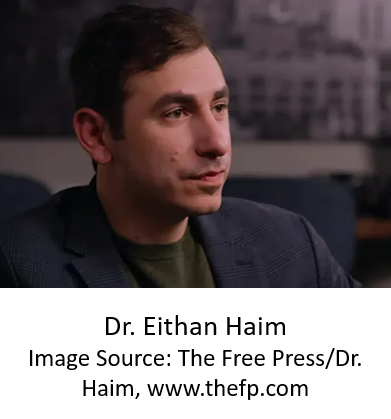
Haim said: “I was doing surgery at the hospital, and people I knew would tell me how they were implanting these puberty-blocking devices into 11, 12, and 13-year-old kids. They told me how the kids had all these psychiatric issues that were going unmanaged but were being attributed to this one thing,” meaning the need to change their gender.
Haim further disclosed that, seven months after the alleged dissolution of the transgender program, the head of the program, which—to the public—did not exist, was given the opportunity to take part in the hospital’s most prestigious lecture series called “Grand Rounds.” Haim said that during his lecture, the program head bragged about “how he was running this active transgender clinic, seeing patients who were very young, and talking about the algorithmic approach to managing ‘these people’ with social transitioning, puberty blockers, hormones, and surgery.”
While the public believed the TCH transgender program was no longer in operation, it was actually a priority, yet it wasn’t listed on the hospital’s website. “This is important,” Haim said, “because even the hospital departments that treat ultra-rare diseases have a section on the website where people can schedule appointments and learn about the doctors. But the transgender clinic didn’t have a page on the website.”
He explained that the program was being hidden because it was so controversial. “Every kid that walks into that clinic,” he said, “is being told he or she has to adopt this identity…. If parents hesitate to accept it, they are threatened with their child’s suicide.” He made the salient point that, “instead of telling these kids that they’re perfect the way they are, that growing up is hard, but that they could grow up to be something amazing, they are telling them to adopt this false identity, which is based on their own self-hatred.”
As Haim saw all this play out, he felt he had to speak up or never forgive himself for failing to do so. He believes two major factors drive the bizarre belief that doctors can change a child’s (or adult’s) gender:
- The changes that occurred during covid are what allowed the transgender ideology to proliferate and allowed doctors to do this to children on a large scale…. First was the prioritization of ideology over evidence, and second was the censorship of anyone who questioned that ideology with the presentation of evidence. Specifically, it’s the belief that truth is subjective, independent of objective reality. So something is true because they say it’s true, which is especially concerning when it comes to medical recommendations.
Haim believes the transgender agenda should never have been allowed to come this far, but has done so due to the lack of medical professionals speaking out against it. “When you are claiming something to be true that is, in the most obvious way, untrue, but you don’t have voices in the medical community who will speak out and challenge it, these [lies] go unopposed … and [the ideology] becomes part of the medical standard.”
Charges against Haim
Houston Public Media reported in June that Dr. Haim had been charged with “four counts of criminal HIPAA violations after leaking internal documents” that showed TCH was still performing gender procedures after being admonished that such procedures could constitute child abuse.
One year ago, Governor Greg Abbott signed into law SB 14, which bans the performance of gender-transition procedures on children. Transgender activists whined that “gay and trans people” were being targeted “as part of a broader effort in Texas and across many states dominated by conservative politicians to stigmatize and punish queer people in ways that profoundly upend the lives of tens of thousands of families.”
In the meantime, Dr. Haim is charged not only with disclosing protected health information, but also with committing “‘malicious harm’ to the hospital and its patients.” Although the documents he provided did not disclose any personally identifiable patient information, opponents continue to suggest otherwise. He reportedly faces “10 years in federal prison and a maximum fine of $250,000.”
Conservatives have rallied around Haim, raising “nearly $1 million for his defense.” The son of Lt. Gov. Dan Patrick and “a prominent former U.S. attorney during the Trump administration, Ryan Patrick,” is Haim’s legal counsel.
In addition to Rufo, Haim’s supporters include U.S. Sen. Ted Cruz, R-Texas, who, according to The Texas Tribune, denounced what he called “selective prosecution and the weaponization of the Department of Justice against political opponents.” Texas Congressman Chip Roy (R-Austin), “sent a letter to U.S. Attorney General Merrick Garland similarly suggesting misuse of law enforcement to ideologically target detractors, and requesting information for the House Judiciary Committee.” Congressman Dan Crenshaw (R-Houston) also came to Haim’s defense, claiming he has “done nothing wrong.”
Misuse of Medicaid funds
Amid all the controversy, two Texas state lawmakers, Rep. Brian Harrison (R-Midlothian) and Sen. Mayes Middleton, (R-Galveston) criticized TCH for using Medicaid funds to cover transgender treatments. And Fox News reported that the U.S. House Oversight Committee “is investigating whistleblower claims related to fraudulent billing to Medicaid programs for pediatric gender transition care, including at Texas Children’s Hospital in Houston (TCH).”
Members of the committee sent letters to the Centers for Medicare & Medicaid Services (CMS) and the U.S. Department of Health and Human Services (HHS) expressing concern that “medical providers at TCH are falsifying diagnosis codes for patients seeking gender transition care not covered under Medicaid.”
The letters cite a specific instance of the fraudulent use of a diagnosis code to hide the gender transition care of a female patient and present it as “testosterone deficiency and hypogonadism, in order to obtain Medicaid approval for testosterone treatment that would otherwise be denied under Texas Medicaid regulations if prescribed for the purpose of gender transition.” The letters were signed by Subcommittee on Government Operations and the Federal Workforce Chairman Pete Sessions, R-Texas, and Subcommittee on Health Care and Financial Services Chairwoman Lisa McClain, R-Mich.
Committee members also “expressed alarm about its perception that the Biden administration is prioritizing action against individuals who made the allegations,” referring to the prosecution of Dr. Haim.
In the same report, Fox quoted Haim as saying: “If they can come after me as a whistleblower, they’re going to come after you…. So we’re going to have to take this to court, and we’re going to have to win.”
The committee is requesting “documents, communication, and a staff-level briefing to learn of any ongoing audits or investigations into fraudulent Medicaid billing related to gender transition care.” Spokespersons for CMS and the HHS Office of Inspector General acknowledged receipt of the letters and said they would “respond to the members of Congress.”
Second whistleblower
Last month, The Washington Stand reported that a second TCH whistleblower, nurse Vanessa Sivadge, may also be facing federal retaliation. The Stand’s Joshua Arnold wrote:
- The feds knocked on Eithan Haim’s door on the day of his graduation from medical school. They knocked on Vanessa Sivadge’s door while she and her husband were hosting friends for dinner. Haim and Sivadge don’t know each other, but they did both witness illegal activity at Texas Children’s Hospital (TCH), which was secretly providing gender transition procedures to minors in violation of state law.
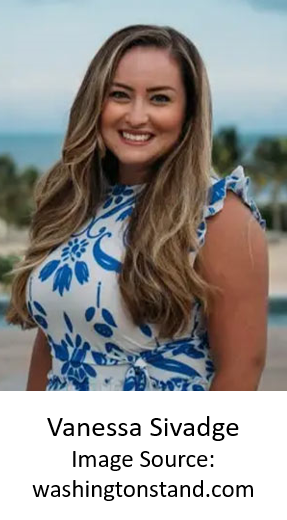
Sivadge told Arnold that FBI agents indicated they “knew what I believed,” and that “her beliefs made her a person of interest in an investigation regarding the public release of confidential patient information.” Sivadge said she “had no idea who [Haim] was” at the time.
The agents were seeking to discover the whistleblower’s identity, and were likely focusing on Sivadge as someone who shared his beliefs and therefore might know him. “They proceeded to just say that if I didn’t help them, they couldn’t protect me. They said someone at my job, at my work, had given them my name, and that I wasn’t safe.” She added that they were “very vague” and made “very veiled threats.”
Arnold believes the FBI may have been directed to Sivadge because of an article she wrote that appeared in The Washington Stand in August 2022, titled “What Happened to ‘Do No Harm’? A Nurse’s Firsthand Look at the Transgender Craze.” Arnold says the article “would give the FBI rather reliable information about what Sivadge believed.” She, in turn, admitted that “I really pondered whether or not to use my name with that piece, and I decided at the end to do that. I knew that [it]would carry some risk.”
The FBI ultimately determined Haim’s identity from other sources, and his indictment followed. As for Sivadge, she says the FBI’s visit to her home “was the catalyst for going public” as a second whistleblower. “In the moment, I was just so terrified. And then the anger sets in…. Before, the FBI had at least an external reputation of prosecuting crime, exposing corruption, and fighting terrorists. And I think that things have really shifted and changed for the worse.” She admits that legal retaliation against her “still looms darkly over her shoulder,” and she has proactively hired a lawyer.
It turns out her concerns were valid. The Family Research Council (FRC) reported that on August 16, Sivadge was fired from her position at TCH for her whistleblower activities, noting that her request for a religious accommodation and transfer from the transgender clinic due to her religious beliefs was ignored.
“Employers can’t legally retaliate against employees who exercise their rights under the U.S. Department of Labor’s whistleblower protection laws,” FRC wrote, meaning that Sivadge’s termination was illegal.
Meanwhile, jury selection in Dr. Haim’s trial was set to begin on August 20.
Bad Grades? Dumb Down the Grading System
It was only a matter of time. As the National Assessment of Education Progress (NAEP) scores continued to tumble despite the dumbing down of the tests themselves — they now measure social-emotional characteristics in addition to academics — public-school administrators had to do something. The solution, at least in California and reportedly soon if not already in other states, is to lower the grading scale.
In April, reports surfaced of a dumbed-down California grading system (shown below), which was purportedly posted on Facebook by a concerned California parent and brought to light nationally on the Dr. Phil TV show. The chart turned up on X, courtesy of a user called “Joker King,” who wrote: “84-100 is an A? 24-44 is a D? In my day, anything below 65 was failing, now it’s a C. This is unacceptable….”
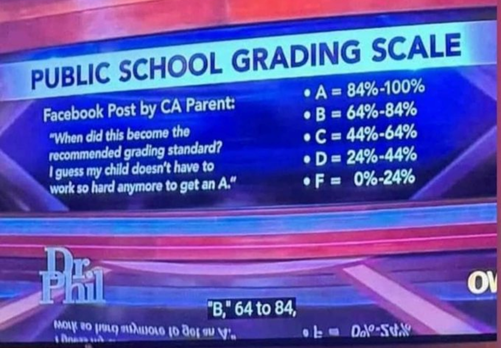
The grading scale was decried by nearly all who commented on the post. One responder uploaded a Peanuts cartoon with the caption: “No one is going to give you the education you need to overthrow them.” Another wrote: “My New York school is about to implement the same thing but less obvious, so therefore more insidious. It’s called ‘equity in grading.’ We will just eliminate 0-50 and all grades [will] start at 50. If a kid can make it to 65, they pass.” Yet another user recalled: “When I was in school you had to have a 70 to pass.”
Although the hour-long daytime Dr. Phil show on CBS ended in the spring of 2023 and, according to the official Dr. Phil website is now streaming on Merit+, independent sources, including Snopes, determined that the screen shot of the grading system had in fact appeared on the show. While Snopes claimed it could not verify the authenticity of the grading scale, neither could it be disproved.
But the move to lower grading standards has been in the works since the pandemic. In November 2021, the Los Angeles Times published an article describing how, “faced with soaring Ds and Fs, schools are ditching the old way of grading.” The article described the tactics of Alhambra high-school teacher Joshua Moreno, who “got fed up with his grading system,” which he derided as “a points game” and “inequitable.”
Moreno scrapped the grading system, stopped assigning homework and awarding points for students’ work, and instead began giving them “multiple opportunities to improve essays and classwork.” His goal was “to base grades on what students are learning, and remove behavior, deadlines, and how much work they do from the equation.” For many parents, this was a how-to for dumbing down their children’s education.
According to the Times, Moreno was hardly the only teacher or school district to embrace such practices:
- Los Angeles and San Diego Unified — the state’s two largest school districts, with some 660,000 students combined — have recently directed teachers to base academic grades on whether students have learned what was expected of them during a course — and not penalize them for behavior, work habits, and missed deadlines. The policies encourage teachers to give students opportunities to revise essays or retake tests to show that they have met learning goals, rather than enforcing hard deadlines.
School district leaders excused the obvious downgrading of classroom practices as “teaching students that failure is a part of learning.” In letters addressed to principals, they asserted that traditional grading “has often been used to ‘justify and to provide unequal educational opportunities based on a student’s race or class.’” The letters alleged that “century-old grading practices” perpetuate achievement gaps by “rewarding our most privileged students and punishing those who are not.” In other words, students in most need of traditional education will again be shortchanged, as the so-called “privileged students” will find a way to succeed, perhaps through tutors or other outside means provided by their “privileged” parents.
‘Equity Grading’
In the realm of equity in grading or “equity grading,” the name Joe Feldman frequently appears. Feldman is a former teacher, administrator, and self-appointed “grading consultant” who wrote the book Grading for Equity.
The book is promoted as emphasizing “accurate, bias-resistant, and motivational grading practices that improve learning, reduce failure rates, and strengthen student relationships.” It supplies a historical backdrop that implicates traditional grading as “a sorting mechanism to provide or deny opportunity, control students, and endorse a ‘fixed mindset’ about students’ academic potential,” clearly indicating the biased premise upon which the content is based.
One teacher who reviewed the book took issue with a number of its precepts, including the recommendation that teachers should accept “late work” from students as a matter of course, and the assumption that “all my ‘grades’ are on summative assessments only…that I don’t recognize growth…and that every assessment assesses the same skills (and therefore a student’s understanding of those skills changing from task to task).”
This teacher credited the book as a “conversation starter among staff,” but found its argument “poorly supported” and “the warrants underlying the argument profoundly flawed ‘if you want a practicing teacher to drink the Kool-Aid.’”
Fordham Institute findings
In February of this year, the Fordham Institute published a policy brief titled Think Again: Does ‘equitable’ grading benefit students? The report shows that changes in grading practices promoted by equity grading, such as preventing teachers from giving less than 50 percent credit to students regardless of how little work they do or how poorly they perform, bans on grading homework or class participation, etc., “ultimately harm the students they are meant to help.”
For many parents, Fordham’s findings are obvious. Lowering standards through lenient grading systems and prohibiting penalties for late assignments and cheating only serve to discourage responsibility and accountability among students, while hampering teachers’ efforts to manage their classrooms. High expectations create motivation; low expectations encourage laxity.
Even the Washington Post wrote of the Fordham report: “The researchers admit that some adjustments in traditional grading can be useful. ‘But top-down policies that make grading more lenient are not the answer, especially as schools grapple with the academic and behavioral challenges of the postpandemic era.’”
The report notes that many of the equity-based grading reforms were “not birthed during Covid,” although the push to implement them emerged from the pandemic’s disruption and chaos. But as the report authors write, the increasing popularity of these reforms and their growing implementation by states and districts is new. “Unfortunately, many of these policies lower academic standards and are likely to do long-term damage to the educational equity their advocates purport to advance.”
Grade inflation
Another factor in the equitable grading debate is grade inflation, by which “teachers assign ever higher grades for the same level of academic work.” The Fordham report contends that “in the last few years, grade inflation has not only accelerated but has become normalized and pervasive, reframed as a core battleground in the struggle for greater educational equity.”
The report references the influence of the previously mentioned Joe Feldman, whom the authors note “regularly consults with school districts and whose 2018 book Grading for Equity has become a staple of teacher professional development.” The authors question Feldman’s contention that his grading reforms actually counteract grade inflation, “particularly for more privileged students,” because “equitable grading no longer includes nonacademic, compliance-related, and subjectively interpreted behaviors.” Feldman worries, for example, that “classroom participation” — which he considers to be a subjective grading practice — “will disproportionately inflate the grades of privileged students—who often benefit from advantages such as being more likely to encounter academic English at home.”
Fordham refutes this concern, writing:
- Although this may be true in some cases, the claim that his recommended policies combat grade inflation ultimately confuses two aspects of grading: what should contribute to a course grade and how those activities should be assessed. After all, a teacher might grade class participation (the “what”), which Feldman claims may lead to grade inflation, but also use a rubric to do so strictly and fairly (the “how”).
The report further finds that, contrary to claims that “strict grading harms students,” lenient grading actually does so by leading to “less learning.”
The Fordham report is packed with information and data without discounting everything about equity grading. But even when the authors concede that some classroom biases exist, they maintain that these “are not just about outright prejudice.” They believe reforms that “increase transparency around expectations and grading can be beneficial, noting: Research confirms that scoring rubrics can reduce the effects of bias.”
Reading is key
Supporters of traditional education know that the ability to read is key to acquiring all other knowledge, including math, and that children in general are not being taught to read, hence the push to lower the grading scale.
A May 2023 editorial in the Los Angeles Times admitted that California “knows how to turn students into better readers,” and questioned why this wasn’t happening. The editorial bemoaned the fact that “more than half of California students can’t read at grade level,” and acknowledged that despite a degree of normalcy having been restored post pandemic, test scores from the spring of 2023 showed that “the percentage of grade-level readers crept down ever so slightly, from 47.5 percent to 46.7 percent.”
The editorial stated: “Learning to read is a complex process that requires phonics and related skills, with students directed by a teacher through the decoding of letters into sounds, sounds into words, words into sentences and stories. But it also requires building children’s vocabularies as well as their enthusiasm for literature.”
Phyllis Schlafly could have explained all this many years ago when she was teaching her own children to read using the phonics method. While the article touted the “science of reading,” as if it were a new phenomenon, this method is little more than the proven phonics instruction that Phyllis and others touted for decades as the most effective way to teach reading. (See Education Reporter, December 2023.) The Times reported that as of July 2023 some 32 states, New York City, and Washington DC “had adopted policies favoring science of reading, according to an analysis by Education Week.” The editorial acknowledged that “bringing phonics out of the shadows won’t magically turn students into top-notch readers. But it can definitely bring about large-scale improvement and should be the state’s highest educational priority over the next few years.” Whether or not that happens remains to be seen.
Ulterior motives
In March of this year, For Kids and Country founder Rebecca Friedrichs and longtime newspaper editor Roger Ruvolo, authored a piece in the Washington Examiner that suggests public schools “are intentionally” dumbing down education. “This casts a pall on the country’s future, and this ominous cloud is cast by design,” they wrote.
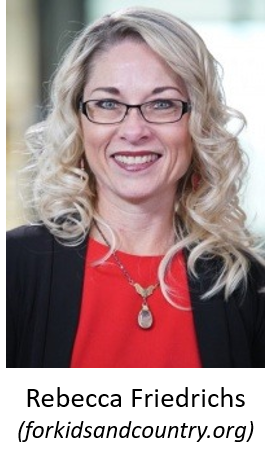
As she explained in her 2018 book Standing Up to Goliath, Friedrichs laid much of the blame for the state of America’s public schools at the feet of the teachers’ unions, particularly in the states where the unions wield the most power. She and Ruvolo used Illinois as an example. “Nothing but goose eggs in reading at 32 Illinois schools, according to a 2022 report from the Illinois State Board of Education,” the authors wrote.
They added that despite Illinois school districts spending more than $30,000, $40,000, or even $50,000 annually per pupil, “not a single student — zero — tested at grade level in reading in 32 schools. Similarly, not a single student tested proficient in math in 67 Illinois schools.”
The authors charged that, for decades, teachers unions “have worked relentlessly to convince Americans that we need trillions poured into our schools. They’ve used our tax dollars to destroy our children: to indoctrinate them, sexualize them, turn them against parents, demoralize them, dumb them down, and replace learning fundamentals with communist propaganda.”
But parents should take heart. When news outlets like the Los Angeles Times and the Washington Post acknowledge that all’s not well with public education, it’s a step in the right direction. There’s also hope in the increasing push for school choice, the rise in homeschooling and private schooling, and the burgeoning number of other educational alternatives such as microschools.
And all is not lost when concerned parents like Moms for Liberty, Moms for America, and many other courageous parents groups, take center stage and demand change.
What Books Should Kids be Reading?
(Seventh in our series of recommended reading lists for children of all ages. We will continue this feature in Education Reporter until all our lists have been republished. — Ed.)
Classic children’s books are scarcely to be found in school classrooms and libraries today, so parents must ensure that their kids are reading books that educate, absorb, and entertain in a manner that stimulates curiosity and increases the child’s eagerness to learn about the world.
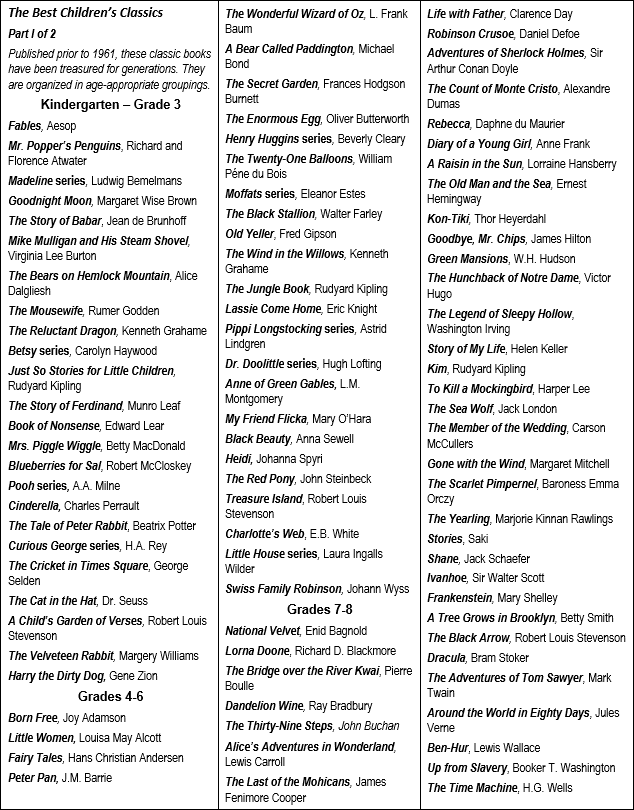
The Best Children’s Classics list was put together by Peter Bernstein and Christopher Ma from a compilation of titles published by the National Endowment for the Humanities, based on recommendations it had requested from public and private schools across the country. The list will appear in two parts, with part I in this month’s issue of Education Reporter.
Additional Education Reporter suggested reading lists:
- A Child’s Reading List (February 2024)
- The Ultimate Reading List — Classics that Endure (Part 1) (March 2024)
- The Ultimate Reading List — Classics that Endure (Part 2) (April 2024)
- Children Will Love Discovering Lost Classics (May 2024)
- Bennett’s Reading List (Part 1) (June 2024)
- Bennett’s Reading List (Part 2) (July 2024)
- The Best Children’s Classics (Part 1) (August 2024)
- The Best Children’s Classics (Part 2) (September 2024)
- Recommended High School Reading List (October 2024)
NOTE: Most books on this list can be ordered online through booksellers including:
- ThriftBooks
- Amazon.com : vintage books classics
- Project Gutenberg (Free Archive, eBooks only) Choose (EPUB3 (E-readers incl. Send-to-Kindle))
> > > > Send to Kindle to upload ebooks to your Kindle device downloaded from Project Gutenberg.
The Best Children’s Classics
Click the image below to open as a (printable) PDF document
Mallard
Social Justice Fallacies
by Thomas Sowell, Basic Books, 2023
The incomparable Thomas Sowell has written a truth-telling book about one of the leading movements championed by liberals today, that of “social justice.” In a similar vein as Professor Wilfred Reilly’s Lies My Liberal Teacher Told Me, Sowell strips away the rhetoric and heart-tugging theatrics, and explains in a factual but interesting way why social justice is a political agenda and does little for the very people it is intended to help.
Social justice is a crusade that seeks to put all people on an equal playing field by manipulating and changing institutions. But as Sowell writes: “Even in a society with equal opportunity — in the sense of judging each individual by the same standards — people from different backgrounds do not necessarily even want to do the same things, much less invest their time and energies into developing the same kinds of skills and talents.”
The author gets to the heart of the movement by explaining that its intent is to create the assumption that, “because economic and other disparities among human beings greatly exceed any differences in their innate capacities,” these disparities prove that the root causes are exploitation and discrimination. The bulk of the book debunks this “proof” and instead shows exactly the opposite, that while discrimination does exist, the real damage has been done by do-gooders and reformers who believe they have greater knowledge than everyone else and therefore should decide how others are to conduct their lives.
Throughout the book, Sowell uses examples to show how social justice manipulators have actually done more harm than good. He first provides interesting historical facts that explain why certain groups of people are better at certain things; the Scots in producing quality whiskey, for example, noting that they cannot match the French in wine making because “the grapes that grow in France do not thrive in Scotland’s colder climate.” He cites the historical skills of Germans in producing beer, emphasizing that in each case, “neither race nor racism, or any other form of discrimination is necessary to account for such reciprocal inequalities.”
Sowell further provides examples of groups that, lacking in their educational backgrounds, nonetheless often succeed in other endeavors where personal talent and dedication are key factors. “Sports and entertainment,” he writes, “have long been among such endeavors with high achievements for such American groups rising out of poverty as the Irish, blacks, and Southern whites.”
From these “equal chances” fallacies, the author moves on to dissect “racial fallacies,” and he skillfully disproves the social justice warrior contention that “racism” is the primary explanation for group differences. He finds particularly disturbing “the extent to which people who present empirical evidence counter to prevailing beliefs are met with ad hominem denunciations and with efforts to suppress their evidence, by means ranging from censorship to violence, especially on academic campuses.” His presentation of historical and empirical evidence on this topic is one of the most absorbing sections of the book.
Social Justice Fallacies also considers the role of government in the social justice warriors’ quest. He cautions: “The confiscation and redistribution of wealth — whether on a moderate or comprehensive scale — is at the heart of the social justice agenda.” This should be of concern to every American, regardless of skin color or ethnicity, who has worked hard for the material wealth they have accumulated.
The author then discusses in depth the issue of taxation and its various implications for all economic groups. “Raising the tax rate X percent does not guarantee that the tax revenue will also rise X percent,” he writes, “or that it will even rise at all. When we turn from theories and rhetoric to the facts of history, we can put both the explicit and the implicit assumptions of the social justice vision to the test.”
He summarizes the tax issue by warning that measuring the growth or inequality of incomes “is a little like Olympic figure skating — full of dangerous leaps and twirls and not nearly as easy as it looks. Yet the growth and inequality of incomes are topics that seem to inspire many people to form very strong opinions about very weak statistics.”
In his chapter on “knowledge fallacies,” Sowell gets to the central point of the book, that throughout history, some people have considered themselves “intellectuals,” believing that their role was “indispensable” and that they should govern the masses based on assumptions of their own superiority.
Providing the historical perspective as he does so effectively throughout the book, Sowell writes: “[Jean-Jacques] Rousseau said in the 18th century that he considered it ‘the best and most natural arrangement for the wisest to govern the multitude. Variations of this theme have marked such movements against economic inequality as Marxism, Fabian socialism, Progressivism, and social justice activism.‘”
He points out that in the 19th century, Karl Marx said: “The working class is revolutionary or it is nothing,” which Sowell interprets as meaning that “millions of human beings mattered only if they carried out the Marxian vision.” He adds that Fabian socialist George Bernard Shaw took it a step farther, noting that Shaw “regarded the working class as being among the ‘detestable’ people who ‘have no right to live.’”
Finally, Sowell’s “facts and myths” subsection is alone worth the price of the book. He discusses in depth why raising the minimum wage is a terrible injustice for the people who need entry-level jobs most, and why such social justice efforts as putting the payday loan small businesses out of business benefit no one, and least of all those they are intended to save from exploitation.
“Fact-free moralizing is a common pattern among social justice advocates,” the author writes. “But the fundamental problem is an institutional problem, when laws allow third-party surrogates to pre-empt other people’s decisions and pay no price for being wrong, no matter how high the price paid by others, whom they are supposedly helping.”
Similar to Lies My Liberal Teacher Told Me, Thomas Sowell’s Social Justice Fallacies should be required reading, at least at the college level, as well as for any American concerned with the current division in our country. As Sowell so correctly observes: “In politics — whether electoral politics or ideological politics — the word ‘crisis’ often means whatever situation someone wants to change. Far from automatically indicating some dire condition threatening the public, it often means simply a golden opportunity for surrogates to use taxpayers’ money and the government’s power to advance the surrogates’ interests, whether these interests are political, ideological, or financial.”
To read the entire book, go to Amazon.com OR Barnes & Noble to order!
Education Briefs

Conservative author and pundit, Christopher Rufo, posted an old news article on X, uncovered by The Washington Free Beacon, about Democrat vice presidential candidate Tim Walz’s affinity for Communism. The 1991 article painted a rosy picture of Chinese students — doubtless under the watchful eyes of their CCP masters — pen-palling with Walz’s American students as if they lived in a free country where ordinary people do ordinary things. The one truth in the fantasy descriptions of Chinese life was the disclosure of China’s onerous “one-child” per family policy that was in place at the time. The article failed to note, however, that male children were preferred and that females were often aborted or killed after birth. Walz was quoted as telling his students that China “is governed by communism,” which he claimed “means that everyone is the same and everyone shares.” He bragged that workers, such as doctors and construction workers “make the same,” and praised the Chinese government for providing housing and “14 kg or about 30 pounds of rice per month. They get food and housing,” he enthused. Rufo described Walz as “a real-life communism respecter,” adding that “I’ve traveled to China a half-dozen times. Lived there for a year. It’s a fascinating country, but you’d have to be a moron or a communist—or both—to believe that the CCP is a regime committed to the idea that ‘everyone is the same and everyone shares.’” A commenter to Rufo’s post asked: “Is anyone surprised? This imbecile equates SOCIALISM with just being ‘NEIGHBORLY,’” referring to a viral video in which Walz said exactly that. (The video can be viewed at the X link above.) Another commenter sagely noted: “Capitalism is when you are free to share…. Communism is when you execute people who don’t share the way you want them to.”
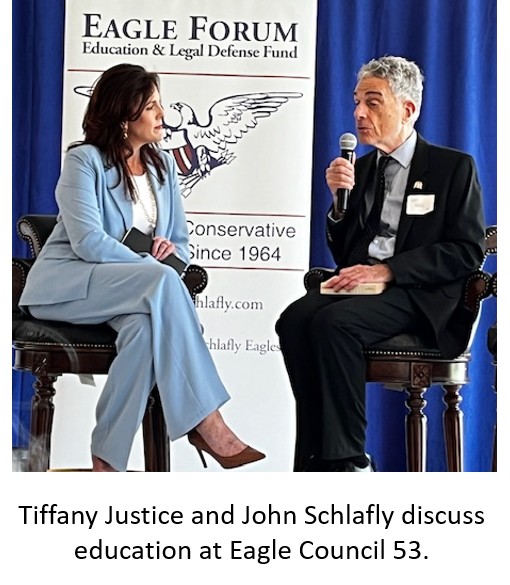
Uber successful Moms for Liberty will host Summit24, their annual “Joyful Warriors” national conference, in Washington, DC August 29 through September 1. Billed as “the ultimate gathering of parents fighting to defend their parental rights and improve education in America,” the summit caps off the many events and activities the organization holds across the country during the year. According to co-founder Tiffany Justice, the summit “attracts hundreds of parents and other group members to the nation’s capital for three days of training, strategizing, and relationship building to empower them to carry on the fight for the future of their children and our country.” The Moms’ conference comes on the heels of the Phyllis Schlafly Eagles’ Eagle Council, which took place earlier this month and featured Tiffany Justice among its many distinguished speakers. During the two-day meeting, Justice opened a discussion about education by celebrating the 50th anniversary of Phyllis Schlafly’s seminal book, Child Abuse in the Classroom (1984, 1985, 1993), which is still available and relevant today. Justice led a panel of moms, along with Eagles leader John Schlafly, in the discussion. The panel shared personal experiences and showed how involved parents and citizens can make a difference by running for their local school boards or otherwise becoming active in their school districts. Similarly, the Moms for Liberty summit will inform, empower, and help “like-minded warriors” arm themselves with the tools to “fight the issues” and navigate “the chaos created by a radical ideology.”

During the Democrat national convention, 320,000 Chicago students were kept out of class in order to “attend, volunteer, and participate in the civic process of hosting the convention” at the behest of the Chicago Teachers Union (CTU). According to Fox News, the students were “locked out of class” so they could “be indoctrinated by the DNC.” The CTU bused teachers to Soldier Field on the final night of the convention “to watch Harris’ acceptance speech on the big screen.” Observers would be hard pressed to imagine the same courtesies being extended to any other political party. The Fox report observed that even when Chicago schools are open, “many of them are mostly empty.” Between 2018 and 2023, “enrollment declined by more than 50,000 students, and 181 district schools were operating at less than 50 percent” capacity. The district is prohibited from closing empty schools due to a CTU-backed law that placed a moratorium on doing so until at least 2025. But the CTU does not appear concerned about these facts nor that Chicago students are illiterate and cannot do basic math. “District wide,” reports Fox, “reading and math proficiency rates are under 30 percent.” Instead of encouraging student enrollment by actually teaching basic skills, the CTU wants to fill the underused and abandoned school buildings by converting vacant floors into shelters for illegal alien “unaccompanied migrants.” This scheme is actually part of the $50 billion CTU contract currently in negotiation with the city. Fox reports that the contract “would cost taxpayers, over time, more than triple the amount the mayor proposed for the entire city’s budget for 2024.” In stating the obvious, that Chicago public-school students are unlikely to learn reading and math even when in class, Fox added: “…But they will learn the sad lesson that, for education bureaucrats and union bosses, learning comes second place to politics.”
Tim Walz, Education Radical
By Stanley Kurtz, Senior Fellow at the Ethics and Public Policy Center (EPPC)
Originally published August 8, 2024 in National Review. Reprinted by permission.
If someone asked me to name the most radical state education standards in the country, I’d point to Minnesota. I did just that last year when I singled out Rhode Island, Illinois, and Minnesota as the embodiments of our “Blue State Education Nightmare.” Truly, Minnesota is the worst of the lot, and I’m going to tell you why.
Note first, however, that the story of Minnesota’s nightmare education standards isn’t just about Tim Walz’s radicalism, although it certainly establishes that. No, the problem is that America is still largely blind to the threat that Minnesota’s standards represent. Minnesota’s reworked education standards, steeped in the benign-sounding “ethnic studies” approach, are a kind of stealth critical race theory.
Ethnic studies derives from a different radical tradition than CRT, although the two traditions now blend and overlap. But while critical race theory is known and understood, ethnic studies still sounds to most Americans like innocent heritage boosterism.
In reality, ethnic studies — especially the brand of it Tim Walz has brought to Minnesota — is race-based neo-Marxism. Essentially, ethnic studies is a kind of anti-civics in which students are taught to reject and replace America’s system of government.

And the same neo-Marxist radicalism that now has Minnesota’s public schools in its grip pervades the new Advanced Placement African American Studies course. That AP African American Studies course is being contested in a few states but is still accepted in most. Once AP African American Studies is established, AP Ethnic Studies is sure to follow, not to mention AP Gender Studies and more. So between the College Board and state-standards takeovers like we’ve seen in Minnesota, a bizarre and radical brand of race-based Marxism — a kind of cousin of CRT — is on the march through our schools. Most Americans still don’t get that, so here’s the story you should know.
In 2021, in the wake of the George Floyd demonstrations and riots, Governor Walz introduced what he called his “Due North” education plan, featuring funding for a major ethnic-studies initiative. With Republicans in control of the state senate, Walz’s initiative went nowhere. After Democrats took control of both legislative houses in 2022, however, Walz’s ethnic-studies proposal took off. But what is ethnic studies and where does it come from?
The ethnic-studies movement is based in California and traces its origins to the 1968 student strike at San Francisco State College that ushered in the first Black Studies department, along with the associated founding of the Third World Liberation Front, which demanded and got the first college programs in Ethnic Studies (Chicano Studies, and the like). That famous strike at San Francisco State was conducted by one of the first college black student unions.
The Black Student Union at San Francisco State College was decidedly radical, guided as it was by members of the Black Panther Party who’d enrolled at the school for the express purpose of mobilizing student strikes. The Panthers, in turn, were deeply influenced by revolutionary movements sympathetic to communist Cuba and China. Those movements swept through the Bay Area in the mid 1960s.
The story of the radical origins of ethnic studies has been lovingly unearthed and chronicled, not by conservative sleuths but by proponents of ethnic studies themselves. They see their radical origin story as a paradigm for what ethnic studies should be — not a professionalized academic discipline but a practice of revolutionary agitation dedicated to uprooting and replacing the American system. The intellectual lodestars of this movement are Cedric Robinson, author of Black Marxism: The Making of the Black Radical Tradition, and his student, Robin D. G. Kelley, author of Freedom Dreams: The Black Radical Imagination.
As I’ve argued, both last year’s pilot AP African Americans Studies course and the newly revised and finalized AP African American Studies course were designed to teach and promote the perspective of Robinson, Kelley, and the black-studies and ethnic-studies movements they guide. As we’ll see, the same is true of Minnesota’s ethnic-studies standards.
For years, the neo-Marxist radicalism of ethnic studies was largely confined to university programs of black studies, Latino studies, ethnic studies, and such. Things began to change, however, in 2016. That’s when California then-governor, Jerry Brown, signed a law mandating the creation of a high school ethnic-studies course, with a model curriculum to be designed by a committee of ethnic-studies professors and like-minded K-12 teachers.
The model curriculum released in 2019 was, according to Williamson Evers, an education expert and prominent critic, “revolutionary anti-capitalist propaganda.” The draft was filled with critical race theory and held up militant and violent revolutionaries as models for students to follow. California’s draft ethnic-studies curriculum also defined the campaign to boycott Israel as a “global social movement that currently aims to establish freedom for Palestinians living under apartheid conditions.”
The curriculum set off such an outcry that the California Department of Education was ordered back to the drawing board. The 2020 model, however, was no better. Still pervaded by Marxism, the curriculum refused to focus on any but a few “marginalized” ethnic groups. The Jews and the Irish were even criticized for assimilating and securing white “racial privilege.” The California legislature soon bottled up a bill to make ethnic studies a high school graduation requirement. The sponsor, however, was able to dislodge the bill and pass it just before the session ended as a response to the death of George Floyd. Governor Gavin Newsom, however, vetoed the bill, citing the need to revise the model curriculum. Opposition from Jewish groups was the biggest factor in the veto, but Newsom’s presidential aspirations probably played a role as well.
A year later, in 2021, with Governor Newsom’s signature on a barely changed bill, California became the first state to require a course in ethnic studies for high school graduation. The mandate doesn’t take effect until the 2025-26 school year. Some school districts, however, have already adopted the original radical curriculum. Meanwhile, districts that abhor that curriculum are scrambling to find a moderate alternative, which at present does not exist.
Newsom has played his hand deftly. By criticizing the optional model curriculum, he’s distanced himself from it for purposes of a possible presidential run. Even so, there is nothing to stop individual districts from adopting the radical and antisemitic version of ethnic studies embodied in the controversial model curriculum, and many California districts have already done so. The authors of the original radical curriculum, and their allies, have reconstituted themselves as advocates for “Liberated Ethnic Studies” and hired themselves out as consultants. Meanwhile, radical versions of ethnic studies have spread to other states: Oregon, Washington, Connecticut, and Vermont. In those states, however, ethnic studies remains an elective.
Things are different in Minnesota. Not only has Minnesota made ethnic studies a required part of classroom instruction, it has mandated the infusion of radical ethnic-studies ideology into every required subject, even math and science. Worse, Minnesota has adopted a radical leftist version of ethnic studies, a version closely allied with California’s original Liberated Ethnic Studies advocates. In fact, the Minnesota Ethnic Studies Coalition, a project of Education for Liberation Minnesota (the group allied with the California radicals), has been formally granted input into the development of Minnesota’s model ethnic-studies implementation framework by state law.
In other words, even California’s Newsom hasn’t gone as far as Minnesota’s Walz. Newsom vetoed California’s original ethnic-studies bill to force at least a modest rewrite of the radical curriculum. That, and some other features of the California approach, gave individual school districts at least a degree of flexibility. Walz, in contrast, has embraced the radical approach, imposed it on every district, infused it into every subject, and handed power to the most extreme curricular radicals in the state — counterparts and allies of the very group that Newsom has labored to keep in check. Blue states that have made ethnic studies a mere elective don’t begin to compare. Walz takes the prize for education radicalism, no contest.
Although Minnesota’s turn toward ethnic studies has been radical, that’s not how the public was sold on the change. On the contrary, to the extent that the public has been informed at all, ethnic studies has been portrayed not as an anti-capitalist ideology or a blueprint for identity politics but as a unifying force, a way of bridging ethnic divides.
Walz initiated the drive for ethnic studies in 2021, in direct response to the George Floyd protests/riots. Expansion of ethnic studies was a key plank in his “Due North” education plan, and he touted Due North in his 2021 “State of the State” message. Although the legislature specifically rejected the governor’s request to include ethnic studies in the state’s social-studies standards, Walz’s commissioner of education began working with Minnesota’s education radicals to put ethnic studies in the standards anyway. Any objection to this administrative end run was removed after Democrats took over the legislature in 2022 and went on to incorporate ethnic studies into state standards by law.
In 2022, Walz even moved to incorporate ethnic studies into the “knowledge and skills” listed in the state’s “compulsory attendance law.” That would have forced ethnic studies on even private schools and homeschoolers, an overreach that leaves Gavin Newsom in the dust. The ethnic-studies mandate for private schools and homeschoolers was removed in later drafts, but the effort gives you some sense of where Walz is coming from.
Despite these bold moves, Walz has generally kept a low profile on this issue, while his Democratic allies have falsely presented ethnic studies as a program of moderation. The term “ethnic studies” sounds innocent enough. Sadly, the public has been fooled up to now, and there’s been relatively little pushback against this revolution in education.
The great exception is Minnesota’s conservative think tank, The Center of the American Experiment. There, education experts Katherine Kersten and Catrin Wigfall have churned out a steady stream of exposés of Minnesota’s ethnic-studies radicalism.
Kersten, of course, has highlighted the ethnic-studies standards themselves. These emphasize “resistance,” requiring students, for example, to “organize with others” to resist “systemic and coordinated exercises of power” against “marginalized” groups. But Kersten has also shown how ethnic studies now permeates other subjects. Fourth-graders, for example, “will no longer be required to learn the names and locations of continents, the Atlantic Ocean, the Amazon, England, or China.” Instead, geography students will “describe places and regions, explaining how they are influenced by power structures.” And do Minnesota’s ethnic-studies advocates follow California by coming down on Israel? You bet they do, as Kersten shows. Minnesota ethnic-studies advocates helped spark anti-Israel student walkouts in the immediate aftermath of October 7.
Wigfall dug up a PowerPoint slide show detailing St. Paul’s ethnic-studies curriculum, crafted by some of the same radicals from the group, Education for Liberation Minnesota, that will be putting together the statewide ethnic-studies framework. The slide that explains the concept of “resistance” (a theme present throughout the new state standards) blatantly endorses a set of leftist political causes by advertising a series of protest signs: $15 minimum wage, No Human is Illegal, Black Lives Matter, Food Justice, Climate Justice, No Bans, No Walls, Abolish Prison, a gender-queer symbol, and more.
Historian Wilfred McClay, author of the acclaimed U.S. history textbook Land of Hope, reviewed an earlier draft of Minnesota’s reworked social-studies standards and called them “among the worst in the country.” According to McClay, Minnesota’s ethnic-studies-infused standards make “radical political activism,” not academic knowledge and the cultivation of civic identity, the goal of education. Implicitly, McClay says, Minnesota’s new standards call into question “the very legitimacy of the regime under which we live.”
That is precisely the goal of advocates for Liberated Ethnic Studies, the key Midwest outpost of which is Education for Liberation Minnesota (EdLib MN). A leader of that group, Brian Lozenski, is arguably the most influential Minnesota voice when it comes to ethnic studies. Lozenski gave key legislative testimony in support of the ethnic-studies bill of 2023. As a leader of EdLib MN, and as a member of the official working group charged with advising the state on its ethnic-studies framework, Lozenski embodies the radicalism of Minnesota’s new ethnic-studies-based education standards.
In a 2020 piece, “The Black Radical Tradition Can Help Us Imagine a More Just World,” Lozenski touts the work of Cedric Robinson and Robin D. G. Kelley — leading thinkers of the radical ethnic-studies movement — as the answer to Minnesota’s education woes. To Lozenski, the George Floyd “uprising” of 2020 presages the “inevitable death” of the current “social order.” Lozenski oozes contempt for “the egoistic pursuits of U.S. society and its desperate cling to individualism.” Educationally, he adds, transforming the social order requires reforms like agitation for defunding the police and an end to all standardized testing.
Robinson, perhaps the leading thinker for radical ethnic-studies advocates, is known for elaborating a theory of “racial capitalism,” which holds that capitalism is inherently racist. The liberation of oppressed minorities can never be achieved without the death of capitalism, Robinson says. This is what he and Kelley teach; this is what was embedded in California’s 2019 ethnic-studies model curriculum; and this sweeping hostility to capitalism is embedded in Minnesota’s new ethnic-studies standards as well. Those standards require students to “develop an analysis of racial capitalism,” an otherwise obscure neo-Marxist bit of jargon that puzzled and dismayed even liberal reviewers of Minnesota’s new social-studies standards. It all makes sense, however, once you understand the radical, anti-American, and anti-Western foundations of ethnic studies.
This is what Tim Walz has unleashed in Minnesota—the teaching of a radical ideology that consciously rejects the legitimacy of America’s system. Minnesota now has the most radical education regime of any state that I know of. That regime was adopted at the behest of Tim Walz, under false pretenses of moderation. That sort of bait and switch is exactly what we have to fear on this and a great many other issues from the Harris-Walz ticket in 2024.
Stanley Kurtz is a Senior Fellow at the Ethics and Public Policy Center. Beyond his work with Education and American Ideals, Mr. Kurtz is a key contributor to American public debates on a wide range of issues from K-12 and higher education reform, to the challenges of democratization abroad, to urban-suburban policies, to the shaping of the American left’s agenda. Mr. Kurtz has written on these and other issues for various journals, particularly National Review Online (where he is a contributing editor).
Education Related Links