Ethnic Studies Combines CRT, Decolonization, & the LGBT Agenda
For years, parents and conservative activists have been battling critical race theory (CRT) in educational settings and state legislatures, even as leftists have been busily rebranding it as “ethnic studies,” which ingeniously combines CRT with several other radical left ideologies as part of a “social studies” curriculum.
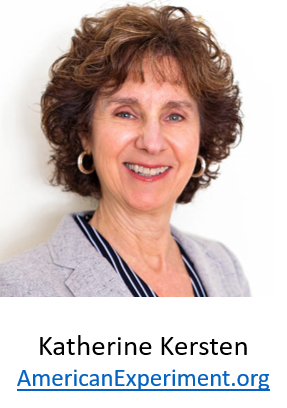
The Center of the American Experiment’s Senior Policy Fellow, Katherine Kersten, writes in The Federalist that, in 2021, “California became the first state to make an ethnic studies course a high school graduation requirement.” She reports that state education policy officials adopted “a deeply flawed, leftist curriculum after rejecting an initial ‘liberated’ draft as too radical,” which begs the question of just how bad was the original?
In 2022, Frontpage Magazine ran a piece by investigative journalist Matthew Vadum which disclosed that the original curriculum “encouraged public-school students to pray to bloodthirsty Aztec deities. The quaint religious practices of Mesoamericans about 700 years ago included slicing out human hearts along with flaying victims and wearing their skin.” Given that this thoroughly outrageous portion was dropped — where was the leftist dogma of “separation” when it was written — parents can well imagine what the curriculum may still include.
Vadum answered that in part, noting that in 2022, ethnic studies was already being taught in at least one school district in Monterey County, California. “Schoolchildren there learn that capitalism is bad and are encouraged to embrace ‘redistribution of wealth’ and a ‘shift in economic thinking.’”
He added: “One chart students examine identifies Christians as the ‘privileged/hegemonic’ group that is responsible for ‘creedism, Islamophobia, and anti-Semitism.’ The chart also describes ‘Muslims, Jews, non-major world religions, atheists, and indigenous spiritual traditions’ as ‘oppressed/marginalized’ groups. It states that ‘religious freedom/regenerating indigenous spiritual traditions’ are a form of resistance to ‘oppression.’”
New social studies standards
Katherine Kersten points out that California isn’t the only state embracing ethnic studies; blue states including Oregon, Washington, and Vermont are following suit. But she cites Minnesota’s “new K-12 social studies standards” as exemplifying “this dangerous new disguise for CRT,” noting that Minnesota lawmakers “enacted what are likely the most radical education measures in the nation.”
Kersten is no stranger to the education scene in Minnesota. A longtime journalist, she has written for The Minnesota Star Tribune and many other publications on the topic of education. In May 2001, Education Reporter reprinted her article on the folly of “mixed-sex wrestling” — or girls wrestling boys — which was taking hold in Minnesota high schools at the time. Today, boys pretending to be girls compete against girls in many sports. In February 2002, Phyllis Schlafly published Kersten’s overview of the Lord of the Rings trilogy in Education Reporter.
Minnesota’s new standards incorporate ethnic studies throughout the core social studies disciplines of history, civics, economics, and geography. Kersten describes one ethnic studies “anchor standard” as an example: “It requires students to ‘organize with others to resist systemic and coordinated exercises of power’ against ‘marginalized,’ oppressed groups.” She explains that this is ethnic studies in its “liberated” form, which not only teaches race-based identities and “white privilege,” but incites students to act to “disrupt and dismantle” America’s fundamental social and political institutions.
And it appears the standards will not only indoctrinate but fail to teach anything of value. For example, Kersten writes that “fourth graders will no longer be required to learn the names and locations of continents, the Atlantic Ocean, the Amazon, England, or China. Instead, they will ‘describe places and regions, explaining how they are influenced by power structures.’” Studies of states and capitals are required to include “a recognition of indigenous land these places were built on.”
The standards discredit American institutions, including our criminal justice system and policing. One claim is that our contemporary police departments have “historical roots in early America,” teaching that they “sprang directly from slave patrols of the Old South.” This biased, misleading, and untruthful instruction will be force-fed to fifth graders. High school students will be taught that “the notion of criminality itself is racist: ‘Explore how criminality is constructed and what makes a person a criminal.’”
Kersten worries that this campaign to further radicalize Minnesota’s public schools “has generated minimal public pushback.” A key reason for this is “the promotion of ethnic studies as a unifying cultural learning experience, while in fact it stokes interracial hostility and delegitimizes authority.” In other words, ethnic studies is being sold as a unifying program to foster understanding and empathy, when exactly the opposite is taking place.
This deceptive strategy, Kersten believes, “is likely to become a national model for activists seeking to transform our K-12 education system.” She writes:
- Ironically, Minnesota lawmakers have now injected this extremist version, not in one required course for teens but in academic standards for all subjects, including math and science, from kindergarten through 12th grade. In addition, the ideology has been hard-wired into teacher licensing requirements and fundamental school mechanics, so the transformation will be difficult to reverse.
It’s important to note here that three out of four academic reviewers — “experts in citizenship and government, economics, geography, and history — criticized the standards, some in scathing terms.” One reviewer echoed Kersten, denouncing the standards “as among the worst in the nation.” Nonetheless, the Minnesota Department of Education (MDE), which had hand-picked the reviewers, ignored their well-founded criticisms and kept the standards as written.
The Walz influence on Minnesota education
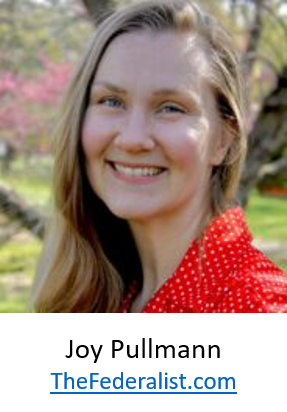
The extreme radicalization of Minnesota’s education standards can at least partially be attributed to Democrat vice presidential candidate and current Governor Tim Walz. Author and executive editor of The Federalist, Joy Pullmann, made the case against Walz in an August 27 article where she described how Walz’s appointees to key state agencies will require applicants for teacher licenses “to affirm transgenderism and race Marxism. Without a teaching license,” she explains, “individuals cannot work in Minnesota public schools, nor in the private schools that require such licenses.”
These teacher licensing rules were enacted in 2023 under the auspices of Governor Walz. Pullmann writes that because they require teachers to “affirm” students’ “gender identity” and “sexual orientation,” the new rules will effectively “ban practicing Christians, Jews, and Muslims from teaching in public schools.”
Last spring, the pending changes passed muster with administrative law judges. The Federalist warned that universities are also affected. Beginning in 2025, universities “must either train their teaching students to fulfill these anti-Christian requirements or be banned from offering state licensing — and thus the ticket to the vast majority of teaching jobs — to their students.”
Religious schools in Minnesota will also be affected by the new rules. Doug Seaton, founder and president of the Minneapolis-based nonprofit Upper Midwest Law Center, says some will capitulate, while others will not. Seaton told The Federalist:
- Forcing people to testify to beliefs they don’t hold, often called compelled speech, is clearly unconstitutional. They’re essentially requiring people to affirm these ideas that they don’t really believe, in many cases, as a condition of being a public-school teacher or being part of a program to be a licensed public-school teacher. You can’t force that kind of speech, you can’t require adherence to ideas that aren’t believed.
Seaton further noted: “The 13-member board that made these changes is appointed by the governor, whom for the last six years has been Walz. So, Walz is poised to make similar bigoted, totalitarian, and unconstitutional policies across the United States should he be elected vice president.”
Curricular changes under Walz
Both Kersten and Pullmann note that Walz signed the law establishing the ethnic studies initiative last year.
- The department’s standards and benchmarks require first-graders to “identify examples of ethnicity, equality, liberation, and systems of power” and “use those examples to construct meanings for those terms” … Fourth-graders must “identify the processes and impacts of colonization and examine how discrimination and the oppression of various racial and ethnic groups have produced resistance movements.” High-school students are told to “develop an analysis of racial capitalism” and “anti-Blackness” and are taught to view themselves as members of “racialized hierarchies” based on “dominant European beauty standards.”
Under the new requirements, teachers will be forced to teach this disturbing nonsense to their students. Teachers must now understand, for example:
- That knowledge creation, ways of knowing, and teaching are social and cultural practices shaped by race and ethnicity, often resulting in racially disparate advantages and disadvantages.
- The histories and social struggles of historically defined racialized groups, including but not limited to Indigenous people, Black Americans, Latinx Americans, and Asian Americans.
- The cultural content, world view, concepts, and perspectives of Minnesota-based American Indian Tribal Nations and communities, including Indigenous histories and languages.
- The impact of the intersection of race and ethnicity with other forms of difference, including class, gender, sexuality, religion, national origin, immigration status, language, ability, and age.
Pullmann recalls that “Walz’s first executive order as governor was to install a ‘diversity, equity, and inclusion,’ or DEI, council.” His radical “Department of Human Rights” forced school districts “to report student discipline by race and require equal outcomes (equity) in discipline,” with the result “horrific chaos and violence.”
As if all this weren’t enough, student achievement has plummeted under Walz’s watch, from “among the best in the nation to declining more sharply than anywhere else in the nation,” according to Kersten’s Center of the American Experiment. “The most recent scores show Minnesota fourth graders dipping below the national average in reading for the first time ever recorded on the well-respected Nation’s Report Card.”
Parents and observers might wonder how, given the extreme requirements for teachers (as listed above), they could possibly have time to teach anything resembling basic skills or usable core knowledge.
Kersten warns that Minnesota should be viewed as the provider of a cautionary tale. “Unless legislators and citizens understand ‘liberated’ ethnic studies’ real agenda,” she points out, “many more states will follow” its lead.
Newsela: Instilling Leftwing Ideology & Electioneering for Democrats in Schools Nationwide
In its February and March 2023 issues, Education Reporter exposed the liberal bias and poor rewriting of mainstream media news articles by the popular platform, Newsela, which is now used in 90 percent of U.S. schools. When it was founded in 2013, Newsela was allegedly intended to foster reading and English Language Arts using mainstream news stories rewritten for students at various grade levels, hence the “ela” in the platform’s title.
However, “media literacy” has become the popular buzz term in education and in our culture, which observers say has little to do with actual literacy and much to do with spreading leftwing propaganda. Never a disseminator of unbiased news stories for the sole purpose of helping students become better readers, Newsela has jumped on the media literacy bandwagon.
An organization called Media Literacy Now publishes a report each year summarizing “the status of media literacy education for K-12 schools in the U.S.” The latest U.S. Media Literacy Policy Report, released in February of this year, shows that “19 state legislatures” have acted to create policy on media literacy, with 18 state governors signing bills “concerning K-12 media literacy or digital citizenship education,” and one state legislature passing “two resolutions.”
Perhaps unsurprisingly, California has passed “a comprehensive media literacy law that will redirect priorities and funding to media literacy curriculum and professional development.” This development, states Media Literacy, “is a major advancement that will reverberate across the country.”
For many, the question is who determines what “media literacy” means in terms of what students will be taught? Newsela provides a prime example.
Exposing Newsela
A recent article by the Foundation for Freedom Online (FFO), an organization that seeks to “protect Americans from internet censorship” through educational reports, legal assistance, and public policy analysis exposes Newsela’s “advocacy for media literacy instruction ahead of major elections.” FFO’s mission is “to provide nonpartisan insights and assistance to all peoples taking a stand for freedom of speech, freedom of expression, and the free exchange of ideas online.”
According to the Foundation, “Media literacy organizations (including the well-known government-funded media blacklisting organization, NewsGuard), have focused on creating products for educators to teach students not how to read or think critically, but instead teach students what they should read.” They write:
- In their own words, Newsela curates material from “trusted sources and makes it instruction ready for ELA, social studies, and science classrooms.” The content from these “trusted” and “vetted” sources is rewritten by their editorial staff to be easily read and interpreted based on a child’s reading level.
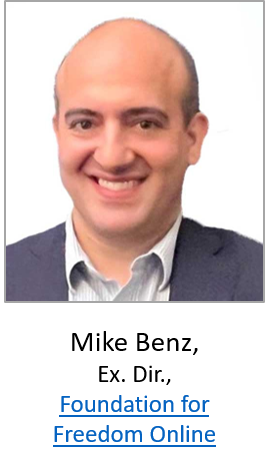
Newsela’s “trusted sources” are “exclusively establishment-approved partisan publishers such as The New York Times, Washington Post, Associated Press, and The Guardian.” None of Newsela’s over 100 content partners are non-establishment. Even moderate right-of-center outlets like the Wall Street Journal and Fox News are absent.
The Foundation reports that Newsguard blacklists conservative news sites under the guise of combatting “misinformation,” and that research shows it scores right-leaning news outlets 27 points lower than liberal sites. Newsguard is even on record as “calling for ad revenue to be stripped from disfavored websites,” and provides advertisers with “Brandguard,” a product consisting of “inclusion and exclusion lists” that dissuade advertisers from doing business with excluded organizations.
Last September, Accuracy In Media (AIM) reported that the Biden Administration’s American Rescue Plan included “a provision that combines with other COVID legislation to make $190 billion available to help K-12 schools upgrade their curricula to Newsela … a platform run by a progressive former teacher who is dedicated to teaching Critical Race Theory in public schools.”
AIM employs “investigative journalism and citizen activism to expose media bias, corruption and public policy failings.” It explains that Newsela has teamed up with “radical content providers including the Zinn Education Project, the 1619 Project, and the Southern Poverty Law Center,” and that Newsela is a “workaround” for teaching controversial topics that some states have banned.
An investigative hidden-camera video report produced by AIM last year exposes teachers and administrators admitting to the liberal bias of Newsela’s repackaged “news.” One administrator noted in the video that, while restricted from teaching CRT, her school district has “access to a company called Newsela.” What she loves, she said, is that “they just curate a ton of articles from the Washington Post and like kind of all over … and rewrite them kid friendly,” clearly implying that CRT is taught through Newsela’s “news” stories.
Electioneering for Democrats
FFO contends that Newsela is aligned with the nationwide movement among states to adopt media literacy education, and “has been increasingly crafting and packaging election-related educational resources with a focus on pushing media literacy in the classroom.” (Emphasis added.) But as many ask, from what skewed point of view?
The AIM investigation caused some controversy for Newsela, but the organization continues to operate unfettered, bringing censored reports posing as unchallengeable fact to students across the country.
A since-deleted post from the American Press Institute (API), an affiliate of the News Media Alliance, enthused about API’s partnership with Newsela, writing in part:
- We can’t think of a better time to emphasize media literacy than election season. These resources [e.g., Newsela] ensure that any student, no matter his or her reading level, is equipped with the necessary tools to analyze the media and its messages. And once students are better able to evaluate media based on reliability and accuracy, they’ll be able to apply these skills beyond the classroom for years to come.
While posing as non-biased, a deep dive into API’s website reveals its bias; for example, against former president Donald Trump, labeling him a “prolific liar.” This particular page also quotes sources critical of law enforcement, charging police with “disseminating falsehoods about crime” and faulting their response to criminal acts.
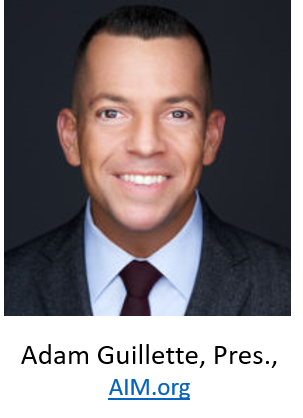
Prior to the 2022 midterm elections, Newsela created a free content guide for teachers, which covered topics such as voting rights, climate policy, the economy, “races and candidates to watch.” Parents and observers may well imagine the slanted views that were presented given the controlled sources of information from which the content was produced. FFO writes that with the looming 2024 presidential election, Newsela has for months “been increasing efforts to push educators to teach students which information sources to trust.”
FFO cautions that many of Newsela’s lessons “are grounded in the work” of its partner, Teaching Tolerance, “a project of the Southern Poverty Law Center (SLPC),” a far-left hate group that not only spews propaganda, but blacklists organizations with which it disagrees, as reported in Education Reporter last October.
FFO further warns that efforts to promote the notion of media literacy have served to allow “the censorship industry” to gain a foothold in American schools, with state policymakers “unknowingly helping them by failing to scrutinize some of the organizations and companies” pushing this agenda.
State Legislators, education administrators, and parents should educate themselves on the issue of media literacy and what this new curriculum is actually teaching K-12 kids.
Project 2025: What’s It Really About?
In their zeal to brand former President Donald Trump an “extremist” and “a threat to Democracy,” mainstream media pundits immediately associated his campaign with Project 2025 when it emerged as a potential political football following President Joe Biden’s disastrous debate performance. Liberal hysteria and handwringing broke out, and Project 2025 became a siren call to support the Democratic presidential ticket in November.
Before he was ousted from the 2024 presidential race, Biden’s campaign charged in early July that “America under Donald Trump’s Project 2025 would resemble the dystopian novel A Handmaid’s Tale,” according to an article by The Daily Signal that was reposted on WorldNetDaily. (The Daily Signal is The Heritage Foundation’s news outlet.) A plethora of leftwing talking heads and comedians have assailed the project, linking it to Trump and calling it “a secret blueprint” to turn the U.S. into a “fascist state.”
In response to the attacks, Trump said he was not familiar with Project 2025 and accused Democrats of trying to associate him with it in order to make him sound more extreme. He told Newsweek that “the other side’s going around trying to make me sound extreme, like I’m an extremist…. I’m a person with great common sense, I’m not an extremist at all.” He called some of Project 2025’s reported proposals “seriously extreme” and said he was not associated with it nor did he wish to be.
How much or how little the former president knows about Project 2025 is anyone’s guess, but it’s clear the Left is using it as another avenue of attack. Several conservative Republicans, among them Sen. Mike Lee of Utah, called the characterization of Project 2025 by progressive Democrats “unfair.”
What is Project 2025?
Project 2025 is a 900-page policy document called a “Mandate for Leadership,” created by The Heritage Foundation in conjunction with approximately 100 other conservative organizations. As Heritage associate director Spencer Chretien explained in January 2023, “it’s past time to lay the groundwork for a White House more friendly to the right. For decades, as the left has continued its march through America’s institutions, conservatives have been outgunned and outmatched when it comes to the art of government.”
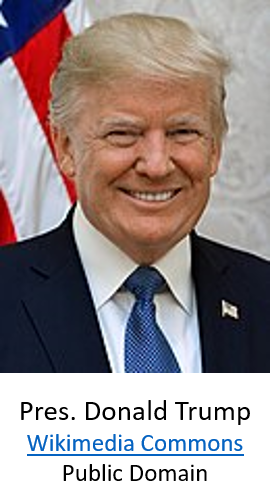
Heritage Foundation President Kevin Roberts admitted in The Daily Signal that Project 2025 “has been successfully demonized by the Left,” noting that “millions of dollars’ worth of attack ads from Biden and PAC allies have been devoted to personal attacks on both Trump and Project 2025.” Now that Harris is the Democrat nominee, Project 2025 remains a weapon for fearmongering in her campaign arsenal.
In a September 4 commentary posted on The Heritage Foundation’s website, Roberts debunked what he called “outright lies” by the Harris campaign that Project 2025 “suggests cuts to Social Security” — it doesn’t — and that it “was created by President Donald Trump.” Both Heritage and Trump have made abundantly clear the total fallacy of this claim.
Roberts’ commentary points out other falsehoods being touted about Project 2025, such as that the only valid definition of a family is a working father married to a stay-at-home mother and their children. “My own parents were divorced,” Roberts says, “and I was raised with the help of my grandparents.”
But what does Project 2025 actually propose? One of its most widely assailed recommendations is elimination of the U.S. Department of Education, which was created in 1980 by the Carter Administration, allegedly as a result of President Carter’s “promises to teacher unions,” and which conservatives note “has clearly failed to live up to its promises to American children.” Heritage points out that the department “is making its own case for closure by promulgating policies that are either ineffective or illegal (or both).” (See more on this topic in this month’s Guest article.)
In essence, Project 2025 seeks to dismantle the “Deep State” by creating a game plan for restructuring the federal bureaucracy “to make it more cost effective, high-performing, and accountable to the people.” The project warns that while the Constitution makes it “abundantly clear” that the executive power of the U.S. government “is not vested in departments or agencies” but in the president himself, “a president today assumes office to find a sprawling federal bureaucracy that all too often is carrying out its own policy plans and preferences—or, worse yet, the policy plans and preferences of a radical, supposedly ‘woke’ faction of the country.”
Other goals set by Project 2025 include making it easier to control public-sector employee salaries and “streamline the firing process,” of public-sector employees to mimic processes used in the private sector, such as limiting the appeal process following a job termination.
The project also seeks to curb union power, noting that “public-sector unions help explain how the bureaucracy has become so entrenched.” The Daily Signal notes that during his presidency, Donald Trump “issued three executive orders to restrain union abuses: one encouraging agencies to renegotiate all collective bargaining agreements, another encouraging agencies to prevent union representatives from using official time for union activity, and one more encouraging agencies to limit labor grievances and prioritize performance over seniority.” Biden revoked each of these orders upon taking office.
Moving forward
Whether or not Project 2025 represents “the most organized set of policy ideas that the conservative movement has ever put together in history,” as The Heritage Foundation and many other conservative groups contend, perhaps the best foot forward was summed up recently by Phyllis Schlafly Eagles President Ed Martin. A member of the Platform Staff at the 2024 Republican National Convention, Martin was up close and personal with the former president’s proposals for his next administration.
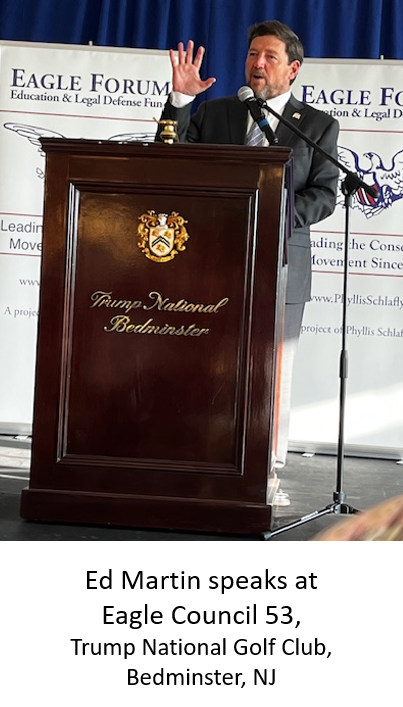
In Martin’s August 26 ProAmerica Report, he stated:
- For all the stupid talk about this project or that project, Project 2025 or whatever else, the actual place to go and look at what Donald Trump has promised to do is in the platform. More specifically, when President Trump spent the last few days of the preparation of the platform, kind of rewriting and writing out his promises — there are 20 promises of what he says he’ll do — and you can say what you want about Donald Trump but when he says he’s going to do something, he doesn’t back off….
A few of Trump’s 20 promises include sealing the border and stopping the migrant invasion, deporting migrants who have broken the law by entering our country illegally, bringing back to America our manufacturing industries, providing tax cuts for workers and ending taxes on tips, ending the weaponization of government against the American people, rebuilding our cities, and uniting our country by bringing it to new levels of success.
Refuting the lie that he will cut Social Security, Trump further promises to “protect social security and Medicare with no cuts, including no changes to the retirement age.” (All 20 promises are worthy of noting here, but please see the link above to read the list in its entirety — Ed.).
As for Project 2025, The Heritage Foundation’s Roberts states that its goal “is not to say that 100% of this must be implemented by the next president. We’ve never been that presumptuous; in fact, the whole point of this is to be of service to any administration, though more likely to be of service to a conservative one.”
Over the summer, Heritage announced it was making plans to launch a campaign “to clear up myths about Project 2025, and punch back against the radical Left along with Trump.”
What Books Should Kids be Reading?
(Eighth in our series of recommended reading lists for children of all ages. We will continue this feature in Education Reporter until all our lists have been republished. — Ed.)
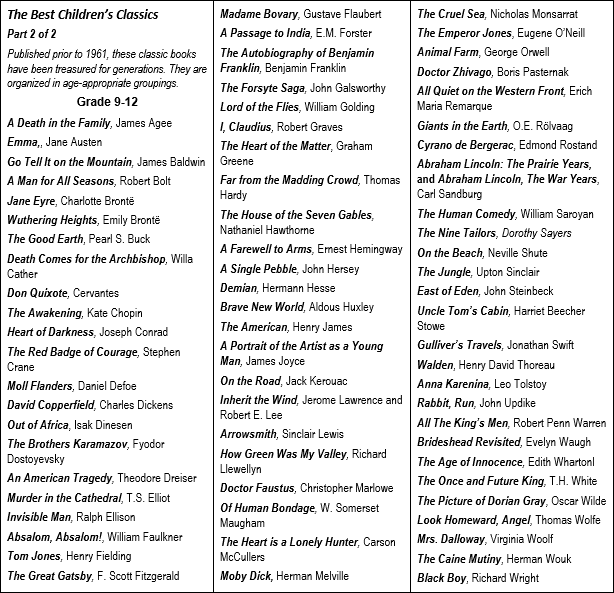
Classic children’s books are scarcely to be found in school classrooms and libraries today, so parents must ensure that their kids are reading books that educate, absorb, and entertain in a manner that stimulates curiosity and increases the child’s eagerness to learn about the world.
The Best Children’s Classics list was put together by Peter Bernstein and Christopher Ma from a compilation of titles published by the National Endowment for the Humanities, based on recommendations it had requested from public and private schools across the country. The list will appear in two parts, with part II in this month’s issue of Education Reporter.
Additional Education Reporter suggested reading lists:
- A Child’s Reading List (February 2024)
- The Ultimate Reading List — Classics that Endure (Part 1) (March 2024)
- The Ultimate Reading List — Classics that Endure (Part 2) (April 2024)
- Children Will Love Discovering Lost Classics (May 2024)
- Bennett’s Reading List (Part 1) (June 2024)
- Bennett’s Reading List (Part 2) (July 2024)
- The Best Children’s Classics (Part 1) (August 2024)
- The Best Children’s Classics (Part 2) (September 2024)
- Recommended High School Reading List (October 2024)
NOTE: Most books on this list can be ordered online through booksellers including:
- ThriftBooks
- Amazon.com : vintage books classics
- Project Gutenberg (Free Archive, eBooks only) Choose (EPUB3 (E-readers incl. Send-to-Kindle))
> > > > Send to Kindle to upload ebooks to your Kindle device downloaded from Project Gutenberg.
The Best Children’s Classics
Click the image below to open as a (printable) PDF document
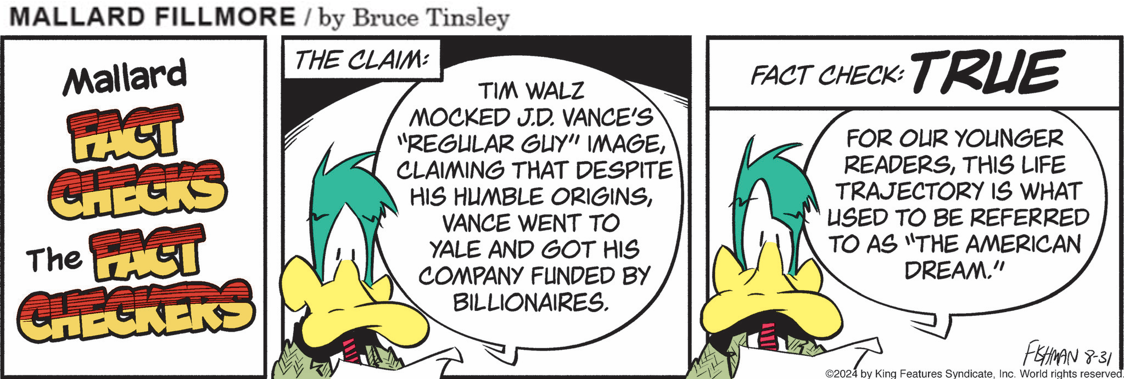
Mallard
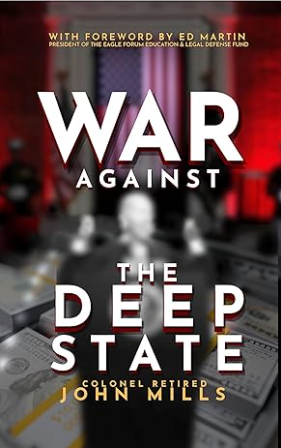
War Against the Deep State
by Colonel Retired John Mills, Pierucci Publishing, 2023
The “Deep State” is a term that has gained a lot of traction since Donald Trump promised to “drain the swamp” in 2016. It is a vague term. Most people have a sense that there is another part of the government beyond the basic three branches; another entity making decisions without direct accountability. Colonel John Mills brings precision and clarity to this concept in his book War Against the Deep State. He describes what the Deep State is and how it infects politics at the local level. Based on his own experience, he shows readers what they can do to fight it on the county level.
In the Foreword, Ed Martin gives a preview of Mills’ work. The Deep State includes the three extraconstitutional branches of government: the administrative state, the surveillance state, and the nonprofit network.
“Moms will win this war,” Mills says. He emphasizes how mothers are deeply connected to their children and communities, and that they care very much about what happens to their children. In looking out for their children, moms have what it takes to go the extra mile and get things done. Many moms just need a road map to see who exactly is threatening their child’s future and how they can make an impact.
Mills writes that there are seven centers of gravity at the county level. These are where the Deep State meddles in local affairs, but they are also where an everyday citizen can fight back against Deep State power. They include:
- County council
- Election board
- Registrar
- School board
- Sheriff
- District judges
- County Attorney
The true power in America is at the local level and is accessible to every citizen. The Deep State gains footholds at the local level because they know this is where the true power is as well. Mills calls this virulent Deep State takeover of local government nodes “maladministration.”
 It is important to fight back at this level because our future is being taken from us. Transgender and LGBT ideology runs rampant in the public-school system. But moms have the right and the ability to make their voices heard at the school board. Foreign drugs are also harming our children. Although it is not particularly common for a child to use China-imported fentanyl, the digital version is nearly ubiquitous for kids. TikTok is digital fentanyl, sent by the Communist Chinese to destroy the minds of America’s children.
The Deep State has many tactics for taking over at the local level. They engage in “old school ballot stuffing”: reproducing fake ballots and forging signatures. This is distinct from ballot harvesting but impacts elections nonetheless. They also engage in voting machine fraud and create fraudulent voter rolls, which are lists of registered voters in a county.
The county registrar oversees the voter rolls. While the registrar is not necessarily part of it, there are many ways third parties can fabricate the voter rolls. There is also no official procedure for independent oversight in the election process. When the Deep State takes command of elections at the local level, it has national consequences.
This is a war, make no mistake about it. On a battlefield, pure numbers are good, but information is the deciding factor for victory. To ensure information dominance over the Deep State, all citizens should know their state and county governments in as detailed a manner as possible. Anyone can take action to increase accountability.
For example, Mills urges the reader to become a pro at letter writing. A clear, honest, well-researched, and easy-to-read letter can go a long way. Never accuse an official of a crime without courtroom-level evidence, Mills says. If one does come into possession of such evidence, they should go straight to the local sheriff and be specific about the abuse of laws and regulations. Do not politicize the issues and do not be partisan. He advises readers, based on his own experience, to be good at what they do, and their reputation will precede them. If one is honest, hardworking, and specific, county officials will have respect for the dutiful citizen. Readers should respect their officials too. Mutual respect is critical for getting things done.
Mills also draws on his own experience battling Deep State influence. He recalls his experience requesting records from the county registrar. The jury pool originates with the names on the voter rolls, but some jurors are rejected for reasons that would also make it illegal for them to vote, so they should not be on the voter rolls in the first place. Col. Mills wanted to get to the bottom of this discrepancy, so he made a legal request for county records. The registrar stonewalled him, but he kept pushing.
Eventually, the registrar resigned, unable to take the heat. Col. Mills got the chance to speak with the state Attorney General the following year and explained what was going on. Mills even dragged this registrar into court for failing to perform her duties. All it took was an $80 filing fee. The case was dismissed, but he was able to enter lots of evidence through his testimonies that could be used in future cases. Shine a light on the truth and it could be useful in the long run.
After providing some instructions on how to fight this fight, Mills dives deep into the various protocols and mechanisms of the Deep State. The Deep State uses public-private partnerships to accomplish things that government would not ordinarily be able to do alone. For example, the Customer Access Portal is a database of information that was originally meant to track terrorists and criminals, but as Elon Musk showed when he took over Twitter, the government was also using it to collect information about average citizens. The connection and cooperation of the DHS, DOJ, and DoD with Big Tech enables the government to use vast amounts of data they would not have access to otherwise.
Col. Mills spent time in Silicon Valley while he worked for the Department of Defense. During the war on terror, Mills acquired firsthand experience working with tech companies to increase and optimize metadata collection to take down terrorists. But once the government had these tools at its disposal, it did not want to give them up.
The United States uses the internet as a weapon to control information at home and abroad, Mills explains. Blog filtering and shadow banning are methods used by public-private partnerships to hide non-mainstream information. Dissident accounts are silenced without a bang, and websites that buck the narrative are hidden at the bottom of Google searches (or not shown at all).
Big data analytics have become an effective tool for controlling the political narrative, and Col. Mills describes how he was involved in the development of these analytic tools to gauge public sentiment. The original intent was to combat terrorism, but such tools have since been used to target American dissidents.
Jack Dorsey (founder of Twitter), Yoel Roth (former Head of Trust and Safety at Twitter), and Vijaya Gadde (former General Counsel at Twitter) were the gatekeepers of truth. Driven by utopianism as well as Deep State guidance, they chose what opinions could be heard and what opinions could not be heard. They had a list of the top 10,000 people in need of censoring, and Col. Mills was on that list, along with many other conservatives and truth sayers.
Senior FBI special agent Elvis Chan revealed that there was state-sponsored censorship going on behind the scenes at Twitter. Now, the DHS and CISA call the shots on what counts as disinformation, misinformation, and mal-information. The information control tactics being used on American citizens are identical to those used in the War on Terror. The Deep State is waging an information war against the American people; 51 intel officers lied about the Hunter Biden laptop to try to squash the supposed misinformation ahead of the election. Mark Zuckerberg even acknowledged that it was a lie earlier this year.
What we need, Col. Mills says, is a modern-day Church Commission. After the Vietnam War, the Church Commission investigated wrongdoing in the intelligence agencies. It set up new rules prohibiting assassinations, government overthrow, and spying on American citizens. These prohibitions have been eroded by the Deep State’s partnership system between local law enforcement, big tech, intelligence, and big government.
He describes a government weapon revealed during the Commission: the Shellfish Toxin Gun. Only 0.0000001g is enough to kill someone by causing a heart attack, and it is untraceable. The Deep State has weapons to assassinate people easily and make it look like an accident. Is this what happened to patriots like Andrew Breitbart and Justice Antonin Scalia? Did the Deep State take them out?
Rich Higgins, an acquaintance of Mills, was fired in 2017 from his job at the National Security Council after he sent a memo exposing how the Deep State was undermining Trump. He was being considered by Trump for a position in the Pentagon, but he died during a procedure necessitated by a bad case of COVID-19. It is speculation, but one has to wonder.
Another way the Deep State skirts the prohibitions of the Church Commission is by using shell companies. The CIA owns many companies, which allows it to pump and transfer capital to fund expensive operations. Air America was one of their front companies, which had many ties to the CCP. The CIA also developed Oracle and In-Q-Tel, data management technologies meant to spy on American citizens. And these are just things the public knows about. A new Church Commission is critical for exposing the depth of the corruption of the intelligence agencies.
The Deep State is also adept at regime change. The same tactics that were used to overthrow Saddam Hussein are now used by the Deep State to undermine the American Constitutional Order. High-Value Targeting is a psychological technique to cripple the morale and information of the other side in order to win a war with minimal bloodshed. Mills agrees there are good uses for these tactics and technologies. From Communism to Islamic radicalism, America has enemies we need to defend against. However, these tactics, technologies, and operations run rampant when there is no oversight or accountability. They can be turned against American citizens.
Americans have been sold down the river by Deep State efforts to promote globalism. Manufacturing and production are important aspects of a cohesive social body, but outsourcing has given this important economic power to China and other hostile nations. “A nation is not a nation unless it builds things,” Mills writes. Globalization since the 80s has exported manufacturing abroad. “The incredible civilization of Greece has now been reduced to a nation of coffee shops.” He names four corners of innovation that need to be retaken and operated domestically without Deep State interference. These are academia, major tech companies, innovative new tech companies, and venture capital firms. Each of these four corners of innovation should be democratized. They should be serving the people rather than the elites and international governments.
In reading this book, it seems that the Deep State is a giant monster, too big to be defeated by the average citizen. But if the people have information on their side and know what tactics to use, Deep State control can be undermined. The American people can fight back at the county level, as long as they are tenacious, active, focused, respectful, and professional. It will take time and endurance to make this change, but Americans must defeat the Deep State in order to restore the American Republic.
To read the entire book, go to Amazon.com OR Barnes & Noble to order!
Education Briefs
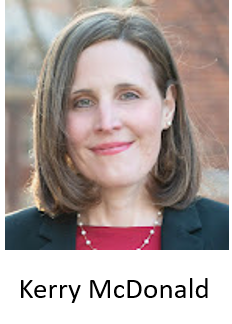
New microschools are opening this fall, continuing the trend in recent years of parents seeking better education alternatives for their children and teachers abandoning their public-school classrooms to become education entrepreneurs. The Foundation for Economic Education’s Kerry McDonald recently reported on new microschools opening in the Phoenix, Arizona area and across the country. She cited as an example former public high school English teacher Elisa Hernandez, who opened her home-based microschool called Noema Learning with 14 middle- and high school students. Parents are able to cover the tuition Hernandez charges using Arizona’s new universal education savings account (ESA) program. Writing on The 74 website, McDonald observed that “as parent demand for more individualized education options grows, everyday entrepreneurs are stepping up….” She singled out the Hilton Horizons Academy in Kingsport, Tennessee as being “one of the first in a growing number of new schools to launch this academic year,” having opened its doors on August 5th. The school’s founder, former teacher Candice Hilton, spent seven years in the public-school system, and then decided to become a microschool founder after researching what it would take to homeschool her daughter. McDonald noted that many microschool architects seek help from KaiPod Learning through the KaiPod Catalyst program, which offers mentorship and “business startup support and ongoing operational assistance to school founders.” This cohort-style program “is free to participants with a small revenue-sharing agreement” if they decide to found a school following the program. According to FEE, these alternative schools, which “are sprouting across the country,” offer teachers and students the freedom and flexibility that enable both to flourish.

A Minnesota school superintendent says Democrat governor and vice-presidential candidate Tim Walz has had a negative impact on K-12 education in the state. Private Christian school superintendent Kim Friesen, a 21-year resident of rural Minnesota, told Fox News Digital that Walz “ignored” rural Minnesotans during the COVID-19 pandemic and beyond, particularly with regard to connectivity so that students could continue their lessons online at home during the lockdowns. She said Walz was focused on large metro areas like Minneapolis-St. Paul in the center of the state, and that “north, south rural and east-west [rural] areas did not get his attention, and we deserved his attention.” An article on Education Curated contends that Walz’s one-size-fits-all treatment of the state’s communities “has led to widespread frustration and a feeling of being marginalized” among rural voters. Friesen warned that the policies Walz has enacted in Minnesota “could be reflected at a national level — such as social issues and illegal immigration.” She pointed to Walz’s signing of an order “making Minnesota a ‘trans refuge state’ where minors from out of state [can] receive transgender surgical procedures and hormone prescriptions,” labeling his action “heartbreaking. It rips away parents’ authority,” she said. “And I don’t believe that’s God’s design. God gave children to parents, not to the government.” Friesen added that she does not view either Kamala Harris or Tim Walz as being ready to lead the country. “They don’t have the wherewithal to fight for the people who are here. And I think they have some distorted views on how to move forward that would not better our state or our nation. So that’s a concern.”
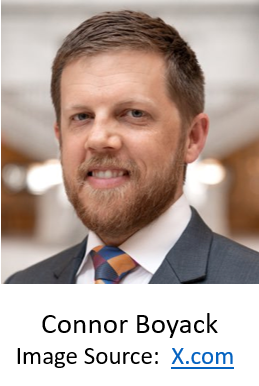
Posting on X (formerly Twitter), conservative author of the Tuttle Twins book series, Connor Boyack, cited a study that shows conservatives are happier than liberals/progressives. Boyack highlighted the SSM Mental Health survey that studied high school seniors from 2005 — 2018, and found that liberal students were “significantly more depressed than conservatives, have been for years, and the gap is growing over time.” Boyack wrote that since its beginning in 1972, the General Social Survey (GSS) has shown “a consistent 10 percent gap between the share of conservatives versus liberals who report being ‘very happy.’” In the SSM Mental Health — ScienceDirect survey abstract, researchers state: “From 2005 to 2018, 19.8 percent of students identified as liberal and 18.1 percent identified as conservative, with little change over time. Depressive affect (DA) scores increased for all adolescents after 2010, but increases were most pronounced for female liberal adolescents … Trends in adolescent internalizing symptoms diverged by political beliefs, sex, and parental education over time, with female liberal adolescents experiencing the largest increases in depressive symptoms, especially in the context of demographic risk factors including parental education.” The abstract culminates by summarizing: “These findings indicate a growing mental health disparity between adolescents who identify with certain political beliefs. It is therefore possible that the ideological lenses through which adolescents view the political climate differentially affect their mental wellbeing.” Boyack’s post asserts that “the wellbeing gap is not unique to youth. This gap exists in polling for decades.”
There’s Nothing ‘Absurd’ or ‘Dangerous’ about Ending the U.S. Department of Education
By Neal McCluskey, Director, Center for Educational Freedom, Cato Institute
Originally published July 22, 2024 in Cato at Liberty Blog. Reprinted by permission.
If you ran a corporation, and a division you did not need suffered massive losses while proving either ineffective or downright incompetent at its job, you would seriously consider dissolving it, right? After all, not only is it not helping, it is an albatross around your neck.
That’s largely what the U.S. Department of Education appears to be for American education. Yet if you propose eliminating it the first reaction from some people is shock and lament: “But it’s about education, so it must be good.” That seems to be the presumption of former Republican Maryland governor, and current Maryland Senate candidate, Larry Hogan, who in this weekend’s Washington Post dismissed the Project 2025 proposal to end the Department. He called it “absurd and dangerous.”

I cannot speak to Project 2025 as a whole because I have not read the vast majority of it. But I have read the section on the Department of Education, and far from being either “absurd” or “dangerous,” it is a thoughtful examination of not just the Department, but the whole federal role in education and how it can be reengineered. I, too, have written about removing the feds from education, including with Lindsey Burke, the author of the Project 2025 Department of Education chapter.
The Project 2025 chapter—which is really part of the most recent iteration of Heritage’s Mandate for Leadership—lays out K-12 results on the National Assessment of Educational Progress and shows that mainly stagnation has accompanied major federal involvement, while it is hardly clear that what progress there has been was either sustainable or a result of Department of Education spending.
Much worse than K-12 has been higher education, where the Department of Education has essentially run almost the entire student loan industry. In 2022, the GAO reported that twenty-five years’ worth of federal student loans would cost taxpayers nearly $200 billion due to forgiveness plans and other non-repayment.
There is, though, difficulty in making estimates, in part because the Department has failed in its basic operations, including tracking borrower repayments, as documented in another 2022 GAO report. And while the Biden administration focused on unconstitutional mass student debt cancelation, the Department failed at another basic job: simplifying the Free Application for Federal Student Aid (FAFSA).
The FAFSA is the gateway to student aid that is, unfortunately, baked into the price of college and, hence, necessary for many people to attend college. Of course, the necessity of aid is another major reason to end fed ed: it is a hugely negative, unintended consequence of federal “help” that is almost certainly a disease worse than the cure.
And do not think the feds have historically been essential for education. A major federal funding role only began in the mid-1960s; the Department has only existed since 1980. This is in large part because the Constitution gives the federal government no authority to govern education (alas, a point neglected in the Project 2025 chapter) and for most of our history few people would have imagined a major federal role.
Finally, just think of how fed ed works: The federal government takes money from taxpayers either today or in the future, hires thousands of people to tie rules and regulations to it— including some advancing highly controversial, values-laden policies—then returns what is left of the money with the rules and regs attached. That is hardly an efficient, or pluralism-respecting, way to deliver education.
In light of its unconstitutionality, failure, and cost, the stronger argument is not that eliminating the US Department of Education is “absurd and dangerous.” It is that keeping it is.
Neal McCluskey is s the director of Cato’s Center for Educational Freedom. He is the author of the book The Fractured Schoolhouse: Reexamining Education for a Free, Equal, and Harmonious Society and is coeditor of several volumes, including School Choice Myths: Setting the Record Straight on Education Freedom and Unprofitable Schooling: Examining Causes of, and Fixes for, America’s Broken Ivory Tower.