Get Ready for Woke Biology: Current Textbooks Accused of ‘Outdated Ideas’
One after another, the dominoes of traditional education are falling. The failure to teach basic academic skills is an increasingly obvious issue impacting many subjects, including reading, math, civics, history, “health,” and even science. Now, any semblance of teaching factual biology appears to be in jeopardy with the accusation that U.S. biology textbooks contain “misguided assumptions on sex and gender.”
The notion that sex and gender are different concepts has existed in American culture for years, and taught more recently by activist teachers to schoolchildren as young as kindergarten. It’s not surprising, therefore, that textbooks featuring actual biology must of necessity come under fire for failure to reflect these myths.

A February 22 article in Newsweek cited a study by the journal Science that accuses U.S. high school textbooks of promoting “an outdated view of sex and gender.” The article quotes study co-author Brian Donovan, senior research scientist at a Colorado Springs nonprofit called BSCS Science Learning, as saying: “Our study suggests that the material that adolescents are exposed to in school textbooks might itself—even if unintentionally—be a source of essentialist ideas,” a reference to the traditionally accepted fact that sex and gender “are interchangeable, and that men and women are fundamentally different.”
In today’s age of placing feelings and desires over the scientific method of discovery, facts can be replaced with newly minted language that serves to obscure and confuse. The buzzword “essentialism,” for example, suggests, according to Donovan, that previously established biological fact is now “an overly simplistic lay view that is at odds with the scientific consensus on sex and gender” and “should have no place in the biology curriculum.”
The opening paragraph in the study overview offers this confusing gem:
- Essentialism is the lay assumption that categories of living things have underlying, unobservable “essences” (1, 2). When applied to sex and gender, this assumption has a range of negative consequences, including stereotyping and discrimination (1, 2). We investigated a potentially powerful—but so far unexamined—sociocultural influence on the development of essentialism about sex and gender: what high school biology textbooks teach adolescents about these topics. We content-analyzed six of the most widely used textbooks in the United States and found that they depart from established scientific knowledge about sex and gender, instead portraying these categories in a manner consistent with essentialism.
The overview goes on to bemoan vague concepts such as “conceptual biases,” which kids are presumably still learning from flawed textbooks, and even attempts to link the texts to “the development of essentialism about racial groups” although it’s unclear as to exactly how gender and race are hereby connected.
The crux of the problem for activists appears to be that the textbooks investigated by the study, which were published between 2009 and 2016 “and comprise about two-thirds of the introductory high school biology classes across the U.S.,” did not differentiate “between sex and gender as different concepts.” The report laments that the textbooks contradict “the scientific literature-backed view that sex is a biological phenomenon and gender is a sociological construct.”
The study accuses those “who hold essentialist beliefs” of ignoring variations within the sexes, but it’s more likely that the textbooks in question are actually meant to teach long-established biological fact as a general rule rather than as an assertion that all human beings of the same sex are exactly alike. In other words, the accusation may be more of a hollow excuse to replace long-accepted biological concepts with the faux “science” in vogue today.
Rewriting textbooks?
The bottom line is that these study findings are being positioned as “a call to action” for the revision of high school biology curriculum so that, according to study co-author Andrei Cimpian, a New York University Department of Psychology professor, “it reflects accurate scientific knowledge rather than misguided assumptions that may foster gender stereotyping and discrimination.”
A website called Writing Tips Oasis may provide a clue as to what this call for revisions might mean in the practical sense. It lists the top 17 science textbook publishers and encourages writers to submit proposals for new content directly to these publishers. Some might speculate that any new proposed content will likely be slanted left, given the current political climate that favors dismissal of scientific facts amid accusations that they perpetuate bias and discrimination. The writing — or rewriting — in this case, is on the wall.
Biology or culture war?
The subversion of biology education in government schools might be the logical culmination of the goal so aptly described in a 2017 Heritage Foundation report titled Sex, Gender, and the Origin of the Culture Wars: An Intellectual History. This well-documented historical account chronicles how feminist efforts “to separate sex from gender,” “shake confidence in the very idea of man and woman,” and “create a world without preconceived roles,” has succeeded beyond the dreams of the “second-wave feminists” who championed it.
This report traces the roots of modern confusion to the sexual revolution initiated by French feminist Simone de Beauvoir following the Second World War. While readers of Education Reporter know these roots date back to the 18th century, Beauvoir was nonetheless a destructive catalyst for modern feminism. Feminists drew on her distinction between gender (society’s prevailing opinions about what man and woman should be) and sex or biology (the seemingly immutable characteristics of the body and closely linked psychological traits)….
Heritage wrote: “In this mode of thinking, gender is merely an idea constructed to keep women in a subordinate position. This critique claimed to show how biological realities and social mores contributing to womanly identity were neither necessary nor healthy, and it posited a future where women would be free to define their identities without any reference to their bodies. A world of complete freedom would be a world ‘beyond gender’—a world in which no members of society would make assumptions about an individual based on biology.”
But not all scientists have agreed with the feminists through the centuries, including those they would likely have otherwise applauded, starting with Charles Darwin, author of the theory of evolution. Among others of his era and later, Darwin was a staunch defender of “the sexual basis for gender on apparently authoritative, scientific grounds.” In his book The Descent of Man, he argued that “males and females have different characters because they have different genetic makeups derived from the successful procreative and survival strategies of genetic forebears.” Edward O. Wilson On Human Nature (Cambridge, MA: Harvard University Press, 1978), pp. 139—140
Dismissing biology
In April 2023, Penn State evolutionary anthropologist Robert Lynch published a comprehensive argument in favor of biological reality in Skeptic, titled From Sex to Gender: The Modern Dismissal of Biology. Lynch’s excellent treatise delves into the biological weeds, yet is both understandable and informative.
On sex and gender, he observes, for example:
- The rhetorical contortions and inscrutable jargon required to assert that gender and sex are nothing more than chosen identities and deny what every parent knows require increasingly complex and incoherent arguments. This not only subverts the public’s rapidly waning confidence in science, but it also leads to extreme exaggerations designed to silence those who don’t agree, such as the claim that discussing biological differences is violence. The lengths to which many previously trusted institutions, such as the American Medical Association, go to deny the impact that hormones have on development are extraordinary.
Lynch’s case for biological fact is refreshingly commonsense and comforting to readers who accept reality and are increasingly alarmed with the unrelenting cultural shift despite its obvious falsehood.

He further notes that “prior to 1955, gender was almost exclusively used to refer to grammatical categories,” such as masculine or feminine nouns in French or Spanish. The new meaning was applied during the 1960s in an attempt to distinguish social and cultural differences from biological ones (sex).
This change, he explains, “is not merely stylistic. Rather, it is part of a much larger cultural and political movement that denies or attempts to explain away the effects of biology and evolution in humans altogether. The prevailing dominant view in the social sciences is that human sex differences are entirely socially constructed. In that interpretation, all differential outcomes between men and women are the result of unequal social, economic, and political conditions, and so we do all we can to eliminate them, particularly by changing our expectations and encouraging gender-neutral play in children.”
Lynch uses the statistical method to graphically show the differences and similarities between men and women, including the different preferences upon which they act when given a choice. His scientific findings “imply that there is a limited capacity for outside interventions imposed from the top down to alter these behaviors,” which is inconvenient for gender activists.
The ultimate Truth
Of course, for believers in a Creator God, scientific explanations are educational but unnecessary. For them, biological reality is rooted in Sacred Scripture and has consistently been taught in Christian civilization for millennia.
An essay by Claire Smith of The Gospel Coalition puts it simply and succinctly:
- While sin entered the world by distorting gender differences, Jesus Christ came as a gendered human and opened the way for our genders and relationships to be redeemed. This does not allow for sex and gender to be redefined; rather, we are to live all the more faithfully within our roles and responsibilities indicated by our sex, while sharing equally in the inheritance of Christ from God.
Smith concedes that the push to label gender as a merely social construct through changes wrought “by feminism, the LGBT+ revolution, and queer theory” have made the previously simple contentment of accepting bodily sex and gender as “givens” more pressing and complicated, “even within the church.”
How the evolution of biology textbooks will play out remains to be seen, but indications are that changes are coming. It will be up to homeschoolers, and parents and teachers in other alternative educational settings to ensure that students continue to learn from a sound biology curriculum.
Robert Lynch notes that “the push for a biologically sexless society is an arrogant utopian vision … that undercuts respecting each individual for their unique individuality. Sex is neither simply a matter of socialization, nor a personal choice.”
How Government Schools are Raising Activists
In his excellent book, The Marxification of Education — reviewed in Education Reporter last November— author and mathematician James Lindsay, Ph.D exposes Brazilian Marxist Paulo Freire’s considerable influence on American education during the past 40 years. While Freire died in 1997, his destructive pedagogy is alive and well today in classrooms across the nation, essentially holding that the role of an educator is to teach students to become dutiful Marxist revolutionaries.
One example of this philosophy in practice recently came to light in a post on X by parent Ramona Bessinger, which exposes the K-12 “Wit and Wisdom” curriculum in North Kingstown, Rhode Island’s 8th-grade English Language Arts (ELA) class. Purportedly available nationwide, Bessinger cautions that it may be known by different names in different areas of the country.
A photo of “Lesson 26” is immediately telling, with a title asking: “How do teens effect social change?” Bessinger explains that students are to “identify elements of effective strategies for social change from [assigned] articles, such as getting a large number of people involved in a social change movement instead of reading vetted literature.”

One of the posted pages instructs students to write “a one-sentence description of Malcolm Gladwell’s point of view of social media as a strategy for creating social change….” Gladwell is a Canadian journalist and author who in the year 2000 published the first of his seven books, The Tipping Point: How Little Things Can Make a Big Difference. The book is a recipe for making sweeping social and cultural changes using small and seemingly inconsequential means. At a glance the book does not appear to be overtly controversial, but the question is why 8th-graders are being directed to put their efforts behind exploring the “how” of social activism rather than studying examples of English literature to which they should rightfully be exposed at this point in their education.
Bessinger posted an 8th-grade grammar lesson, “Experiment with Gerunds,” that embeds the word “uprising” in various contexts. She observes: “There is no part of a child’s education that is not influenced by social justice ideology. Every moment a child is at school is filled with DEI indoctrination. If you wonder where the hate and violence come from, look at K-12 education, then blame the U.S Department of Education along with the AFT (American Federation of Teachers).”
A lesson for small groups requires another Malcolm Gladwell reading (this time from his essay, “Small Change”) which involves discussing the topics of “strong-tie activism,” “high-risk activism,” “motivation and participation,” “traditional activism,” and “social media activism.” Bessinger notes that these “are taught to 13- and 14-year-old children. By the time [they] get to college, they are pros at activism and discrimination. This is all your child does at school. Everything revolves around protesting.”
An “Explore Content Vocabulary” lesson features the word “radicalized.” Discussions of related words and terms build on this chosen word, including “sit-ins,” described as a technique for protesting and creating change; “spread,” — ideas and actions that spread social change from person-to-person and group-to-group; “joined,” — as in people who join a group can make a difference; “fever,” meaning that “the message of social change can spread like a fever.”
Bessinger says in her district of North Kingstown, 14-year-old students “are taught to use social media or a ‘sit-in’ style protest as a possible way to be an effective activist.” She notes that several other curriculum platforms offer the same content but have different names; for example, the American Reading Company. “[The platform] may have a different name, or be arranged differently,” she adds, “but the themes are always the same: racial division, hate, activism, anti-Americanism, collectivism, or communism, etc. It’s important to look closely at the content because they change names and rebrand.”
As may be expected, Bessinger’s post attracted attention and reader comments. One mother responded: “None of this content has anything to do with ELA …unbelievable… the public education system is circling the drain.” Another commented: “20 years ago public schools started having more teacher development/service days. I questioned it at the time. Now it all adds up. It takes time to get where we are today.”
Tennessee parents file suit
Parents in Tennessee confirm there is much more to Wit and Wisdom than Bessinger’s informative post conveys. In July 2022, the pro-parent advocacy group Parents Choice Tennessee filed suit against the Williamson County School District for adopting the curriculum, alleging, among other things, that the district’s action thwarts state law.
A press release announcing the lawsuit stated: “The curriculum was adopted through a process in violation of state law, and over the objections of several parents and educators who raised serious concerns about the graphic, racist, and age-inappropriate nature of much of its content.”
The group charges that Wit and Wisdom:
- Uses Social Emotional Learning to masquerade as a sort of “feel good” approach that steers young elementary-age children to horrific discussions of the savagery of slavery, war, misery, sexual aggression, and death. Wit and Wisdom is conditioning our children to view the world through the eyes of a critical theorist which is destructive and divisive. It’s very clear that this failed curriculum focuses more on political literacy instead of literacy. Not only has Williamson County failed to protect our children from this harmful material, they have also failed to protect our teachers by instructing them to teach this questionable and destructive material with fidelity or else.
An article in the The Daily Wire further described the curriculum as containing “reoccurring emotionally-charged themes which include: suicide ideation, cannibalism, oppressed people of color, oppressive white people, extreme emotion, graphic death, dark imagery, anti-family, anti-American, and anti-church and religion.” The lawsuit charges that Wit and Wisdom “has age-inappropriate topics which include: murder, graphic mating, gender fluidity, anti-authority, torture, rape, adultery, scalping/skinning of humans, stillbirth, excessive gore, excessive violence, drunkenness, and promiscuity.”
The lawsuit seeks a motion for a temporary injunction against the Commissioner of Education and the Williamson County Board of Education to prevent further approval of the curriculum, including “implementation, training, classroom use or instruction of children using curricular materials published by Great Minds and known as Wit and Wisdom pending the further orders of this Court.”
In support of the motion, the plaintiffs submitted several affidavits, including one from James Lindsay, which describes in detail how Wit and Wisdom is based on the Marxist pedagogy of Paulo Freire, and demonstrates how the curriculum of each subject is specifically tailored to do so using a “generative concepts” approach to the lessons. He explains that this approach “is being utilized any time the general curriculum is being skewed to present a ‘hidden’ (usually very thinly veiled) political lesson as either the secondary or de facto primary purpose of the lesson.”
Tennessee is one of 18 states that currently bans the teaching of Critical Race Theory, but as many parents and educators realize, it often continues to be taught stealthily, such as by incorporation into other lessons. The Parents Choice Tennessee lawsuit charges that the curriculum violates state law banning CRT and Common Core Standards, with which Wit and Wisdom is aligned.
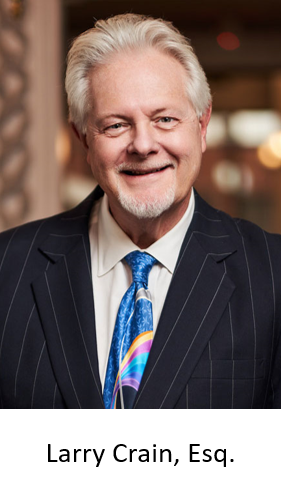
Education Reporter spoke with Larry Crain, Esq., attorney for the parent group, about the current status of the lawsuit. He explained that the case was argued before the Chancery Court for the Twenty-First Judicial District of Tennessee two months ago. “We have no idea when a decision will be handed down,” he concedes, “but the case is still very much alive.”
When asked if the Wit and Wisdom curriculum has been removed, Crain confirmed that it is still being taught in Tennessee schools. “The question,” he said, “is whether or not it will be renewed for next year,” but acknowledged that a ruling in the legal action would likely have an impact on the decision to renew. “It is a horrible curriculum,” he added.
Wit and Wisdom from coast-to-coast
Besides Tennessee and Bessinger’s home state of Rhode Island, the Wit and Wisdom curriculum appears to be taught in various states across the country, among them California, Colorado, Louisiana, Massachusetts, Ohio, and Virginia. Great Minds® bills itself as a group of “K-12 advocates with a passion for knowledge [that] has grown quickly into teams of hundreds of teacher-writers on a mission to elevate education in every classroom.”
The website further claims that “it’s all about building knowledge — not just skills. Building deep, lasting understanding rather than just memorizing.” Some observers might conclude that having kids memorize historical, mathematical, and other educational facts is exactly what Progressive/Paulo Freire educators don’t want them to do. It’s much easier to torment and intimidate children with “knowledge in the context of the real world rather than hypothetical scenarios.”
An October 2022 blog post by writer Keith Callis shed additional light on the Wit and Wisdom curriculum after he obtained materials from Williamson County, Tennessee Moms for Liberty leader Robin Steenman. Callis described Wit and Wisdom as “neither witty nor wise,” and instead called it “cunning”:
- It pits adult sophistication against the susceptibilities and limitations of children. It has been created by people well-trained in effective teaching methods and in an assumption among educationists most often labeled Constructivism, the idea, when coupled with Marxist assumptions, that all values are merely imagined and sustained by powerful social groups. Believed en masse, such values or beliefs become “truth.”
Among his examples, Callis highlighted “a suicidal ideation in a first-grade book titled Brave Irene.” The teacher’s manual asks students to act out the scene of the main character, who gets buried over her head in a snowdrift. The story reads: “Even if [Irene] could call for help no one would hear her. Her body shook. Her teeth chattered. Why not freeze to death, she thought, and let all these troubles end. Why not? She was already buried.” What? This is a story directed at first graders. [Emphasis added.]

According to Callis, another potential suicide appears in the 3rd grade and yet another in 4th grade. In the 3rd-grade text, titled Amos and Boris, a mouse “began to wonder what it would be like to drown. Would it take very long? Would it feel just awful? Would his soul go to heaven? Would there be other mice there?”
In the 4th-grade selection, “a small child sees his mother’s infidelity. She is kissing a man who is not his father. It devastates him: ‘He wanted to die…. He had gone up on the ridge and taken the hatchet and tried to end it by cutting himself.’
“Madness. A hissing madness that took his brain. There had been nothing for him then and he tried to become nothing but the cutting had been hard to do, impossible to do, and he had at last fallen to his side, wishing for death, wishing for an end, and slept only didn’t sleep.”
It is this type of horror that young children are being exposed to in Wit and Wisdom lessons and texts. Then there are the unrelenting references to racial discrimination and inequality. While Callis concedes that some of the information and images presented in the history lessons contain historical truth, “nothing in this curriculum completes the picture to correct the impressions left on children’s imaginations and emotions. And things have changed. Adults need only to look around to see that violence and racism are simply not omnipresent. But for children it is different. They are impressionable.
“This curriculum is an example of intellectual dishonesty of a very sophisticated but low and debased kind.”
Education Reporter applauds the efforts of whistleblowers like Bessinger and Steenman, and we await the ruling in the Tennessee case against the Williamson County School District for its adoption of Wit and Wisdom.
Legal Recourse for Saving Kids
Calling the school’s policy “a trifecta of harm,” a judge with the U.S. District Court for the Southern District of California ruled last September that the Escondido Union School District could not force two longtime teachers, Elizabeth Mirabelli and Lori Ann West, to violate their religious beliefs by lying to parents about their students’ gender dysphoria. The teachers were placed on leave for defying the school district’s policy of requiring them to hide students’ gender questioning from parents, and the ruling included an order for their reinstatement.
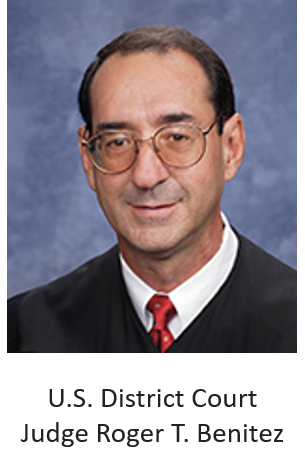
The Washington Free Beacon quoted U.S. District Court judge Roger Benitez as finding that the district’s policy “harms the child who needs parental guidance and possibly mental health intervention to determine if the incongruence is organic or whether it is the result of bullying, peer pressure, or a fleeting impulse. It harms the parents by depriving them of the long-recognized Fourteenth Amendment right to care, guide, and make health care decisions for their children. And finally, it harms plaintiffs who are compelled to violate the parent’s rights by forcing plaintiffs to conceal information they feel is critical for the welfare of their students.”
The Free Beacon further noted that the ruling was issued just as California’s attorney general Rob Bonta “has mounted an all-out battle against a growing number of school districts that are bucking state guidance to secretly transition kids,” doubtless because many parents are resisting such subterfuge. In a January 10, 2024 “legal alert,” Bonta doubled down on his earlier directive to school districts, claiming that “outdated social stereotypes” are a leading reason for keeping parents informed of their child’s gender-related issues when presented in school, and that school districts therefore would be violating their “duty of care” to students by revealing such crucial information to parents without the “student’s express consent.”
The original lawsuit was filed in April 2023 by the Thomas More Society and LiMandri and Jonna, LLP, charging that the Free Speech and Free Exercise rights of Mirabelli and West under the First Amendment were violated. At issue is the school district’s policy to not only accept without question a child’s claim of transgender status, but for teachers and school district personnel to begin aiding the child’s gender transition while deceiving his or her parents about it.
After ignoring the court’s original directive to do so, Judge Benitez again ordered the school district to reinstate the teachers in January 2024. While the court stopped short of sanctioning the school district, it reinforced the order that the teachers be returned to their former positions.
Legal showdown
On February 1, the Thomas More Society announced that Mirabelli and West’s lawsuit was expanded to include California Governor Gavin Newsom and Attorney General Rob Bonta. Thomas More Society communications writer Tom Ciesielka explained that Mirabelli, et al. v. Olson, et al. “now names Newsom and Bonta as defendants in the suit, along with the officials of the Escondido Union School District, California Department of Education, California State Board of Education, California State Superintendent of Public Instruction, and Rincon Middle School, where both teachers are on staff.”
According to the expanded legal action, the defendants “are all operating under the supervision and control of the Governor, who has ultimate responsibility for overseeing the state’s education system.” The plaintiffs’ attorneys say the school district claims it is “compelled by the state to adopt and enforce parental exclusion policies in which California dictates the deception requiring teachers to lie to parent about their students,” which suggests the state government “is the driving force behind the violation of Mirabelli and West’s constitutional rights.”
Attorney Paul Jonna explained that “the California Department of Education tried to have it both ways. On the one hand, they tried to tell the court that their ‘guidance’ on gender identity policies is not mandatory, even though they used words like ‘must’ and ‘required.’” On the other hand, the education department “is working hand-in-hand [around the state] with the California Attorney General enforcing this supposedly non-binding ‘guidance’ with litigation and by withholding millions of dollars of state education funds … Because the California AG and the Governor are so connected to this fight, we’re naming them as defendants to hold them fully accountable as well.”
Battle lines drawn
In at least six other states, litigation is pending against school districts for transgender policies that keep parents in the dark over pronouns and social transitioning of students. An article in Education Week (May 2023) exulted: “None of the parents suing schools over this issue have won a legal argument against a school district yet. Two cases have been dismissed after judges ruled that the school districts did not violate any laws. In two other cases, parents have appealed the court’s decision and the final verdict is pending….”
But so far parents are not dissuaded. As the litigation shows, in most cases their demands are simply that school districts “be obligated to inform them if their child chooses to use a different name and pronouns at school, or questions their gender identity, even if the child has asked teachers or counselors not to reveal that information.” In a Virginia case cited by Education Week, teachers joined parents in asserting that “their religious freedoms under the state constitution were violated when they were required to use a student’s preferred name.”
The growth of parents’ rights activism in recent years demands that schools recognize the right of parents to direct the upbringing and education of their children, but most school districts remain defiant and are refusing to back down. Supported and fortified by amicus briefs and other legal help from radical LGBTQ organizations like GLAD (Gay and Lesbian Advocates and Defenders), district administrators seem convinced they are obligated “to support students by, at the bare minimum, dignifying them when they say, ‘this is my name, and [these are] the pronouns that I want to use.’”
Goldwater Institute attorney Adam Shelton confirms the issue is about parents’ rights. “It’s not a transgender issue, or an issue about whether or not gender affirming care should be provided or not provided,” Shelton told Education Week. “It’s usually about whether or not parents should be involved with this sort of decision-making process.”
Secrecy in Kansas
Last month, Parents Defending Education (PDE) posted an announcement from Kansas Attorney General Kris Kobach that several school districts in his state are allowing personnel “to hide from parents the fact that a student may be using a different name or pronouns at school.” Kobach had previously challenged such policies in six school districts, which were allowing schools to “socially transition” students without the parents’ knowledge or consent.
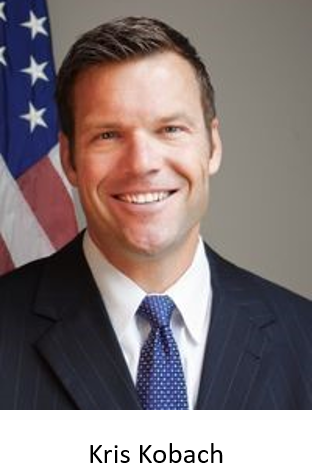
“A child changing his or her gender identity has major long-term medical and psychological ramifications,” Kobach wrote. “Parents should know, and have an opportunity to be involved in, such an important aspect of their well-being.”
Of the six school districts that received letters from Kobach, two rescinded their offending policies in short order. Both the Belle Plaine USD and the Maize USD responded that they “had no intention of cutting parents out of the process” and either rescinded or amended their policies without delay. The remaining four, however, dug in their heels and refused to make any changes. Three of these districts are in the Kansas City metro area, and one in Topeka, which some observers note are more liberal areas.
PDE reports that Kobach also sent a letter to the Kansas Association of School Boards (KASB) based on evidence that “KASB may have been involved in promoting policies that push parents out of the way on this issue,” but the organization has refused to confirm or deny involvement in drafting such policies. Kobach’s letters to the KASB and four holdout districts can be found here.
PDE Vice President Caroline Moore says Kobach’s pushback in Kansas “could easily be adopted and tailored to fit any state,” depending on its political appetite and the willingness of state officials to take on rogue school districts. “Parental exclusion policies purposely tarnish relationships between parents and children, to no avail,” she adds. “Kansas is a great example of recognizing an issue that impacts all and correcting course, so these policies don’t plague another generation of students and their families.”
Transgender activism in red state schools
But PDE further warns of a transgender activist push “to reach every American child with their perverse ideology” and contends that they “have spent the last few years crusading through red state schools to achieve that goal. And they’re making headway.”
A March 13 article at Townhall.com notes that transgender activists “began their mission to reach children in blue state schools in the early 2010s, but now are fully committed to the idea of also capturing children in red states with their dangerous ideology. Unfortunately, as we can see in places like Utah, Idaho, and Ohio, they are succeeding at a frightening pace.”
The Townhall article explains, for example, that school board associations and other high-profile organizations are targets for activists who use them as “trojan horses to enter schools in unsuspecting communities” by providing transgender policies and pushing for their adoption.
PDE submitted hundreds of public records requests in Utah, Idaho, and Ohio “seeking any policies or guidance regarding transgender and gender identity issues.” The organization says numerous schools have “succumbed to outside pressure,” unbeknownst to parents and community members. Some examples of Utah school districts with transgender policies include the Alpine School District, North Summit School District, and the Kane County School District. “In most cases,” reports PDE, “the Utah School Boards Association directly provided these policies and encouraged the adoption of them.”
In Ohio, Akron Public Schools “has a policy that states district staff will work with students and/or their parents regarding transgender issues.” PDE says districts “often use this language to avoid admitting parents will be left in the dark while also signaling [that] parents do not need to be involved.”
Columbus City Schools’ policy for parents who oppose their children changing genders is “to subordinate their role to mere opinion-givers. District staff then ‘continue to work with families and students in an effort to arrive at a mutually agreeable solution.’” Both the Akron and Columbus districts “either leave parents out of the equation or try to force them into accepting a compromise with their kids.”
Townhall.com opines that, like the parents and teachers in Escondido, California, the attorney general in Kansas, and the many brave pro-parent activists working nationally in PDE and other organizations on behalf of parental rights, “any chance of stemming the tide of gender ideology in our nation’s schools will require parents and communities to speak up and hold their officials accountable…. If we remain silent, we could lose an entire generation of children.”
What Books Should Kids be Reading?
(Second in our series of recommended reading lists for children of all ages. We will publish additional lists in Education Reporter over the next few months. — Ed.)
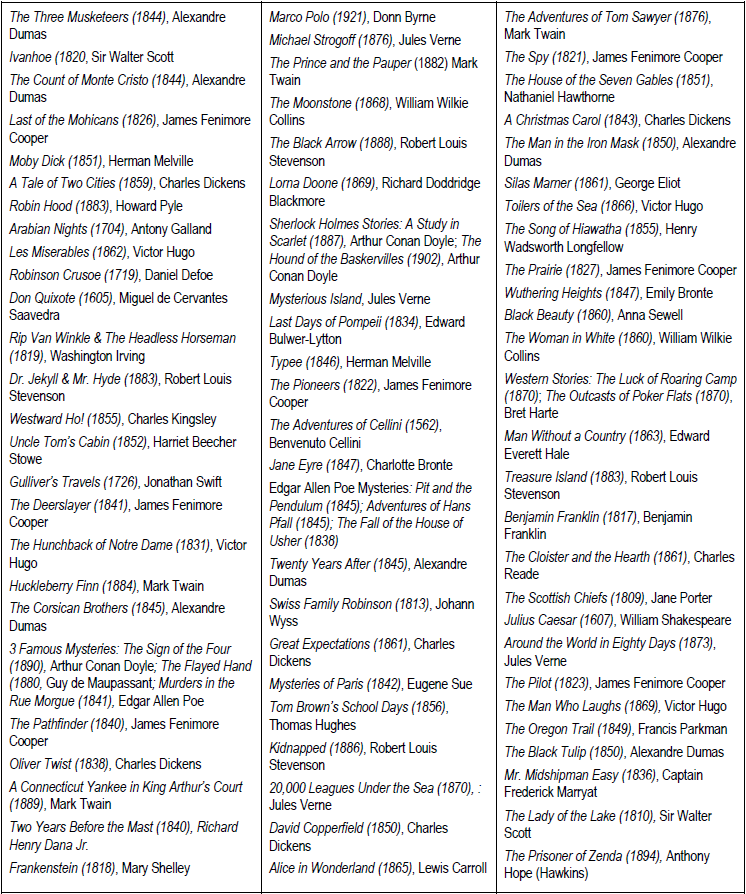
Classic children’s books are scarcely to be found in school classrooms and libraries today, so parents must ensure that their kids are reading books that educate, absorb, and entertain in a manner that stimulates curiosity and increases the child’s eagerness to learn about the world.
The following list displays the title, year published, and author of each book. Please note that some duplication of titles may occur from last month’s list. This is part 1 of The Ultimate Reading List — Classics that Endure, which originally appeared in the June 1997 issue of Education Reporter. We will publish Part 2 in next month’s issue.
Additional Education Reporter suggested reading lists:
- A Child’s Reading List (February 2024)
- The Ultimate Reading List — Classics that Endure (Part 1) (March 2024)
- The Ultimate Reading List — Classics that Endure (Part 2) (April 2024)
- Children Will Love Discovering Lost Classics (May 2024)
- Bennett’s Reading List (Part 1) (June 2024)
- Bennett’s Reading List (Part 2) (July 2024)
- The Best Children’s Classics (Part 1) (August 2024)
- The Best Children’s Classics (Part 2) (September 2024)
- Recommended High School Reading List (October 2024)
NOTE: Most books on this list can be ordered online through booksellers including:
- ThriftBooks
- Amazon.com : vintage books classics
- Project Gutenberg (Free Archive, eBooks only) Choose (EPUB3 (E-readers incl. Send-to-Kindle))
> > > > Send to Kindle to upload ebooks to your Kindle device downloaded from Project Gutenberg.
The Ultimate Reading List — Classics that Endure (Part 1)
Click the image below to open as a (printable) PDF document
Mallard
Tuttle Twins Season 1 Graphic Novels
by Connor Boyack, Libertas Press
Since 2017, Education Reporter has reviewed the Tuttle Twins series of books by Connor Boyack because they fill an important gap in government school education as well as provide a valuable addition to homeschool curricula. The books offer solid academic teaching in civics, history, economics, and more for elementary school children ages 5-11.
In addition to the original 12 book series plus the more recent 13th volume — The Tuttle Twins and the 12 Rules Boot Camp — Libertas and Boyack have introduced 12 hard-bound graphic novels adapted from episodes of the Tuttle Twins animated cartoon series produced by Angel Studios. These books bring to the printed page the principles of freedom portrayed in the animated shows, giving children an alternative learning experience.
 This reviewer viewed the animated cartoon episode, When Laws Give You Lemons, upon which Season 1, Book 1 of the same name is based, and found it entertaining, humorous, and educational. Some of the characters are quirky, and the dialogue seems more suited to the older children in Libertas’s target audience. While the description of the hard-bound book series does not specify a preferred age, the upper age range may be best suited to the content.
As an expanded version of the very first Tuttle Twins book, The Law, published in 2014, both the cartoon and the hard-bound version of When Laws Give You Lemons teach students how the U.S. government was intended to protect the God-given rights of its citizens, and contain elements of economist and statesman Frédéric Bastiat’s eternal truths on the law and the fallacies of socialism. When the Tuttle Twins travel back in time to the French Revolution in the cartoon, Bastiat appears briefly as a character.
Through their characters and story lines, the Tuttle Twins books teach the value and importance of individual rights, free market economies, the value of “the golden rule,” and the significance of private property. Customers may order the graphic novel set in a 12-book bundle, or the books may be purchased separately.
The full set includes:
- Book 1 — Season One — Episode 1 adaptation: “When Laws Give You Lemons”
- Book 2 — Season One — Episode 2 adaptation: “War of the Worms”
- Book 3 — Season One — Episode 3 adaptation: “Pencils, Pirates, and Ice Cream People”
- Book 4 — Season One — Episode 4: “Of Business and Benjamins”
- Book 5 — Season One — Episode 5 adaptation: “Rising Tides & Dirty Deals”
- Book 6 — Season One — Episode 6 adaptation: “The Inflation Monster”
- Book 7 — Season One — Episode 7 adaptation: “Cakes, Pies, & Flat Earth Guys”
- Book 8 — Season One — Episode 8 adaptation: “Wonky Wages”
- Book 9 — Season One — Episode 9 adaptation: “Dumpsters & Disobedience”
- Book 10 — Season One — Episode 10 adaptation: “Roll for Power”
- Book 11 — Season One — Episode 11 adaptation: “Free Speech Freestyle”
- Book 12 — Season One — Episode 12 adaptation: “Fight for the Future”
Each book features full-color pages and a hard cover.
The Tuttle Twins books are all based on well-known works and teach critical concepts that reinforce liberty, honor, personal responsibility, and the value of hard work, in language children can understand. Each of the original volumes is short (chapter length) and simplifies a complex topic in order to educate and make learning fun. The stories are based on the everyday lives, activities, and experiences of the fictional twins, their family, friends, and neighbors.
The Libertas Institute also offers a curriculum on how to teach free-market principles to students, with lessons and activities for both young and older children. There are currently a total of 120 lessons in both print and downloadable formats.
The curriculum teaches how to prioritize needs and wants, the importance of choices and the principle of hard work, the creation of wealth and value, and the importance of freedom for the creation of beneficial goods and services.
Parents and grandparents may wish to familiarize themselves with these potentially helpful resources to ensure that their children and grandchildren learn the truth about the intent of America’s Founding Fathers and documents.
To read the entire book, go to Tuttle Twins to order!
Education Briefs

Florida’s sensible Parental Rights in Education Act, signed into law by Governor Ron DeSantis in April 2022, will stand, according to a March 11 press release from the governor’s office on the final court ruling. Despite endless attacks by liberal forces, including the mainstream media, the lawsuit against the measure failed, awarding DeSantis and the parents’ rights movement a major victory. The Florida chapter of the Parental Rights Foundation supported the bill as it wound its way through the legislative process, but immediately upon its passage, LGBT advocacy groups filed suit against it, alleging that it was “an unlawful attempt to stigmatize, silence, and erase LGBTQ people in Florida’s public schools.” An email from the Foundation to its supporters says the the state “has agreed to issue a notice to school districts clarifying that the law applies to classroom instruction but does not prohibit other mentions or discussions related to gender identity. In exchange, the litigants have agreed to drop their appeal, which has been before the U.S. Court of Appeals for the 11th Circuit for more than a year.” The plaintiffs also acknowledged in the settlement that “the law does not violate the Constitution and that First Amendment rights were never at risk.” While the law’s opponents insist the settlement rolls it back in large part, the original language remains in place and unaltered. Currently, parents’ rights bills have either passed or are at various legislative process stages in in 32 states, despite insistence by the Left that such rights must be curtailed or eliminated. Concerned Florida parents will need to remain vigilant that the law they helped enact continues to be upheld in the state’s government schools.
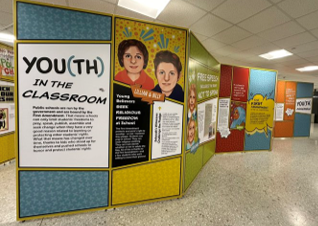
Chinese American activist and patriot Xi Van Fleet, who escaped the Maoist purge in Communist China during the 1980s and became a U.S. citizen, recently posted on X (Twitter) how American Marxists are taking propaganda from the classroom into public spaces such as the Dulles International Airport. The exhibit Van Fleet described “is all about the 1st Amendment, how students have the right not to say the pledge, not to salute the American flag, to wear the hijab, to walk out or sit in, to protest, to take off a day from school for political events, to become little lobbyists, to be able to curse schools in social media, to demand funding for teen moms,” etc. In short, she wrote, “it is about showing kids how to become revolutionaries to overthrow the system using their Constitutional rights.” Her post explains that such demonstrations are “how Communists use Constitutional rights to destroy the Constitution. In [Saul] Alinsky’s words: ‘Make the enemy live up to its own book of rules.’” One respondent to Van Fleet’s post observed that the premise of the display at Dulles “is convoluted. The Constitution was meant to restrict government, not grant rights. This country’s citizens possess inalienable rights from God. There is no God in DC, or the Federal government.” Another commenter noted: “The message is [intended] to influence us in the direction they want to drive us. Everything has a purpose with these people. They marry truth (you have free speech), to a lie (use it to rebel) ….” In March 2023, Education Reporter highlighted Van Fleet’s first-person experiences as a survivor of the “Chinese Cultural Revolution,” and her resultant dedication to the preservation of liberty in her adopted country. Last October, her book, Mao’s America: A Survivor’s Warning, written to sound the alarm about the dangers America faces, was published by Hachette Book Group.

The Tuttle Twins recently made their political debut in the South Carolina legislature with their Season 2, Episode 8 educational cartoon titled Spooky, Stinky Subsidies. Author Connor Boyack described in a March 18 email: “In this episode, [twins] Ethan and Emily, along with the sage Ludwig Von Mises, find themselves navigating a literal spooky landscape—a ghoulish metaphor for the distorted, murky market environments often created by sometimes well-intentioned but ultimately harmful subsidies.” The point of the cartoon is to show how subsidies “not only fail to level the playing field but actively corrupt it, creating environments where businesses rely on government favor rather than customer satisfaction to succeed,” in terms even kids can understand. State Representative Robert J. (RJ) May (R-Lexington) introduced the cartoon during debate over a $2 million film commission subsidy for an ongoing program filmed in South Carolina called “Righteous Gemstones.” May said he had no problem with the show, but rather with “the manipulation of the free market and whether or not we should rely on central planning from this body and this building, or whether we should allow the free market to determine the winners and losers … The free market often breeds success and innovation,” he said, “and often at a lower cost.” His opponent defended the subsidy, reasoning that the film company could take their dollars to another state. May again disagreed, citing a study by the University of Southern California Sol Price School of Public Policy that shows such subsidies are often a bad investment, with little return for the millions of tax dollars invested. “On average,” May said, “the only advantage [according to the study] was a short-term wage gain, and market share in the industry didn’t budge.” He then invited his opponent and the audience to Google and watch on YouTube the Tuttle Twins cartoon “if you have questions about what subsidies mean and how they manipulate the market.” When roundly criticized for getting his information “from a children’s cartoon,” May quickly retorted that no, he knew what subsidies were, but since his fellow representative seemed to be struggling with understanding how subsidies aren’t part of a free market, a cartoon that distills these important ideas into kid-friendly terms was perhaps a good place to start. Fans wonder if the commonsense educational value of the Tuttle Twins’ books and cartoons may earn them another shout out in another state legislature one day soon.
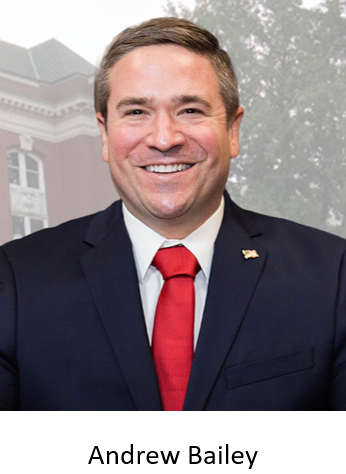
Missouri attorney general Andrew Bailey is cautioning school districts around the state to “immediately cease discriminatory practices against students and staff.” Bailey communicated his warnings in separate letters to three school districts specifically, although the implication is that there are potentially additional guilty parties. The districts targeted are all in St. Louis County: the Lindbergh School District, the Parkway School District, and the Webster Groves School District. Specific to the Lindbergh District, Bailey wrote: “the district has instituted race-based criteria for students seeking to enter the gifted program. According to reports my office has received, the program’s traditional pathway to entry requires a student to score in the 95th national percentile on at least one screener or standardized test (math or reading) and in at least the 85th percentile on the other. Alternatively, students who are part of an underrepresented racial or ethnic population in the district are only required to achieve standardized test scores in the 84th percentile on one test (math or reading) and in the 50th percentile on the other before being considered for additional testing. The district’s policy states that its goal is to reach a 20% equity index for underrepresented student populations. If these reports are true, Lindbergh School District is discriminating on the basis of race, in direct violation of both state and federal law.” In the Parkway District, reports indicate students are prevented from forming “religious-based” clubs, such as the Fellowship of Christian Athletes, which includes prevention from hanging posters, making announcements, or holding meetings on campus. In Webster Groves, “race-based criteria for its employees and applicants” has reportedly been introduced. Bailey has ordered each of the three districts to immediately cease and desist their allegedly discriminatory practices, with the promise that he will use his full authority under the law to ensure Missouri students and staff are free from such treatment. The district-specific letters may be viewed here.
10 Times as Many Teachers Say Trans, CRT Lessons Hurt Rather Than Help Schools
Originally published by The Washington Stand, February 27,2024. Reprinted by permission.
A new survey reveals a cavernous gap between teachers’ unions and the views of most parents, teenagers, and teachers on whether public schools should teach LGBT ideology to students — and whether parents should have the right to opt their children out of those classes.
While elite teachers’ unions such as the National Education Association (NEA) and the American Federation of Teachers (AFT) believe schools should teach sexual orientation and gender identity (SOGI) classes to children, their customers — parents and students — disagree, as do many of their members, according to a series of new polls released last week [mid Feb.].
More than 10 times as many teachers said debates over LGBT ideology, including sexual orientation and gender ideology, “have had a negative impact on their ability to do their job,” compared to 4% who said they improve learning, according to the Pew Research Center: 41% to 4%. Social Studies and English teachers were the most likely to say SOGI topics harmed their teaching time; they were also the classes most likely to discuss those issues, the survey found.
Yet some left-wing activists are working to change that. MacKenzie Scott, the ex-wife of Amazon founder Jeff Bezos, donated $10 million to a group that instructs math teachers to “infuse social justice into mathematics.”
Teachers, Parents, and Students Do Not Want LGBTQIA+ Issues in the Classroom
Half of all teachers say “students should not learn” about gender identity issues in school, including 62% of elementary school teachers, 45% of middle school teachers, and 35% of high school teachers. Among those who believe the school should weigh in on such divisive topics, 33% of teachers say gender “can be different than sex assigned at birth,” while 14% believe in biological sex. More than twice as many elementary teachers believe transgender ideology as believe in biology; the proportion reaches three-to-one among high school teachers (45% vs. 15%).

The poll apparently shows those supportive of transgender beliefs are more likely to address the topic in school. Just under one-in-three teachers say sexual orientation or transgender ideology come up occasionally (21%) or frequently (9%). But teachers who belong to the Democratic Party were 15 points more likely to confess that LGBT issues creep into their classrooms than Republican teachers (36% to 21%).
Although a plurality (48%) of teachers believe parents should be able to opt their children out of transgender ideology indoctrination classes, one-third of instructors believed such classes should be compulsory.
“On both topics, parents’ views were more evenly split than the views of teachers,” according to the Pew survey. For instance, a majority of parents (54%) believe they should be able to determine whether teachers can subject their children to trans ideology.
The largest percentage of teens do not want to hear about LGBT ideology in the classroom, either: 48% say the topics should not be taught at school. Teens are also slightly more likely to believe in biological sex than in transgenderism (26% vs. 25%). But Democratic students are 525% more likely than Republican students to say gender identity is not tied to physiognomy.
Teenage students are more likely to feel uncomfortable hearing about transgender or sexual orientation issues than feel comfortable (33% vs. 29%). More than twice as many Republican students are more likely to feel uncomfortable hearing about such topics than to feel comfortable.
Only 14% of all teens say transgenderism or homosexuality “has never come up in any of their classes.”
The poll seems to indicate many teachers believe parents have too much say in their children’s education. While a plurality of teachers said parents had “the right amount” of influence, teachers were more likely to say parents had “too much influence” than not enough (32% to 19%). Democrats were 42% more likely than Republicans to believe parents had too much influence.
Republican-leaning teachers are more likely to honor parents’ views on these subjects, the poll found: 69% of Republican teachers say schools should not be in the business of teaching LGBT issues, and 80% say parents should decide whether their children attend such classes. Half of Democratic teachers say public school LGBT classes should be mandatory, and 53% say schools should teach transgender ideology.
A strong majority of teachers (58%) belongs to the Democratic Party, Pew noted.
Asian and “[w]hite Democrats are more likely than [b]lack and Hispanic Democrats to say parents should not be able to opt their children out of learning about sexual orientation and gender identity,” Pew stated. In all, 53% of Asian Democrats and “six-in-ten [w]hite Democrats say this, compared with 42% of Hispanic Democrats and 34% of [b]lack Democrats.” A plurality of black Democrats say parents should be able to opt out of LGBT indoctrination (46%, compared to 34% who oppose it).
Teachers’ Unions Out of Touch with Students, Poll Shows
The views of teachers, parents, and students strongly conflict with the stance of the nation’s largest teachers’ unions, the three-million-member NEA and the 1.5-million-member AFT. The NEA provides model legislation to teach LGBT ideology in public schools and carries out numerous training sessions to promote gender ideology to teachers.
The NEA’s “Pronoun Guide” includes “Ze, Zim, Zir, Zay or Zee.” It urges teachers, “Inspire and encourage your student” with its two-page list of “LGBT+-affirming books.” It instructs teachers in 33 states how they can obtain a free “Rainbow Library” from GLSEN.
“You can use your work environment,” e.g., the classroom, “to show support for students of all backgrounds — for example, by hanging a Black Lives Matter poster or Pride flag or making clear that you will use a student’s personal gender pronouns,” the NEA advises teachers.
The union’s leadership has strongly emphasized its commitment to radical LGBTQ advocacy, regardless of parental objections or, seemingly, state law. “We will say gay! We will say trans!” bellowed NEA President Becky Pringle at the group’s 2022 Annual Meeting and Representative Assembly, taking aim at the popular “Parental Rights in Education” law, signed into law by Florida Governor Ron DeSantis (R), who went on to win a rousing double-digit reelection months later. The bill says teachers may not “encourage classroom discussion about sexual orientation or gender identity” before the fourth grade. The NEA stated its union members would “validate our students,” presumably when children’s gender choice conflicts with their parents’ values.
The NEA’s chief union rival, the AFT, “also coached its members on how to inject gender identity politics into the classroom,” found a report from the Defense of Freedom Institute. The AFT’s Together Educating America’s Children (TEACH) conference last July held sessions on “Affirming LGBTQIA+ Identities in and out of the Classroom” and “The TGNCNB [Transgender, Gender-Nonconforming, Nonbinary] Inclusive School and Classroom.”
Teachers in Tennessee’s Clarksville-Montgomery County School System, which strongly supported President Donald Trump in the 2020 presidential election, learned that the U.S. operates as a “system of oppression” that confers “privilege status” on “white,” “able-bodied,” “men, cisgendered,” “heterosexual,” “Christian” Americans; but the U.S. allegedly brands an “oppression status” on any “person of color”; “woman, trans, nonbinary, genderqueer,” “LGBQ+, polyamorous”; and people whose religious views are “pagan.”
The LGBTQ movement’s advocacy goes outside the classroom to the restroom, locker room — even the hotel room. Last summer, teachers at Governor’s Ranch Elementary School in Littleton, Colorado, attempted to force a fifth-grade girl to share a bed with a boy who identified as a girl on an overnight field trip. Last July, the AFT adopted a resolution supporting “inclusive” policies allowing men to access female facilities, “including, but not limited to, bathrooms and locker rooms.” AFT President Randi Weingarten walked away from a reporter who asked her about girls who do not feel safe undressing in front of boys in their locker rooms.
“Both teacher unions ignore the reality that most teachers want to teach, not affirm a student’s gender identity, either due to their personal values or their beliefs that doing so oversteps their authority and encroaches on the role of parents,” says the Defense of Freedom Institute.
Ben Johnson is senior reporter and editor at The Washington Stand, Family Research Council’s outlet for news and commentary from a biblical worldview. The Washington Stand is based in Washington, D.C. and is published by FRC.
Education Related Links