Furries in Schools: Fact or Fiction?
The average person has probably never heard of animal “furries,” which in this context refers to people, including children, who identify as cats, dogs, and other animals. Some reportedly believe, at least to an extent, that they actually are the animals they portray, wearing the requisite costumes and adopting the animal’s behaviors.
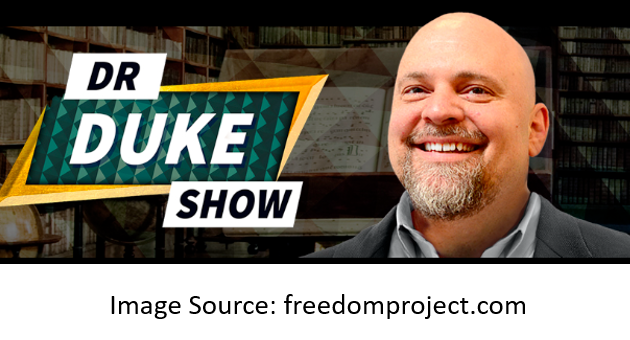
In April 2022 on his online show, Dr. Duke Pesta discussed the topic of furries in Wisconsin schools with conservative radio host Vicki McKenna, who assured listeners: “This is real. This is happening. Kids can identify themselves as ‘furries,’ — as an identity — and their behavior is protected.” The furries’ behavior can include biting, scratching, pouncing, crawling or scooting on all fours, barking, meowing, growling, licking, hissing, rubbing up against other students’ legs, and more. (Unfortunately, this episode has been taken down, but is referenced in the May 2, 2024 Dr. Duke show; link is included later in this article — Ed.)
McKenna described a time when she stumbled upon an adult furries convention and assumed it was all in fun; people dressing up as anthropomorphic animal and comic book characters, but said she discovered “it’s much more than that. It’s something of a sexual fetish; in [their] video games and comics, sexual themes are present; for some there is sexual activity with other furries known as ‘yiffing.’”
Pesta said the problem “is way broader than one would think,” in reference to the fact that students identifying as furries are being accommodated at some schools as if their fantasies are real. He showed a video clip of a substitute teacher describing a day in her classroom when one of the students “meowed” at her. She related:
- I’m looking at the seating chart as I’m going up and down the rows and marking who’s here and who’s not. I get to the third row and I hear this “meow.” I said “excuse me,” and continued to take roll. When I heard it again, I said “okay, what’s up with that and who’s doing it? This little girl in the very front row said “you have to meow back at him. He identifies as a cat.”
The teacher was subsequently informed by the administration that she wouldn’t be invited back as a substitute because “she couldn’t identify with all the students in her classroom.”
Alex Newman also reported on the furries phenomenon in 2022, noting that “estimates suggest there are already hundreds of thousands across America.” As for furries in the schools, he stated:
- Concerns about the practice first gained national prominence among adults outside the government-school insane asylums after a Michigan mom complained at a school-board meeting about “litter boxes” being put in bathrooms. The superintendent claimed it was not true—a denial that left-wing establishment bootlickers parroted mindlessly to allay fears of upset parents and taxpayers.
Indeed, virtually all the mainstream naysayers piped up to debunk reports about schools in Wisconsin, Michigan, Colorado, and other states establishing protocols and making accommodations for furries, including litter boxes for those who identify as cats. “Fact checkers” came out of the woodwork to label the reports “false.” The Associated Press (AP) called them “unfounded,” Snopes debunked the notion, and Education Week called the allegations “a disruptive and demeaning hoax.” Even Wikipedia chimed in against the “rumors.” Some of these outlets blamed Republicans, presumably for the common-sense laws enacted in many red states to protect innocent children from transgender activists.
But are all reports about furries unfounded? Newman, Pesta, McKenna, and others recognize the obvious correlation that if children are told they can “switch genders and then declare themselves boys if they’re girls or vice versa,” they should logically also be able to identify as a cat, dog, or another animal. If the schools must respect students who identify as the opposite gender or one of the many invented genders, the next logical step is that they must also respect those who identify and dress up as animals.
Recently, Education Reporter received a first-hand report of furries in at least one Pierce County, Washington elementary school. The mother of an 11-year-old daughter, who asked to remain anonymous, removed her child from the school and began homeschooling her after she found out there were litter boxes in the girls’ bathrooms. “Some of the girls identify as cats,” the mother said, “and they use the litter boxes.”
Uproar in Utah
In April 2024, middle school students in Utah’s Nebo School District walked out in protest of the furries’ behavior during the school day. On his May 2nd show, Pesta played a video clip of the protesting students who said they were “standing against what the furries are [doing] wrong.” During the show’s opening, a gleeful McKenna said: “To all of the people who are monitoring this show, we told you so…. You accused us of lying about this; we want an apology.”

Among the actions the student protestors described in the video: “They bite us, so we just kick them and we get in trouble. They attack us, they bite us, they scratch us, they pounce on us, and we get in trouble. We can’t look at them or talk to them but they can attack us. And there are litter boxes in the girls’ bathrooms.” When the interviewer objected that the litter boxes were just a rumor, the kids shouted “No!” and assured him they had seen them.
A Fox News report on the protest noted: “About 75 parents and students protested the ‘furries,’ chanting during a walkout, ‘We the people, not the animals,’ and ‘Compelled speech is not free speech,’ and ‘Stop brainwashing us!’”
USA Today reported that a Change.org petition was created to convince the Nebo School District “to enforce its dress code, which would prohibit students from wearing furry costumes.” The petition, which references the district’s dress code policy, gained “over 2,700 signatures” at the time of the newspaper’s April 22 story.
Per the petition, the dress code reads: “Jewelry, accessories, tattoos, hair, facial hair, and other elements of a student’s appearance that draw undo [sic] attention, distract, disrupt, or otherwise interfere with the learning atmosphere at school or at school activities and events, or that create a health, safety or welfare issue are prohibited.” This would presumably include the costumes, masks, and headwear of furries.
Deny, deny, deny
Despite the publicity arising from the Utah student walkout, the school claimed that “misinformation had been circulated online” in a statement it issued to Fox News Digital:
- We want to assure you that rumors circulating online about student behavior are completely untrue…. These are 11 and 12-year-old students, and while sometimes these children may come to school with a headband that has ears, sometimes with giant bows, and sometimes dressed as their favorite athlete, there have been no students attending school wearing masks, animal costumes, or acting like animals.
The school district further claimed that accounts of the students’ animal-mimicking actions were also false. According to the district, the allegations are “unfounded” and not occurring in district schools.
As some critics surmise, the vehemence with which school districts in various states have pooh-poohed reports about furries in classrooms perhaps has more to do with the sheer absurdity of the concept, and the embarrassment and backlash that would likely result if their administrative support of the lunacy were widely known.
In an April 19 Townhall.com op ed, senior editor Matt Vespa wrote: “There are school walkouts happening over furries. Please shoot me into the sun…. I thought this was satire—it’s not. A school in Utah is coming under fire for allowing ‘furries’ to infiltrate their campus, reportedly licking and biting students. What the fresh hell is this nonsense?”
Vespa further commented on a local Utah news station’s interview with “Strudel,” a furrie who he said tried to make a sensible point about the controversy, “but the costume—I can’t take it seriously…. Furries in schools—allegedly. Please pass the hemlock.”. (“Strudel” was interviewed by the local ABC News 4 affiliate in full costume. She appeared to be a very “furry” dog. —Ed )
While the furries are sometimes accused by transgender activists of sabotaging their cause, the phenomenon appears to some pro-family activists to be part of the same cultural sickness. Parents should be aware of this phenomenon, which appears to be spreading and could be coming to their children’s school, if not already there.
Sexualized ‘Suicide Prevention’ Programs Endanger Kids
Last August, founder and president of Moms for America, Kimberly Fletcher, raised the question of whether so-called “suicide prevention programs” in schools actually work or merely confuse already confused and troubled children. She shared her concerns in an article on the Moms for America website, which also appeared on Townhall.com.
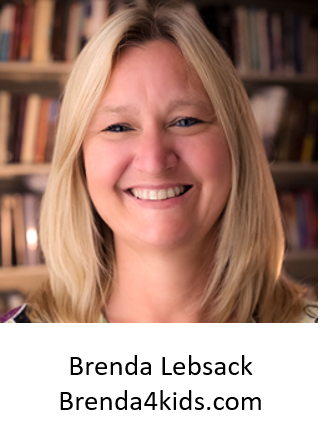
The article provides information on “new programs aimed at confusing children and exposing them to mature and inappropriate content without their parents’ knowledge or consent,” as documented by Brenda Lebsack, a 25-year veteran of California’s public schools. Lebsack is the founder of the parent advocacy organization Brenda4Kids, (new website is Interfaith4Kids) which aims to “pull back the curtain on what’s really going on in public education.” Lebsack agrees that parents “have been left in the dark about many changes concerning educational content, laws, policies, and the fast erosion of parental rights.”
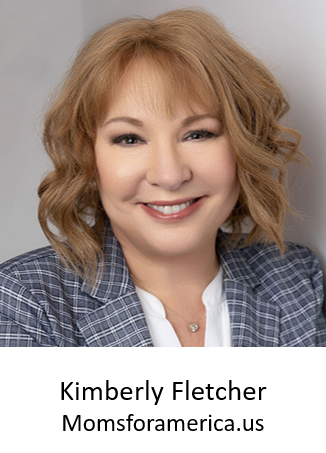
With the mental health crisis so prevalent among young people, including the rise in suicide rates, Fletcher explains that “administrators now have areas of the school dedicated to suicide prevention. There are increasing campaigns, many spearheaded by grieving families who have lost a teen to suicide, to encourage students to reach out for help. There is even contact information for suicide prevention programs listed on the back of student identification badges at many schools.”
While all this sounds good, the problem is in the content of the supposed solutions. One cause for serious concern is the federally funded “988 Suicide & Crisis Lifeline,” which is allegedly a suicide prevention hotline for minor children; however, “when underage students contact the hotline, they are surveyed about their genders and sexualities.” As Lebsack points out, “surveying children about their gender and sexual practices without parental consent is against the law.”
Fletcher reports that In the survey, of which Lebsack provides screen shots, “children are given eleven different ‘genders’ to choose from and even given the option to write in their own identity.” [Emphasis added.]
Also researched by Lebsack is the Trevor Project, “a hotline and chat-based resource recommended by 988 and other suicide prevention programs aimed at school-aged children. The chat features claim to be for ages 13-24, but they are available for students in kindergarten through 12th grade at all public schools.” Since there is no verification process, younger users can easily access the chats by lying about their age.
The controversial Trevor Project focuses on suicide prevention for LGBTQ+ students. Lebsack explains that the Q in this case “stands for ‘Questioning,’” If a child merely expresses “doubt or confusion” about his or her gender or sexuality, the child is considered “an LGBTQ+ identifying student who is then sent to programs like the Trevor Project.” For example, if a student takes the “illegally administered” 988 survey and indicates doubt about his or her sexual identity, he/she “is then directed to the Trevor Project that encourages further confusion.”
Additionally “chat rooms” are available to children and teens through the project’s online platform. Fletcher writes that these chat rooms “have shocking names and content. Among the groups are ‘Witchcraft, ‘Furries United’ (for catgirls/boys and other students who want to pretend to be animals or are just curious), ‘Gay Men Club’ (with the tagline ‘Let’s talk about boys!’), ‘Non-Binary Pals,’ and more.” [Emphasis added.]
These chat groups can easily be joined by adults. Thus, Fletcher warns, “underage students who are confused are actively encouraged by supposed suicide prevention programs to chat with unvetted adults around the world. This is a serious issue.”
According to Alex Newman’s Report 65 on Freedom Project Media, numerous critics have accused the Trevor Project of “grooming children,” including Dr. James Lindsay, “a leading secular critic of the sexualization and indoctrination of children.” Lindsay called the organization a “groomer Project posing as suicide prevention.” It has also come under fire from the Libs of TikTok.
Suicide programs nothing new
As with so many other destructive courses that have been introduced in public schools over the past 50 years, Phyllis Schlafly cautioned about the danger of suicide education more than three decades ago. In her February 1991 report, Phyllis indicated that in the late 1980s, “there suddenly developed a frenzy to ‘deal’ with the problem of teenage suicide. Government-financed conferences were held, a whole new social service bureaucracy started to form, and some legislatures even mandated that suicide courses be taught in the public schools.”
Phyllis wrote that researchers at the time had found that these courses only served to “stir up suicidal feelings when teenagers discuss the topic openly.” Despite the classes, they “continued to believe that suicide was a possible solution to their problems,” and students who took them said that “talking about suicide makes some kids more likely to try to kill themselves.”
Although the researchers’ conclusions proved “a clear need to evaluate such programs to determine their efficacy and safety,” that the courses produced “unwanted effects,” and that the results raised a “cause for concern,” the instruction continued.
As Phyllis pointed out, “most teenagers are not at risk for suicide and it is dangerous to pretend they are and expose them to classroom discussions about suicide.” One of the studies showed that “suicide can be subject to imitation,” and that talking about suicide to a random group of teens without knowing which of them might be pre-suicidal, could be “playing with fire.”
All these years later, the tragedy of teen suicide has become a much more pressing issue. The suicide and death education courses that have persisted in public schools have obviously served to make the situation more dire than it was 33 years ago. Schoolchildren today are subjected to psychological manipulation through social and emotional learning (SEL), the LGBT agenda, and critical race theory which preaches white supremacy and victimology.
Remarkably, what Phyllis warned about in 1991 is precisely what has come to pass in 2024, and its failure is glaringly apparent. See Education Reporter, May 2024, then note Phyllis’s words below:
- Psychotherapy about a sensitive and volatile subject such as suicide, administered to a class of minor children (each with different emotional makeup) by a “counselor” (i.e., an unlicensed psychologist) who has spent a few hours in a workshop, should be prohibited in the public-school classroom. It is to be hoped that legislatures and schools will now abandon their folly about suicide education.
Phyllis’s hope was not realized, and instead we have suicide hotlines that will lead children who are already confused and conflicted down pathways that, at best, have the potential to push them further into harm’s way.
Lebsack, Fletcher, Newman, and other pro-child voices are encouraging parents to find out what policies are in effect in their school districts and spread the word to other parents when objectionable programs are discovered. “We cannot ignore this issue,” Lebsack warns. “Our children are counting on us to take action.”
Worried DOJ Tracking Moms for Liberty
The powerhouse education policy organization Moms for Liberty has apparently struck a nerve with the U.S. Department of Justice (DOJ) after having proven itself a thorn in the side of the Biden Administration with its phenomenal success on behalf of parents’ rights. Indeed, the organization has been inciting ire and angst within the federal government for three years due to its rapid growth in membership (115,000 plus) and state chapters (45 and counting).
Last month, reports surfaced in conservative media that the DOJ’s “hate crimes” response unit was tracking the moms in the same way it tracks the Ku Klux Klan and other bonafide terrorist groups.
The Daily Wire broke the story after gnawing on it for at least a year, describing that it had gained access to “internal emails” which reveal how the DOJ’s “Community Relations Service” (CRS) has been tracking the Moms for Liberty’s movements.
The emails were obtained in response to a lawsuit filed by America First Legal on behalf of the Daily Wire, to compel the release of the information after the DOJ ignored Freedom of Information Act requests for the records. The emails show that the CRS “scoured the news” for articles “through Google and LexisNexis alerts” using key words; some associated with geographic locations such as “washington, dc n-word” and “washington, dc confederate flag.” CRS also tracked the group “alongside symbols such as the noose, the Confederate flag, and the swastika.”
Among many others, the words and terms tracked by DOJ officials included “anti-Semite, bias, bigot, discrimination, hate speech, homophobia, islamophobia, moms for liberty, oath keepers, swastika, and white supremacy.” [Emphasis added.]
While the CRS purports to “prevent and respond to community tensions and hate crimes, bias, bullying, and discrimination” in a non-partisan manner, it supports the progressive agenda and has been labeled by conservatives as an arm of the Democrat Party. While it discredits grassroots, pro-parent organizations like Moms for Liberty, Parents Defending Education, and others, it provides credibility to the far-left hate group Southern Poverty Law Center by relying on it for information. The Heritage Foundation, for one, has advocated for elimination of the CRS.
Manipulation and subversion
The Daily Wire described how CRS tracking and manipulation can subvert the will of the people when carried out by their elected public officials. One reason for tracking Moms for Liberty was to “identify school boards considering enacting conservative-leaning education policy.” For example, the emails show that when a Google alert triggered a story about the Virginia Department of Education releasing “new policies for transgender students,” the CRS swung into action.
Conciliation Specialist Hannah Levine wrote to school board members in Roanoke County, Virginia to offer the DOJ’s “services in conflict resolution,” except that there was no conflict. The problem for CRS and Levine was that Virginia Governor Glenn Youngkin “had drafted a ‘model’ policy that would prevent schools from gender-transitioning children without their parents’ consent, which school boards had the option to adopt.”
Since Youngkin “won twice as many votes” as his Democrat opponent in “deep-red Roanoke County, with similar results down-ballot,” the school board policy likely had many more supporters than detractors. “In a democracy,” noted the Daily Wire, “that means the locality had chosen to implement conservative policy. In the United States, schools are locally controlled. Yet CRS seemed to ask local school board members to defer to CRS because of ‘tensions’ between the elected leaders who had an overwhelming mandate, and a tiny band of leftist agitators.
“[CRS] then pressured school boards to defer to the DOJ to resolve the differences of opinion between duly-elected conservative officials and leftist activists, instead of enacting platforms they won elections on.”
There is no evidence that Moms for Liberty or any elected officials in Roanoke were doing anything “hateful” or wrong, but were supporting policies their voters expected them to implement. But the DOJ “seemed to be operating on the premise that either the Republican governor’s proposed policy was itself ‘hate,’ or that lawless leftist activists created ‘tensions,’ which opened the door to federal intervention designed to diffuse the tensions by appeasing them. Two leftist protesters were detained by police for allegedly disrupting a school board meeting on the topic by screaming.”
The emails further show that CRS pressured and pestered local people to accept their “services” using official doj.gov email accounts, even when those being pressured rejected the help. CRS “provided ideological ‘trainings’ such as ‘Transgender Training for Law Enforcement’” even while maintaining the lie that it was “a neutral arbiter on issues like Youngkin’s transgender policy.”
While the DOJ failed to comment on the media reports about the tracking, Moms for Liberty boldly rejected the intrusion, calling the Daily Wire’s findings “a new low for the Department of Justice.” Co-founder and spokeswoman Tiffany Justice said:
- We reject the notion that advocating for parental rights and the well-being of children is an act of hate and we call on the Department of Justice to clarify its position on this matter. The actions of the federal government should never infringe upon the rights of parents to engage in the democratic process.
Reason for concern
The DOJ may have reason for its apparent concern over the rise in grassroots parental pushback against the radical leftist agenda it evidently supports. And Moms for Liberty shows no signs of slowing down.
Among the high-profile conservative news outlets that echoed the Daily Wire’s exposure of DOJ’s spymails was Newsmax.com. Then in separate articles dated May 22, both the Associated Press and Newsmax and provided clues that may help pinpoint the real reasons the federal government appears to be seeking to discredit the parents’ rights movement in general and diminish the moms’ influence in particular.
The articles report that “Moms for Liberty plans to spend more than $3 million on a multi-state advertising blitz to increase its membership and engage voters before November, following through on a pledge it made last year to become more politically active across the country in 2024.”
Co-founder Tina Descovich said the new campaign “came about as investors have approached the group wanting to see it grow in specific states.” By law the organization, a federally recognized 501 (c) (4), is not required to disclose its funding, and Descovich declined to do so, saying merely that her group’s intention is to “grow more grassroots chapters,” for example in Georgia, where there are currently just seven Moms for Liberty chapters.
The ad push is quickly being expanded into Arizona, North Carolina, and Wisconsin, with additional growth planned for later this year in Michigan, Nevada — particularly Clark County, where Las Vegas is located — and Pennsylvania.
Although Moms for Liberty’s success in electing school board candidates during the most recent election cycle fell short of its outstanding previous wins, Descovich said negative stories about the group have not hurt its funding support.
“No one reached out to me and said, ‘We’re not going to donate to you anymore because of these stories,’” she related. “Everybody understands that the work we’re doing is going to be under intense attacks and scrutiny.”
Indeed, it is, including by the U.S. Department of Justice. But the group plows forward, currently planning its annual Joyful Warriors National Summit in Washington, DC at the end of the summer. In addition, Moms for Liberty has announced on Instagram that it will be a coalition partner at the 2024 March for Kids on August 31, also in the nation’s capital.
What Books Should Kids be Reading?
(Fifth in our series of recommended reading lists for children of all ages. We will continue this feature in Education Reporter until all our lists have been republished. — Ed.)
Classic children’s books are scarcely to be found in school classrooms and libraries today, so parents must ensure that their kids are reading books that educate, absorb, and entertain in a manner that stimulates curiosity and increases the child’s eagerness to learn about the world.
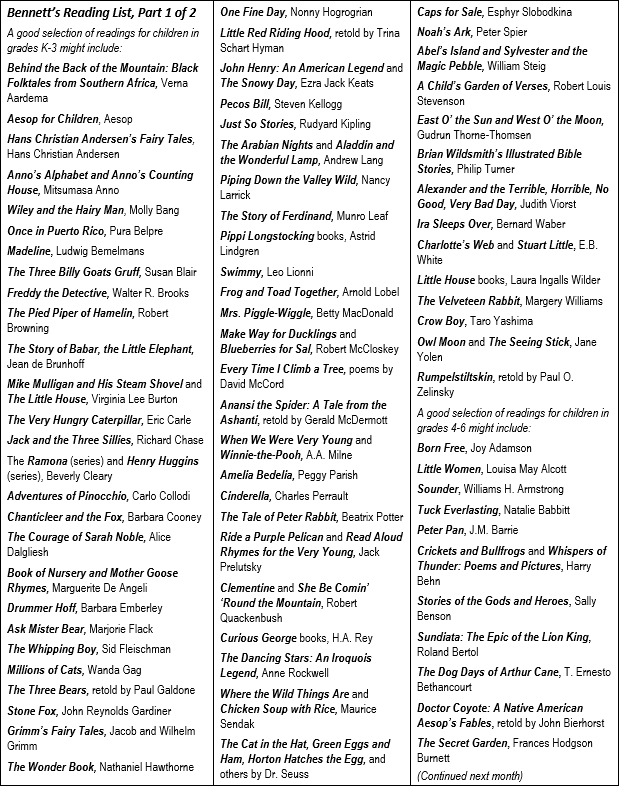
Bennett’s Reading List was included in a booklet titled James Madison Elementary School: A Curriculum for American Students, published by then-Secretary of Education, William J. Bennett, U.S. Department of Education, August 1988. It was included in the September 1988 issue of Education Reporter. This list will appear in two parts.
Additional Education Reporter suggested reading lists:
- A Child’s Reading List (February 2024)
- The Ultimate Reading List — Classics that Endure (Part 1) (March 2024)
- The Ultimate Reading List — Classics that Endure (Part 2) (April 2024)
- Children Will Love Discovering Lost Classics (May 2024)
- Bennett’s Reading List (Part 1) (June 2024)
- Bennett’s Reading List (Part 2) (July 2024)
- The Best Children’s Classics (Part 1) (August 2024)
- The Best Children’s Classics (Part 2) (September 2024)
- Recommended High School Reading List (October 2024)
NOTE: Most books on this list can be ordered online through booksellers including:
- ThriftBooks
- Amazon.com : vintage books classics
- Project Gutenberg (Free Archive, eBooks only) Choose (EPUB3 (E-readers incl. Send-to-Kindle))
> > > > Send to Kindle to upload ebooks to your Kindle device downloaded from Project Gutenberg.
Bennett’s Reading List
Click the image below to open as a (printable) PDF document
Mallard
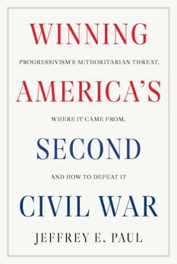
Winning America’s Second Civil War
by Dr. Jeffrey E. Paul, Encounter Books, 2023
Dr. Jeffrey Paul is currently a professor of social philosophy at West Virginia University, the latest of the influential academic positions he has held. His book explains how the liberal madness in American universities came about, chiefly at the hands of German progressives in the 19th and early 20th centuries at the universities of Europe, where the philosophies of our nation’s early higher education leaders were formed.
The American nation that took shape at the end of the Revolutionary War was unique in the history of the world, based on the belief that human beings have “a right to self-ownership,” rather than ownership by other men or by government. But as the author makes clear, there were forces trying to undermine the true spirit of the founding almost from the start.
How this came about and what can be done to transcend its adverse consequences for American political culture and institutions is the essence of this informative treatise, which this reviewer found to be one of the most critical in recent years.
America’s Founders believed human beings have natural rights pertaining to “the relationship between man and society,” but that the “larger framework was the theistic worldview shared by most colonial Americans of the time…” In other words, the Founders believed in natural rights which come from God. As such, American citizens were entitled to the fruits of their labor, and the purpose of government was to protect their God-given rights.
 This prevailing view lasted through the Civil War, when, at least theoretically, equal rights were secured for all citizens, but as Paul points out, it was then that the founding purpose of the nation began to be eroded and undermined. He shows that following the Civil War, “a counterrevolution began silently and out of public view that would, over time, set the stage for a second civil war.”
The counterrevolution began in higher education, which given the progressive ideology of colleges and universities over many decades, should come as no surprise to readers. After 1865, Paul writes, “the philosophy of natural rights — pioneered by John Locke, written into the Declaration of Independence, and reaffirmed by constitutional amendments following the Revolutionary and Civil Wars — would have seemed to be a settled statement about the fundamental relationship between the individual and the government.” But not so. “[A]cademics,” writes Paul, “became the growing enemy of this country’s founding principles, with deleterious consequences in primary and secondary education, law, the judiciary, journalism, and politics.”
Early in our nation’s history, American universities and colleges were teaching institutions rather than research institutions that awarded doctoral degrees. University and college presidents felt this situation needed to be remedied and looked to Europe, specifically Germany, where doctoral programs and degrees had been awarded for generations. Their remedy was to import into their institutions Americans who had received German doctorates to start doctoral programs, which effectively gave these Americans trained in Germany a monopoly over American higher education.
According to the author, this “monopoly” was fine for the natural sciences, engineering, and medicine (the empirical sciences), but in the humanities it proved disastrous, with the German professoriate “profoundly at odds with those [values] that animated the American Founding….”
Trained at the hands of these German professors at German universities or by Americans awarded doctorates by those institutions, the American theory of property resting on labor, “and therefore on what is conceived to be the ‘natural’ right of each man to that which he has produced” fell out of fashion and gradually became lost.
Writes Paul: “Treating academic disciplines such as political science, history, political philosophy, and sociology as if they were sciences was the equivalent of founding a department of religious studies and staffing it with theologians of one religion.” And by filling these departments with only the opponents of natural rights and simultaneously portraying their disciplines as purely empirical sciences, this is exactly what they did.
When academic leaders rejected the concept of natural rights and replaced it with the belief that there should be “no fixed moral boundaries to government powers,” it included the acquired outlook that “the highly educated were a new class entitled to formulate the rules by which the rest of society should live.”
The author contends that rights as viewed by the Founders are irreconcilable with the progressives that believe there are no individual rights but only a duty to obey [the authoritative state]. “The history of Germany in the 1930s is an indication of what can happen when the view that there are no individual rights becomes the dominant view in a society.”
The progressive (socialist) movement infected both American political parties initially, but gained complete control over the Democrat party in the New Deal of the Franklin D. Roosevelt Administration, and spread from the presidency on down to ultimately dominate the party.
Paul believes that as this irreconcilable contradiction in philosophy has played out in the 20th and 21st centuries, “we are in a very perilous position, far more than at any time in American history.” He writes that, for the most part, Americans did not see this coming, with the exception of Cornell University Professor Herbert Tuttle, an eminent German historian, who warned in 1883 that “American higher education is rapidly becoming Germanized.”
In the author’s view, the immediate peril America now faces could be addressed by the Republican party, which despite its many flaws, essentially remains the non-autocratic party. But Republicans need a key issue with which to attract a majority of voters.
Paul proposes that this overarching issue is an overhaul of America’s system of taxation, the history of which he describes in detail early in the book. In his view, and the views of expert economists with whom he has consulted, the entire system should be overturned and replaced with a universal one percent “personal sales tax” on all expenditures; not just retail sales but including those of financial markets — stocks, bonds — and encompassing virtually every purchase.
More revenue would be raised by this means, he asserts, than by the current system, and at the same time, would be very attractive to the middle class. If taken up by Republicans in a serious and focused way, he believes, it would give them a solid majority.
Winning America’s Second Civil War explains how progressive economists and academicians forced the current tax system that penalizes the middle and lower-income classes, thus encouraging dependence on government. The author warns that if the U.S. “succumbs to a one-party autocracy, it will not be by state expropriation of capital or the abolition of private enterprise. Instead, it would be the result of extracting so much income from people’s earnings that they become utterly dependent upon government provision, as well as by controlling businesses so strictly that their freedom to act depends on rules made up by federal agencies.”
While reforming the tax system is at the top of the author’s list, he also recommends in the short term, “political reforms that can impede the damage done over the past century and a half.” As an example, he recommends that “the government monopoly on public education forcibly funded by the parents should be replaced…. There are already laws now in some states that allow parents to withdraw the percentage of a public schools’ per-child tax revenue and use it to pay for their children’s education at a school of their choice. Those laws should be adopted everywhere.”
As for the universities, Paul doesn’t hold out much hope. “Change, if any,” he writes, “will have to come from the outside, beginning with the elimination of federal subsidies and grants to all universities. The taxpayers who dissent from the ideology that dominates those institutions are having their First Amendment rights traduced.”
Winning America’s Second Civil War is an absorbing study in how America arrived at its current precarious position in history, and provides a perspective that, to this reviewer, has been largely overlooked—that of the influence of the accidental monopoly of German socialist influence over higher education early on. As Paul writes: One can only hope that by recounting what happened since the first civil war, we can begin to recover universal human rights and the institutions founded to protect them.”
To read the entire book, go to Amazon.com OR ThriftBooks.com to order!
Education Briefs

According to multiple sources, including the The College Fix, a second ruling by a federal judge on June 17 has blocked in six more states President Biden’s attempt to rewrite Title IX by adding gender identity. Chief Judge Danny Reeves of the U.S. District Court, Eastern District of Kentucky’s Northern Division penned his decision by opening with the obvious fact that “there are two sexes.” This ruling covers the states of Tennessee, Kentucky, Ohio, Indiana, Virginia, and West Virginia. The plaintiffs in the case include the Christian Educators Association International and a 15-year-old girl identified by the initials A.C., who was intimidated and harassed while being forced to share a locker room with a male identifying as a female. In a previous case, a federal district court in Louisiana issued the first preliminary injunction against the Title IX rewrite covering the states of Louisiana, Mississippi, Montana, and Idaho. The Alliance Defending Freedom (ADF) brought that suit, Rapides Parish School Board v United States Department of Education, arguing before the court that: “The Biden administration’s radical redefinition of ‘sex’ will upend the equal opportunities that women and girls have enjoyed for 50 years under Title IX and will threaten their safety and privacy at every level. The court was right to halt the administration’s illegal efforts to rewrite Title IX while this critical lawsuit continues…. We are pleased the court ruled to uphold safety and privacy while this lawsuit continues.” The new Title IX rule, scheduled to go into effect on August 1st, will now be blocked in at least 10 states with lawsuits progressing in many more.

The Colorado Education Association (CEA) passed a resolution at its assembly last year declaring that “capitalism inherently exploits children, public schools, land, labor, and resources.” Fox News reported that the final version of the resolution states: “Capitalism is in opposition to fully addressing systemic racism (the school to prison pipeline), climate change, patriarchy, (gender and LGBTQ disparities), education inequality, and income inequality.” An earlier draft allegedly included somewhat softer language calling for a dismantling of capitalism to be replaced with a “new equitable economic system,” whatever that was intended to mean. The CEA represents more than 39,000 education employees in Colorado, and appears to be in lockstep with its NEA, its parent organization. NEA President Becky Pringle has declared that “education justice must be about racial justice, it must be about social justice, it must be about climate justice. It must be about all of those things…. For our students to be able to come to school ready to learn every day…. We can never think of education as an isolated system because everything connects to our students’ ability to learn…,” which sounds to many parents and observers that children are only learning far-left political ideology. One commenter to the Fox report noted: “The children are being destroyed by Marxist adults.” Another wrote: “Straight from Marx & Engels’ Communist Manifesto. As with all things liberal, the opposite is true. Communism has been tried and always fails. Capitalism has created the greatest standard of living on earth (including China’s, which uses wealth for evil). The CEA is ignorant!” In a related story, Fox reported on teachers sounding the alarm about “staff shortages, [student] behavioral problems, and social issues wreaking havoc on the education system.” While the activist unions push their radical agenda, some of the best teachers are dropping out and moving on to found micro schools and other educational options that allow them to teach actual academics.
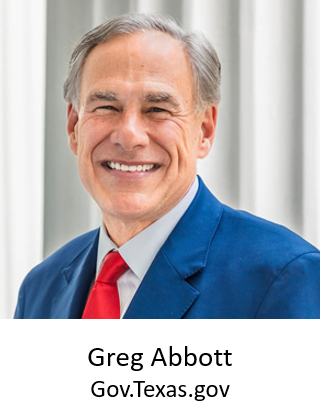
Texas appears poised to enact a substantive school choice program in 2025. The Tampa Free Press reported that Governor Greg Abbott announced he now has enough votes in the Texas legislature to pass a school choice bill given the Republican primary election results in March and a subsequent runoff election on May 28. In the March primary, “six representatives who voted against school choice in last year’s special session were defeated,” and in the May runoff election, “three other anti-school-choice representatives lost their seats.” Additionally, five more representatives who oppose school choice “wisely opted not to seek reelection,” while five pro-school-choice candidates won the races for those open seats. According to the New York Post, the Texas Senate passed Senate Bill 1, known as the Texas Education Freedom Act, “which would provide parents with an $8,000 education savings account per child to allocate to the educational provider of their choice,” but the House never voted on its version of the bill. Governor Abbott and his allies set to work exposing the GOP reps who voted against school choice and supported candidates whom they said “would put the families of their constituents first.” Their strategy was likely successful. As the Tampa Free Press wrote: “Governor Greg Abbott went to war with Texas RINOs over school choice and appears to have won.” According to supporters: “Texas is now ready to make history in 2025 by granting all of the more than 5.5 million students statewide — which comprises 10% of all K-12 students in the country — with educational freedom.”
A former Missouri state representative posted the following analysis on Facebook of why America is experiencing its current crisis in education and the culture in general; or, as the original author, Rev. T.B. McLeod put it in 1904, “the common destiny of all things godless.” As McLeod eloquently and prophetically wrote: “There can be no true religion without a lofty morality, and no more can there be a lofty morality without true religion. Christianity being thus essential to the highest national virtue, then the man who would aid in the exclusion from the schoolrooms of our land that means of instruction which gives light to the mind, rectitude to the conscience, and power to the will needs to be labored with if he is ignorant or, if not ignorant, ought to be resisted as the enemy of free government and of the human race. It is the duty of the state not simply to tolerate or sanction, but to make religious instruction one of the prime factors in its system of popular education. If a sound morality is an essential condition of national safety and prosperity and if the sublime teaching and temper of Christianity essential to the development of the finest virtues in social and public life, then the policy which dissociates religion from education, which puts secular knowledge above morality and religion, which rules in geology and rules out Genesis, rules in science and rules out the Bible, which rules in evolution and rules out God, rules in Herbert Spencer, rules out Jesus Christ, is suicidal policy which, if persisted in, must eventually provoke the common destiny of all things godless. As a nation we cannot hope to escape the dire consequences of the present policy. Things may go on for a time in a somewhat orderly fashion. Our contemporaries may not feel it much. It may take some time to make a full-blooded atheist out of a scion of twenty generations of Christians. Our schools may go on for a time, though their origin be disavowed. But sooner or later their character will be stamped with irreligion and irreligion when complete will bring forth death.” (Thanks to Mr. W. E. Freeland for permission to use the 1904 files of the Taney County Republican.)
American Education Needs a Pro-Parent Overhaul
Originally published by Newsweek.com, April 16, 2024. Reprinted by permission.
With millions of families fleeing public schools in recent years and millions more set to join the exodus in the years ahead, the debate around public education is shifting dramatically. That is bad news for the education establishment. But it can be great news for children—and the country.
While Americans once argued about how best to fix the system, today’s discussions—especially among conservatives and Christians—often revolve around finding the fastest way to get children out. Almost two-thirds of Americans are dissatisfied with the quality of public education. Even liberals are rapidly losing trust in the schools.
The reasons for this trend are not hard to see. On academics alone, the system is a dumpster fire. The federal government’s own National Assessment of Educational Progress shows only about one in three students are “proficient” in core subjects.
But the academic disaster is just the tip of the iceberg.
One in ten students have encountered sexual misconduct by a faculty member, U.S. Department of Education research shows. Violence and crime in school are exploding. Highly sexualized books and lessons have outraged even the most tolerant parents. And suicide, once unthinkable among young people, is now a leading cause of death in children.
Public schools have become, in effect, burning buildings. As children suffer academically and in countless other ways, millions of parents are frantically trying to figure out how to protect their young.
The multi-billion-dollar question, then, is what should be done?
For generations, educational “reformers” have sought to “fix” the system. Countless activist hours and untold billions of dollars have been expended on so-called solutions. Yet, as any parent or teacher will tell you, schools just keep getting worse. Clearly, protesting at school board meetings has not worked.
But what if the system is not actually broken? What if it is doing exactly what the people running it want—turning young Americans against their faith, family, and freedoms? If the diagnoses have all been wrong so far, the treatments must be re-considered as well.
In fact, the individuals who dreamed up and created the current system—from Horace Mann and John Dewey to today’s left-wing “reformers”—had a very different view of education than everyday Americans. They saw the system as a tool for social change.
Even if those who established and ran the system wanted well-educated Americans, the model is flawed. Like collective farming in the Soviet Union, history has shown repeatedly that government does a poor job at just about everything.
The solution to failed communal farms was not “reform.” Instead, it was to restore proper incentives that increase quality, decrease costs, and multiply choices. Only a free-market approach led by parents and voluntary organizations can do this.
The idea is hardly as radical as it may seem at first glance. For centuries in America, families and churches were almost entirely responsible for education. That approach produced the most literate, moral, and educated population in history. America’s Founding Fathers were products of this non-system.
Powerful voices are increasingly calling for radical change. Multiple times before he passed, talk-radio titan Rush Limbaugh urged parents to remove their children from public schools. Amid New Jersey’s push for LGBT programming in schools, Franklin Graham, the nation’s most prominent evangelical, said he would send his children to a Christian school.
In academia, a chorus seeking real change is growing as well. Columbia Law Professor Philip Hamburger argues that public schools threaten parents’ First Amendment rights. The reason: they improperly pressure parents into substituting government speech for their own in raising children.
Top government officials have made similar arguments. Former U.S. Attorney General Bill Barr says the escalating hostility to faith and values of parents—the vast majority of whom identify as Christian—makes the system unconstitutional. In a 2021 speech, he called the “militant and extreme secular-progressive climate of our state-run education system” the “greatest threat to religious liberty in America today.”
Countless church and state leaders have come to similar conclusions. That is why more and more states including powerhouses such as Florida and Texas are moving toward “school choice.” Under this system, government provides tax money for homeschooling or private schools.
To the extent that this policy removes children from government schools, it may be helpful for some. But as experience demonstrates, government regulation and control always follow funding. “Choice” programs risk sucking families back into the system they fled. Parents must draw the line and say: My child is not your activist.
It is time to revisit what worked in the past. Parents, not government, should be responsible for the education of their children, just like they are responsible for feeding and clothing them. If they need help, churches, non-profit organizations, extended families, and communities can fill the void.
It will take time—perhaps generations. But this should be the long-term goal. It will bring down costs, increase quality, and end increasingly bitter feuds taking place in America as parents choose education options that work for their families.
Establishment figures are sounding the alarm about this threat to their fiefdom. American Federation of Teachers boss Randi Weingarten accused Republican leaders like Florida Gov. Ron DeSantis of seeking “complete destabilization of public education so parents will choose private schools.”
The system was in crisis long before DeSantis. Outside-the-box thinking is needed now more than ever. Instead of tinkering around the edges, it is time for more systemic changes to fix this obviously systemic problem—a crisis threatening to tear America apart.
The future of the nation and its children is at stake. This problem must be addressed with the care and thoughtfulness it deserves. Ultimately, solutions will not come from politicians. Parents who love their children must step up and lead the way.
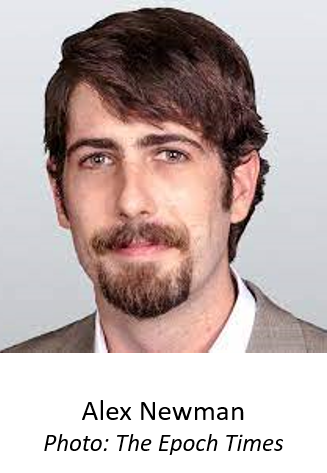
Alex Newman is an award-winning international journalist who taught high school for over a decade. His latest book, Indoctrinating Our Children to Death, has been endorsed by top leaders in education, media, ministry, military, and more. He also serves as volunteer executive director of Public School Exit.
Education Related Links