Supreme Court to Weigh in on Transgender Madness
As transgender activism continues to ratchet up across the country, the U.S. Supreme Court is preparing to weigh in on a Tennessee law that prohibits puberty blockers, cross-sex hormones, and sex reassignment surgeries for minors. The question before the court is whether the law, SB1, violates the Equal Protection Clause of the 14th Amendment to the U.S. Constitution, and the outcome could have a profound impact on similar laws or policies in progress or already on the books in 26 states.
Ratified in 1868, the Equal Protection Clause was intended to prevent post-Civil War discrimination against African Americans. But as the Constitution Center points out, “the text of the Clause is worded very broadly and it has come a long way from its original purpose.”
Nonetheless, the Washington Examiner observed that, during oral arguments on December 4, there appeared to be “enough justices on the nine-member court who seemed skeptical of the Biden Administration’s contention that Tennessee’s law marked a violation of the 14th Amendment’s equal protection clause.”
The lawsuit was originally filed against Tennessee Attorney General Jonathan Skrmetti and others by the ACLU and several law firms claiming to represent “families with transgender adolescents.” In September 2023, Reuters reported that the U.S. Court of Appeals for the 6th Circuit found that Tennessee and Kentucky “could enforce laws banning gender-affirming medical care for minors, such as puberty blockers, hormones and surgery.” The Biden Justice Department then intervened in the case, “asking the Supreme Court to take up the dispute.”
Last July, the same Appeals Court for the 6th Circuit upheld a Tennessee policy prohibiting citizens from changing their sex on their birth certificates. As reported by The Tennessean, the court ruled that “there is no fundamental right to a birth certificate recording gender identity instead of biological sex,” and called the policy, “a nondiscriminatory form of government speech embraced by some States about an undeniable historical fact.”
More than ‘The Dirty Dozen’
Over the past several years, many experts have sounded the alarm about the physical and emotional destructiveness of transgender medical interventions. For example, practicing child and adolescent psychiatrist and author, Dr. Miriam Grossman, told The Washington Stand that such “experimental” procedures “have proliferated, in part because of money, but also because the American Academy of Pediatrics and the American Psychiatric Association for many years have been taken over by a small group of activists who simply push their agendas forward and stifle debate. And too many of my colleagues are simply spineless and not willing to speak up against it.”
Do No Harm’s list of the 12 worst-offending children’s hospitals promoting sex change treatments for minors.
- The Children’s Hospital of Philadelphia, PA
- Connecticut Children’s Medical Center, Hartford, CT
- Children’s Minnesota, Minneapolis
- Seattle Children’s, WA
- Children’s Hospital Los Angeles, CA
- Boston Children’s Hospital, MA
- Rady Children’s Hospital, San Diego, CA
- Children’s National Medical Center, Washington, DC
- UCSF Benioff Children’s Hospital Oakland, CA
- Children’s Hospital Colorado, Aurora, CO
- UPMC Children’s Hospital of Pittsburgh, PA
- Cincinnati Children’s Hospital Medical Center, OH
Grossman was referring to the recently released Stop The Harm Database, compiled by the non-profit health advocacy organization Do No Harm. The data shows that nearly 14,000 minors underwent “transgender surgeries, puberty blockers, or cross-sex hormone injections between 2019 and 2023, generating nearly $120 million in revenue.” (The October Education Reporter briefly described this data.)
Do No Harm’s Data-Gathering-and-Analysis-Methodology further showed that 5,747 minor patients underwent sex-change surgeries and, 8,579 received cross-sex hormones and puberty blockers during the four-year time frame. As chairman Dr. Stanley Goldfarb explained in National Review: “We’ve really been meticulous in trying to make sure that the data are as clear as possible and are as accurate as possible.”
The database lists what Do No Harm calls “The Dirty Dozen Hospitals, or the worst-offending children’s hospitals promoting sex change treatments for minors.” (See sidebar for the list.) But it is important to note that these institutions are not the only ones harming kids. Approximately 225 hospitals nationwide, including some religious-affiliated hospitals, have been found by Do No Harm to be performing transgender procedures.
The database shows that from 2019-2023, “170 children were subjected to ‘transgender’ surgeries and 508 children were prescribed cross-sex hormone or puberty blocker drugs at various Catholic hospitals in the nation.” The organization CatholicVote.org posted a response to these findings by a spokesperson for the U.S. Conference of Catholic Bishops (USCCB). The response reiterated church teaching “about the inherent dignity of each person as created in the image and likeness of God,” and restated that the bishops “have been clear as to what’s morally acceptable when it comes to procedures or interventions related to ‘gender transition.’”
Bishop Robert Barron of the Winona-Rochester, Minnesota diocese, which had no reported violations of USCCB policy at its Catholic hospitals, was more direct. “The surgical mutilation and chemical castration of young kids under the rubric of ‘gender-affirming care’ is a moral outrage,” the bishop wrote in an email to CatholicVote. “That any of it takes place within the confines of a Catholic hospital is appalling.”
CatholicVote’s Accountability Project director, Tommy Valentine, said: “I know a lot of people in and around Catholic healthcare, and it’s clear that most of our Catholic hospitals provide care that respects human dignity. But a minority of them have lost the plot…. We’re all on the same team here, including the bishops, and we need to work together to prevent this madness from ever happening again within our hospitals.”
Unfortunately, many Catholic hospitals operate outside the auspices of the dioceses in which they are located, and “have their own boards of directors that oversee them.” While they are expected to follow church teaching, this obviously does not always happen in practice, and some observers believe transgender activists find ways to advance their agenda while keeping a low-profile. (See Education Reporter, August 2024.) It should perhaps be no surprise that the highest number of procedures that took place in Catholic hospitals were located in either blue or purple states, including “Oregon, California, Washington, New Mexico, New York, Wisconsin, Minnesota, Pennsylvania, and Virginia.”
Serious concerns
The release of Do No Harm’s data prompted a response from the American Society of Plastic Surgeons (ASPS). Manhattan Institute Fellow, Leor Sapir, Ph.D., posted an email on X from ASPS, which reads in part:
- ASPS has not endorsed any organization’s practices recommendations for the treatment of adolescents with gender dysphoria. ASPS currently understands that there is considerable uncertainty as to the long-term efficacy for the use of chest and genital surgical interventions for the treatment of adolescents with gender dysphoria, and the existing evidence base is viewed as low quality/low certainty. This patient population requires specific considerations.
The email further acknowledges that “plastic surgeons have a responsibility to provide comprehensive patient education and maintain a robust and evidence-based informed consent process, so patients and their families can set realistic expectations in the shared decision-making process.”
Do No Harm’s external relations manager and registered nurse, Beth Serio, told the The Daily Signal News Foundation (DCNF): “Its a common lie in the trans industry in America that these procedures are very highly reversible, that there’s no long-term effects. We know that’s simply not the case….”
She added that so-called “’gender-affirming surgery’ is significantly associated with elevated suicide-attempt risks, underlining the necessity for comprehensive post-procedure psychiatric support.” She further explained that many children suffering from gender dysphoria “have comorbidities with different mental health illnesses, and we know that medicalizing does not decrease the incidence of mental health problems. Instead, it increases, typically, the mental health problems that they have…. So, we really have to ask ourselves: ‘Why are we doing it?’”
Of course, there is no replacing the healthy body parts that have been removed from troubled young patients, which has resulted in a burgeoning number of desperate detransitioners whose lives have been permanently ruined by tragic and unnecessary procedures.
Biden-Harris influence
The Biden-Harris Administration has done its part to further the transgender agenda by enabling unelected bureaucrats to take gender-confused children from their “non-affirming” parents through a new federal rule. Inspired by Alex Roque, head of the Ali Forney Center for homeless LGBT kids in New York City, and a social services program in Cuyahoga County, Ohio, the new HHS rule instructs states to place foster children identifying as LGBT “in [gender] affirming homes.”
According to the DCNF, Roque appeared in a U.S. Department of Health and Human Services (HHS) webinar last year, where he stated: “Family rejection of a child’s gender identity cannot be dismissed as a personal view. Non-affirmation must be treated as abuse. If they were denying them food or denying them access to school or denying other things, there would be prosecution.” The DCNF opined that Roque’s opinions “cast a vision for completely transforming child protective systems nationwide.”
The Cuyahoga County program helped seal the deal. DCNF reviewed hundreds of documents and emails obtained through FOIA requests, and found that the program “strong arms parents into affirming whatever confused beliefs children express about their gender. Parents who decline risk losing a voice in their child’s life.” The program, which uses federal grants provided by HHS, proved “an ideal model for infusing gender ideology into foster care and social services.”
The final rule is scheduled for implementation by October 2026. While it specifies children in foster care, Rachel Morrison, director of the HHS Accountability Project for the Ethics and Public Policy Center (EPPC), called it “a dangerous premise [that] could extend outside the foster care context to adoption, custody disputes, and schools.”
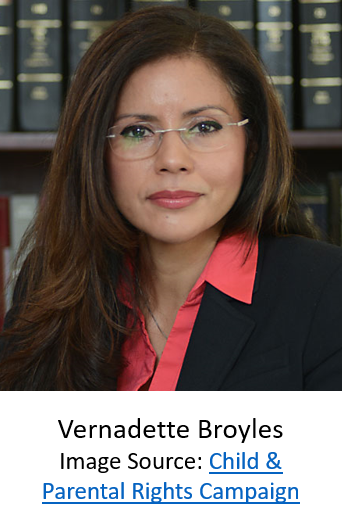
Many observers say this is already happening, and that stories of children being taken from parents who resist affirming their child’s wishes are surfacing nationwide. Vernadette Broyles, president and general counsel of the The Child and Parental Rights Campaign, confirms that more families are being “investigated or disrupted” because they believe in “biological reality.”
In a video interview with Washington Watch, Broyles said her organization is currently representing six families whose children expressed “gender confusion” and who are in danger of being removed from their homes by overzealous school and child protective services activists. “Immediately [when a child expresses an interest in becoming the opposite sex],” Broyles said, “school officials begin to affirm and endorse this imagined identity, hide it from the parents, lie to the parents [and ignore] the objections of the parents, and then continue to socially transition the child.”
Broyles warned that the Biden Administration’s rule “creates an assumption that parents who have a scientific or religious belief that there are two genders are emotionally abusive — or worse, failing to provide for their child’s needs.”
Supreme Court to rule next year
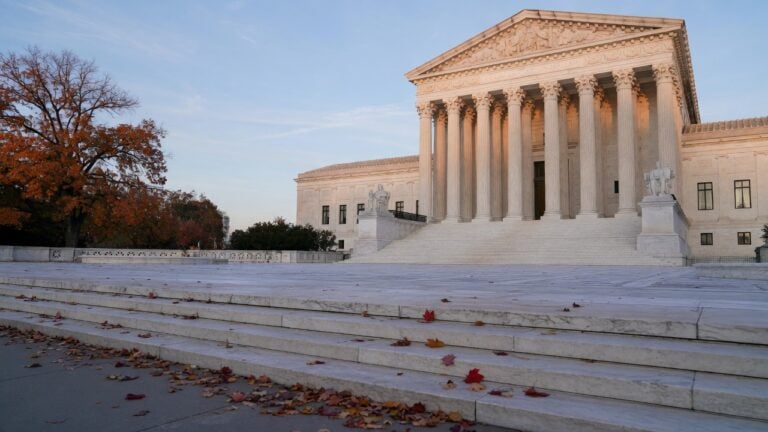
During the December 4 oral arguments in United States v. Skrmetti, both pro-transgender activists and supporters of the Tennessee law rallied outside the Supreme Court. Do No Harm hosted a “Stop the Harm” Rally on the court steps, which organizers say “was an enormous success, even going viral on social media….” Supporters gathered to hear speakers that included producer, writer, and activist Matt Walsh, detransitioner and Do No Harm patient advocate, Chloe Cole, Tennessee lawmakers who sponsored their state’s pro-child law, and other prominent pro SB 1 voices.
Walsh later posted on X that Justice Samuel Alito cited “the Cass Report, a nearly 400-page report that examined ‘gender identity services for children and young people’ in the United Kingdom.” Walsh wrote: “Alito pulled up Page 195 of the Cass report, showing that child sex-changes don’t actually prevent suicide.” ACLU attorney Chase Strangio admits in response that there’s “no evidence that these procedures actually reduce suicides.”
A decision in the case is expected to be announced by late June or early July 2025.
Battle Lines Drawn: Transgender Ideology vs. Common Sense, Biology
Even as the U.S. Supreme Court agreed to review Tennessee SB 1, described in Supreme Court to Weigh in on Transgender Madness, the high court let stand a ruling by the 7th U.S. District Court of Appeals in Wisconsin that allows schools to secretly encourage children’s gender dysphoria.
The suit was brought by parents in the Eau Claire, Wisconsin, School District (Parents Protecting Our Children, UA v. Eau Claire Area Sch. Dist., Wis.), who asserted that the school district’s 2021 policy on transgender issues “directly harms [parent-child] relationships by communicating to minor students that secrets from their parents—including an entire double life at school—are not only acceptable, but will be facilitated by the District upon request.”
In a December 9 article, WorldNetDaily’s Bob Unruh explained that the district court claimed “parental rights were not affected when schools secretly encouraged children to be transgender, so the parents had no standing to bring the case.”
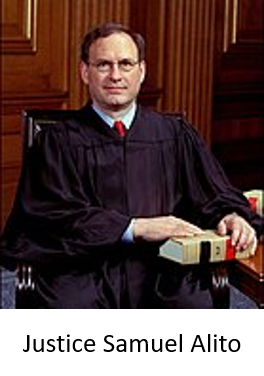
Three justices, Alito, Kavanaugh, and Thomas, disagreed, saying they would have granted the petition because “it’s an issue that is coming up more and more.” CNN reported that the court “didn’t say why it declined to hear the case,” but noted the lower court’s ruling that the parents “didn’t have standing to sue since they didn’t demonstrate the policy affected their children.”
According to Unruh, Justice Alito said:
- This case presents a question of great and growing national importance: whether a public-school district violates parents’ fundamental constitutional right to make decisions concerning the rearing of their children…when, without parental knowledge or consent, it encourages a student to transition to a new gender or assists in that process.
Justice Thomas added “We are told that more than 1,000 districts have adopted such policies.”
Alito further pointed out that the Eau Claire policy is accompanied by “equity training” which encourages teachers and other school personnel “to keep parents in the dark about the ‘identities’ of their children, especially if the school believes the parents would not support what the school thinks is appropriate. Thus, the parents’ fear that the school district might make decisions for their children without their knowledge and consent is not ‘speculative.’”
Americans disagree with trans agenda
One of the issues that contributed to President-elect Donald Trump’s impressive victory in November is the radical transgender movement, which the Biden Administration has relentlessly pushed for four years. Voters indicated through election-related polling that they hope the new administration will put the brakes on this agenda. In one example, a Napolitan News Service poll showed that, despite Democrats’ vigorous transgender partisanship, including support for biological men competing in women’s sports, just 13 percent of all voters, including Democrat voters, agree with them.
The Napolitan survey also found that 72 percent of voters think it should be “against the law to provide children under 18 with puberty blockers, drugs, and/or surgery to help them transition from one gender to another.” A significant majority, 71 percent, said schools should not teach children about gender identity, and 95 percent believe such topics should be off limits for children in 3rd grade and younger. [Emphasis added.]
Clearly, a majority of Americans disagree with the transgender ideology currently dominating our culture and being taught in schools. Most parents don’t want school personnel to pursue transitioning their kids without their knowledge or consent and, in general, most Americans are opposed to the transgender procedures performed on minors as a result of such grooming.
International influence
Nevertheless, the transgender juggernaut rolls on. Last month, Education Reporter noted that a proposed new rule in the State of Oregon, which takes effect in January 2025, will force both public and private insurance companies to cover transgender surgeries and cross-sex hormones “for all ages.” The law will impose penalties, including loss of license, on those who resist.
The rule is based on Standards of Care for the Health of Transgender and Gender Diverse People, a guidance developed and funded by the World Professional Association for Transgender Health. This international non-profit organization promotes “its world vision that people of all gender identities and gender expressions have access to evidence-based healthcare, social services, justice, equality, and respect,” and dedicates itself to the oft-repeated leftist litany of “diversity, equity, and inclusion.” Although not the only state with such a policy, Oregon is the first to base it on WPATH guidelines.
The good news is that, as The Washington Free Beacon noted last month, WPATH and its guidelines “face mounting scrutiny,” and the organization is “increasingly seen as putting activism over medical credibility.” Despite its influence, “even mainstream outlets like The Economist have reported on the group’s alleged research manipulation.”
The Beacon added that “internal emails released in court filings show WPATH also suppressed its own commissioned research about transitioning minors when it failed to show promised benefits.” And it’s no surprise that, when pressured by the Biden Administration, “the group lifted age limits from its standards of care.”
One year ago, an article on the website “Reality’s Last Stand,” accused the World Health Organization (WHO) of squandering an opportunity to create “a reliable international guideline, especially considering the increasing global scrutiny of the affirming care model endorsed by WPATH. In several countries, notably the United States,” the web article noted, “this debate has become entangled in partisan politics. Ideally, an international organization like the WHO would help steer this debate towards evidence-based medicine.”
Unfortunately, the WHO’s guideline development group “blatantly violates” its own mandate that group members be free of conflicts of interest. The “Reality” article shows that “published biographies of 14 out of 21 members reveal clear and significant financial and non-financial conflicts of interest, and there may be undisclosed conflicts as well … The group includes three former WPATH presidents,” two of whom contributed to the most recent versions of WPATH’s “Standards of Care.”
The article offers little hope that the WHO will do anything to establish sensible guidelines for dealing with transgender care issues, but it does note that “Finland, Sweden, Denmark, and Norway have all abandoned the WPATH Standard of Care.” (Since the article was posted, the U.K. issued the Cass Review report, cited in Education Reporter’s previous article, which confirmed a shift there similar to that of the Nordic countries. — Ed.)
UN gender treaty a threat
On December 9, vice president for legal studies at the Center for Family and Human Rights (C-Fam), Stefano Gennarini warned in The Federalist that outgoing President Joe Biden has “agreed to advance a new United Nations treaty that weaponizes international criminal law against opposition to transgender policy.” This treaty penalizes politicians who deliberately “’misgender’ someone or advocate for female-only private spaces” by finding them “guilty of gender-based persecution, a crime against humanity.”
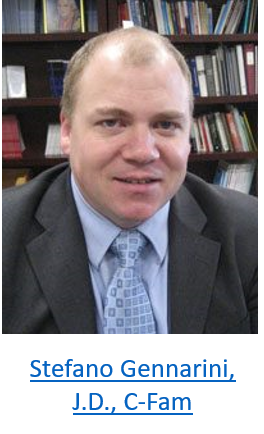
Last month, the UN General Assembly agreed to a timeline of 2029 for finalizing the treaty, which will “enshrine an open definition of gender in international criminal law,” effectively replacing the Rome Statute that accurately defines gender as “the two sexes, male and female, within the context of society.”
Gennarini explains that the Rome Statute “was a hard-fought definition to clarify the meaning of ‘gender persecution,’” a new category of crime invented when the International Criminal Court (ICC) was formed in 1998. He credits “the work of pro-life nongovernmental organizations in collaboration with the Holy See and other delegations” for pushing the Rome Statute through “during many months of negotiations.”
But as conservatives, pro-lifers, and believers in sound science may imagine, this common-sense definition of gender has been a thorn in the side of leftists and LGBT activists, both within and without the UN. “Western countries have been trying to get rid of it,” Gennarini writes. “Now they are closer than ever to achieving their goal with a treaty that, unlike the Rome Statute, is expected to be ratified by the U.S. government.”
The treaty poses an obvious threat to free speech and religious freedom, both in the U.S. and internationally. Gennarini further cautions that “Western leftists want the crime of gender persecution to include things such as denying children cross-sex hormones and surgeries, not recognizing same-sex marriage or adoption, laws against LGBT propaganda in schools, women-only sports, and even denial of abortion. This is not a conspiracy theory. It is already being done by the prosecutors of the (ICC).”
While incoming President Donald Trump is likely to reverse U.S. support for the treaty, Gennarini reasons that, given its extended timeline for final adoption, “a Democrat may be in the White House by 2029.” He recommends that President Trump “simultaneously signal that the United States will not be a part of this dangerous new gender treaty, as well as engage aggressively in negotiations to sanitize the treaty as if he expects the next U.S. president to sign it.”
The new administration should also take advantage of the majority of citizens who voted to stem the tide of transgender madness, and who are rooting for a favorable decision in the Tennessee case, by encouraging them to contact their congressional representatives and ask that they cut off funding “to organizations and multilateral programs” that lobbied for the removal of the Rome Statute at the UN.
America First Legal Puts Parents First
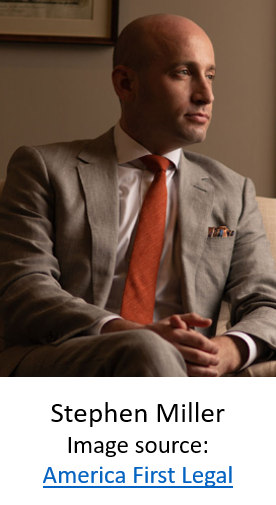
Founded in March 2021, America First Legal (AFL) serves as a sentinel for conservative parents and citizens. Headed by senior members of the first Trump Administration, including former senior advisor to the president, Stephen Miller, and former counselor to the U.S. Attorney General, Gene Hamilton, the group explains on X that its purpose is “to fight for the American people and advance the rule of law….”
Last month, AFL released its “Parents’ Rights Toolkit” for use as a bulwark against woke educators from kindergarten through the university level. A November 21 press release stated that, in addition to helping families protect their children, the kit is intended to “provide the incoming Trump Administration with a roadmap for action against woke leftist teachers and education industry bureaucrats.”
The toolkit includes templates for filing complaints with the U.S. Department of Education for violations of various federal statutes, such as discrimination on the basis of skin color, race, or ethnicity (Title VI), sex discrimination (Title IX), and the Protection of Pupil Rights Amendment (PPRA), which AFL contends is “one important but little used tool for holding administrators and teachers accountable.”
The group described the scope of Title VI, Title IX and the PPRA in a press release, noting that the latter also requires schools to have “prior parental consent to ask children questions” about a variety of matters, including:
- Political beliefs or affiliations
- Mental problems or challenges
- Sexual behavior or attitudes
- Illegal, antisocial, self-incriminating, or demeaning behavior
- Critical appraisals of people with close family relationships
- Relationships with lawyers, physicians, and ministers
- Religious beliefs or practices
- Income level (unless it’s asked simply regarding eligibility to participate in a program)
AFL further relates that if any surveys are administered to students “by an outside entity” (i.e., other than the school), parents have the right to review the survey first, along with any accompanying supplemental materials such as teachers’ manuals. The press release cautions, however, that schools are not required to provide copies of surveys or materials related to gender and race, although parents are entitled to review all such materials. Rather, the parents must first request to do so.
The press release concludes with a statement from AFL’s senior advisor, Ian Prior, which reads in part:
- For the past four years, public schools have been indoctrinating children with radical racist, anti-Semitic, and transgender ideologies. As these schools have blatantly violated civil rights law, the Biden Administration worked hand in glove to federalize these illegal practices. That ends in 2025…. The America First Legal Parental Rights Toolkit empowers parents to assist the federal government in identifying where the law is being broken so that we can turn our failing education system around.
What others are saying
After giving an accurate report on the toolkit, which included quotes from AFL leaders, Fox News opined that its release “comes amid a conservative wave of pushback against DEI policies.” Fox then quoted Texas Democrat Rep. Jasmine Crockett, who asserted that “diversity works,” during a House Oversight Committee hearing on the “Dismantle DEI Act” currently before Congress. She added: “We need to go back to being a country that listens to experts and gets out of our feelings and recognizes again that racism is real in this country, and until we stop pretending that it’s not, we will not solve the problems that we are consistently facing.” It’s unclear from the report who exactly these “experts” are to whom Crockett was referring.

Charlie Kirk’s Turning Point USA (TPUSA) stated online: “AFL intends for the toolkit to be used by parents as the Trump administration prepares to take office and likely implement federal reforms within the Department of Education.”
Conservative online news platform, The Daily Beat, also weighed in on AFL’s enterprise, stating:
- The activism around the “Parents’ Rights Toolkit” aligns with broader conservative educational goals, such as enhancing school choice and maintaining academic excellence. Conservatives argue that empowering parents and increasing transparency in school performance are integral to achieving these goals. The promotion of educational choice, through school choice and education savings accounts, remains pivotal.
The Beat added that “key objectives” of the AFL initiative also include promoting “programs like Advanced Placement and International Baccalaureate, while advocating for teacher compensation based on performance.” These measures, they conclude, “are part of a concerted effort to confront self-serving systems and promote excellence.”
Part of the ‘Great Unbundling’?
The Daily Beat contends that “the AFL toolkit is synchronized with the ‘Great Unbundling,’” a relatively new term used to describe the growing trend in which parents “actively customize their children’s education by choosing individual components.”
A report on abc 15 News Arizona put it this way:
- As parents demand more flexibility in post-pandemic K-12 education, there is a proliferation of options like online schools, microschools, homeschool pods with tutors, outdoor schools, or other parent-directed, á la carte education programs…. Some researchers call it the “great unbundling” of education as parents opt out of traditional school models so they can individualize learning opportunities specifically for their children.
An article on this topic by Education Next cited reasons for the trend as including “widespread parent anxiety, frustration, or desperation over their child’s schooling,” more parents working from home and therefore present during the school day, a more willing acceptance of online schooling since the pandemic, more households locating in rural areas, etc.
The bottom line: As more educational options become available, and more influential parents’ rights organizations, including AFL, Moms for Liberty, Moms for America, and many others, actively engage, parents may actually begin to turn the tide against the teachers’ unions, public bureaucracies, and the establishment status quo. Add to this mix a more parent- and liberty- friendly new Trump Administration, and there may at last be light at the end of an otherwise increasingly dark education tunnel.
Gen Z: A Generation Shortchanged
Information and statistics are mounting about Generation Z (Gen Z; also called Zoomers), people born between 1997 and 2012, and the overall picture isn’t pretty. What’s emerging is that the most recent generation to reach adulthood (with the youngest members about to enter their teens) is not only the most catered to and over-protected, but also the most lacking in basic academic skills, knowledge of our country’s founding, and the great legacy of Western civilization.
Recently, the Cardinal Mindszenty Foundation, an international non-profit organization founded in 1958 to oppose Communism and socialist ideologies while supporting the rule of law, constitutional government, and the authentic teachings of the Catholic Church, delved into the topic of Gen Z. The foundation shared its troubling discoveries in its November 2024 Mindszenty Report.
Of the Gen Z-ers who have entered the workplace, many have already blacklisted themselves by voicing high expectations for salaries and promotions while offering little in the way of knowledge and work ethic. Describing the Gen Z population in general as “hypersensitive, poorly educated, highly polarized,” the report writers asked rhetorically how this might be explained, then responded:
- Numerous studies provide the answers—including “helicopter” parenting, social media, and educational institutions that tell them they are all exceptional people. When they enter the workplace and encounter inevitable criticism, they overreact personally. One consequence is that many employers are trying to avoid hiring Gen Zers.
The report cites a 2023 study which is no longer available online but which showed that “40 percent of business leaders believe recent college graduates were unprepared for the workplace.” The study was conducted by TechSpot and polled 1,243 employers. The general consensus was that these business leaders were reluctant to hire Gen Zers because, “as a group they lack a strong work ethic, communication skills, and preparedness to handle the technological tasks needed in a modern office.”
Some employers said recent grads were demanding starting salaries of $100,000 per year when the going rate for such jobs was $70,000. Many found that their new hires proved difficult to work with, lacked motivation, and “were unwilling to put in the effort to succeed at the job.”
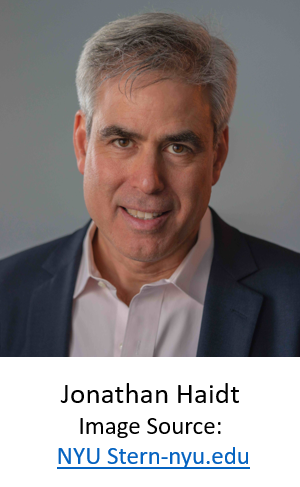
Perhaps the most sobering characteristic of Gen Zers is their hypersensitivity, which many experts believe stems from their relationship to technology and their affinity for and dependence on social media. The Mindszenty Report notes: “Psychologists such as Jonathan Haidt maintain that social media have stunted this generation’s social development and have contributed to increasing rates of suicide and mental illness.”
Dr. Haidt believes widespread use of smartphones and tablets has contributed to negative childhood and adolescent mental health, which can continue into adulthood. In an interview on ABC listen’s Conversations podcast, Haidt said: “More governments, including the United States Congress, should follow Australia’s lead and mandate that 16 be the minimum age for accessing social media.” He was referring to a recently enacted social media minimum age law, which cracks down on use of these apps by Australian youth under age 16.
He added: “We have minimum ages for about four reasons: graphic sex, extreme violence, addiction, and physical danger, but once your kid gets a smartphone [and] social media, they’ve got all four … this is insanity. We have over-protected our children in the real world and under-protected them online.”
Gen Zers, who have become “especially attuned to feelings of their peers acting through social media,” have also become more removed from actual social interactions. “They fear being canceled or doxxed by their peers,” psychologists say, “yet do not hesitate to attack or make fun of a peer they only know online. Thus, Gen Zers experience high rates of anxiety and depression.”
Impact of education
But Gen Zers’ problems stem from more than over-indulgent parents and relentless exposure to social media. As regular readers of Education Reporter know, many excellent books have outlined the dangers to young minds posed by indoctrination and brainwashing in American schools, particularly the colleges and universities. A few examples include: The Marxification of Education, by James Lindsay, which demonstrates the enormous influence of the Brazilian Marxist Paulo Freire, who believed education must focus on political activism rather than academics. Freire’s philosophy distorts traditional education for an emphasis on ideology-based ideas, feelings, and attitudes, all of which are present to some degree in American classrooms.
The book, Brutal Minds: The Dark World of Left-Wing Brainwashing in our Universities, by Stanley K. Ridgley, Ph.D. is another excellent revelation of how both Millennials and Gen Zers have developed. Ridgeley explains that “brutal minds” are distributed all over college campuses, and that their far-left ideology is “embedded in their policies and programs,” which operate under the vague umbrella of “student development.” Almost without exception, he contends, these policies “constitute unauthorized psychotherapy sessions conducted quite often by unlicensed personnel under false pretenses.”
Finally, Mark R. Levin’s eye-opening book, American Marxism, sheds further light on how our youngest generations have been shortchanged and deluded by the education system. Levin writes that our youth have been indoctrinated to “have a passion for justice” in the Marxist sense of the term. They have successfully been convinced that their country is full of “structural inequalities,” and is “interminably dissolute, unjust, and immoral. There can be no justice or improvement,” they say, because “the entire enterprise was irredeemable from the start, and nothing since has or can significantly improve the society.”
Equity grading and inflated grades
In addition to all of the above, the practice of “equity grading,” is becoming more popular at all levels of education. The Mindszenty Report describes this as a practice that “prohibits teachers from giving students bad grades for late assignments, cheating or failing to turn in assignments,” and points out that, rather than helping students, “grade inflation actually decreases student learning.” (Also see Education Reporter, August 2024.)
As Mindszenty further notes: “If grade inflation has been on the rise in K-12 schools, it is on jet fuel in American universities. The average college GPA increased from 2.81 in 1990 to 3.15 in 2020, a 12 percent rise. The median college GPA increased even more, by 21.5 percent.” To the obvious question, are students getting smarter, Mindszenty writers reply with an emphatic “No.”
But grade inflation is a benefit to universities intent on retaining current students and attracting new ones. College “success counselors,” writes Mindszenty, “are the new buzzwords….” They are there for any student with poor grades, whether he or she attends in-person or online, and are inclined to attribute bad grades to factors other than poor performance, such as “time management, family problems, not knowing how to study, or whatever.”
The end result is that American education is shortchanging students. Mindszenty observes that not only are students failing to learn the basics of critical subjects such as civics, but that “a long-term decline in math, quantitative, and science skills is becoming a threat to national security. American students’ test scores in math are dropping, as is enrollment in STEM majors (science, technology, engineering and math).”
So, what are American parents and concerned citizens to do? “Cultural change begins in the grassroots,” states Mindszenty, “and it has begun, with more conservative parents running for local school boards and taking advantage of expanding school choice options and homeschooling…. These are good signs. But the fight for our children has just begun.”
Mallard

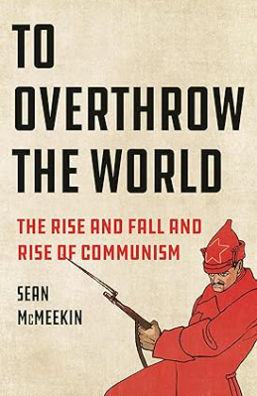
To Overthrow the World: The Rise and Fall and Rise of Communism
by Sean McMeekin, Basic Books, 2024
Reviewed by: Mason Mohon, Sr., Asst. Director of Archives & Research, Phyllis Schlafly Eagles
The commodification of political ideology is a distasteful phenomenon of the Internet age. Ideologies are embraced and discarded like pairs of shoes. They are status symbols in an online game, disconnected from reality. This is especially egregious with Communism. When online users throw on the garb of Communism, Socialism, Stalinism, Maoism, etc., they erase the real history by positing these ideologies as internet quirks.
Sean McMeekin’s To Overthrow the World covers the history of Communism in fascinating and gruesome detail. The grim reality leaps off the pages in McMeekin’s clear and engaging prose. The book is divided into two parts: Communism in theory and Communism in practice.
An often-repeated adage is that Communism is good in theory but hard to implement in practice. It is a misconception to imagine that Communism just means “sharing” or something benign. Communist theory has always been open about violence and authoritarianism. The proto-Communist utopian Francois-Noel Babeuf wrote explicitly about the need for mass violence to establish a property-free society. Babeuf’s writings inspired Karl Marx, who was also explicit about the apocalyptic violence needed for Communism’s arrival.
Violence is perhaps the only part of Communist theory that translates well into practice. Communist economic theory has always been and always will be untenable, completely divorced from reality. Throughout history, every Communist regime begrudgingly tolerated private enterprise to some degree. Those regimes that did not either collapsed immediately or quickly changed course.
Karl Marx, the father of Communist theory, was influenced by (Georg Wilhelm) Friedrich Hegel’s understanding of an underlying logic to human development and history. Marx was a lifelong student, living off his parents’ money and discussing philosophy with Hegelians. He believed philosophy needed to be an active force rather than an object of pontification. Marx’s first writings were about the liberation of the proletarian. They would be liberated, he argued, by a philosophically inspired revolution. He had not yet set foot in a factory or interviewed a worker. His “knowledge” about the proletariat was not based on any data but instead on his dialectical reasoning written in notebooks. Once he met actual factory workers, he was generally unimpressed. They did not philosophize like he did.
Marx believed Communism was the solution to the Hegelian progression of history. Feudalism transformed into Capitalism, and Capitalism would transform into Communism. Importantly, this required minimal human intervention. Historical forces mandated this shift, according to Marxist and Hegelian doctrine.
 In The Communist Manifesto, Marx and Engels encouraged all communists to shout their ideas as loud as they could to take over Europe. McMeekin writes with rightfully cynical disdain about Marx’s arguments: “In the grand and wholly unsourced style of Hegelian history writing,” Marx gave an account of the history of labor and why communism just had to come around. It had little basis, coming from a spoiled and unemployed overgrown child’s philosophical musing.
Communism as a means of governing comes down to a single concept: the abolition of private property by any means necessary. Proudhon, a socialist critic of Marx, warned that Marx’s admittedly authoritarian project would result in the abolition of individuality and freedom. Marx agreed with this assessment. He was fully cognizant that authoritarianism and violent suppression of dissent were necessary for Communism to work.
Marx wrote his economic theory in Das Kapital, arguing that workers are kept down by the capitalist appropriation of supplementary labor-power. Even if their wages go up, this only serves to loosen their chains, but they are not in control of their situation. Labor is always secondary to capital, and capital will never willingly reduce the exploitation of labor. Marx took on Adam Smith, who argued that increases in labor productivity result both in cheaper products and higher wages, benefitting both worker and employer. Marxist economics is zero-sum, however, and disconnected from reality. His theory evaluates the economy through an ideological frame rather than by taking a first principles approach.
Marx’s popularity stemmed from the hypnotic allure of his prophesies of an apocalyptic, violent revolution that would flip the script. He urged all workers to reject international differences and together embrace their quest to achieve political power.
After Marx died in 1883, German Communists fell into ideological civil war. Eduard Bernstein, a faithful disciple of Marx, was the first to realize that his teacher’s predictions for capital accumulation were not coming true. He noticed that economic factors were increasing general wellbeing and wages. He argued that socialists should advocate for workers’ rights rather than overthrow capitalism. This sober reflection was met with excommunication. Die-hard communists argued that, as long as their devotion to the cause was religious, they would not fail.
Meanwhile, The Russian Marxist Party had split into two factions. The majority (Bolshevik) faction was led by Vladimir Lenin, with Joseph Stalin and Leon Trotsky as top lieutenants. Lenin’s mistress, Inessa Armand, argued in favor of using war to springboard revolution. She and Lenin worked to make the idea of intensification toward civil war part of the Communist playbook. During World War I, Lenin critiqued the chauvinism of Russia, but not the Germans or Austro-Hungarians, because the goal was to turn the people against their government. This stemmed from his doctrine of revolutionary defeatism: if your country loses a war, you can use its weakened state as a springboard for revolution. The goal was to organize a large-scale mutiny to poison Russia in wartime.
In October 1916, Lenin formulated his military program for proletarian revolution. Soldiers should subvert their own countries. Instead of fighting against other workers, they should turn the gun to the capitalists. He urged women and children to join the fight as well. He was promoting and working toward the global bonfire of violence Marx prophesied in Das Kapital.
On February 23, 1917, the strikes began in Russia. Two days later, serious violence started. Tsar Nicholas II called in the military to crush the violent strike, but when the soldiers were ordered to fire on protesters and refused, and a soldier shot his commanding officer, mutiny spread like wildfire. Lenin was directly supported by the German government. They supplied his travel and funded the Bolsheviks in Russia, hoping to cripple their wartime enemy. On October 25, Bolsheviks surrounded and stormed the Winter Palace, taking over just after midnight and stopping the clocks. The first communist regime was born, and Lenin encouraged soldiers to overthrow their generals loyal to the old regime, thus the beginning of communism in practice.
After the Bolsheviks took power, many less radical socialists and Mensheviks resisted, but they were crushed. Many government employees refused to cooperate and walked out. The banks shut their doors to the Bolsheviks out of protest. The slow grind of nationalizing the entire economy began.
The Bolsheviks executed the Romanov family on July 16, 1918. Four daughters survived the initial machine gun fire due to the diamonds in their clothing, so Red Guard troops bayoneted them to death. To hide the evidence, they mangled and destroyed the bodies beyond recognition. They were not positively identified until 1989.
On August 30, 1918, three shots were fired at Lenin, kicking off the Red Terror, the first of many communist atrocities. Execution without trial became standard operating procedure. In the first two months, 15,000 people were executed. Germany was aghast and set out to depose the communist regime they helped create. Lenin responded by ordering general conscription. All allied powers were declared hostile forces. By summer 1919, the Red Army had 3.6 million troops.
Three “White” armies rose against the Bolsheviks in an attempt to restore the Constituent Assembly. White was a pejorative term used by the Bolsheviks to describe counterrevolutionaries. These armies were mostly crushed in 1920, and the Bolsheviks became the unambiguous victors.
The new government sought to nationalize all industries, causing widespread unemployment and shortages of fuel and other resources. Russia was also cut off from all international trade. The Supreme Council of the National Economy took charge of the entire economy, but was renamed the State Planning Committee (Gosplan) in 1921. Inflation got so bad that they abolished monetary payments. McMeekin writes, “In this way, the Bolsheviks, in a kind of Communist reductio ad absurdum, tried to abolish money itself — only to realize that economic activity of any kind was impossible without it.” They introduced a new gold-backed currency to stanch the bleeding. Every Russian industry crumbled, with output falling to a fraction of what it had been before the revolution.
Filth and famine were rampant, resulting in widespread disease along with a shortage of doctors and medical equipment. In Ukraine, more than two percent of the population died from Typhus. In Odessa, the death rate was six times the birth rate. Because everyone was sick, hungry, and dying, the Soviet government began enforcing compulsory labor, touting it as a great Soviet achievement and a virtue of their country.
Christian holidays were replaced with new Communist holidays. Marriage by a priest was no longer recognized, and devolved into a civil contract that could be dissolved at any time with no obligation. With all these achievements under their belt, Lenin and the Soviet government knew that, surrounded by capitalist countries, Communism must be spread outside of Russia if they were going to survive.
The Bolsheviks soon moved their central government from Petrograd to Moscow, and began fomenting revolution in nearby countries, with limited success. Communist parties in Germany and Italy became leaner, with only the doctrinally pure remaining. In aligning themselves with Moscow, these European communist organizations were granted access to funding, enabling strikes and protests. However, Moscow-funded uprisings in Germany and Italy floundered. In Italy, Mussolini and the Black Shirts reacted with a march on Rome in October 1922 and put the communists in prison.
French and German communists began agitating in Germany, which was already in rough shape economically. Communist organizations paid workers not to work, making the situation worse. Hyperinflation left Germans angry and looking for a radical anti-Communist alternative, which directly fueled the rise of Adolf Hitler and the Nazi Party.
In Russia, the revolution did not bring liberation, but a new slavery. Thousands of protesters were killed and executed, and nearly 7,000 were placed in concentration camps. Lenin implied that Russia would have to tolerate some private enterprise for a period to help the economy, but after he died, nobody could be sure how long he meant. Bukharin, a Marxist intellectual under Stalin, argued that socialism must grow out of private enterprise and that they must tolerate some private enterprise to learn the secrets of capitalist production. Ironically, the secret itself is private enterprise.
In 1927, farmers were withholding their stock from the economy because money had become worthless. This increased the risk of famine. Stalin began purging competing leaders. He then blamed Bukharin for the private farmers withholding stock and got rid of him as well. On December 21, 1929, Stalin achieved supreme power. To “solve” the farmer problem, Stalin arrested over 2.6 million private traders, which laid the groundwork for the Gulags. Stalin demanded the complete eradication of these private farmers (kulaks) on December 27, 1929, and then pushed for industrialization. Communist Russia boasted full employment and rapid growth, but workers were paid little or nothing.
When production targets weren’t met, the regime held show trials for alleged capitalist spies who were supposedly trying to undermine communism. A fifth of the country’s 35,000 trained engineers were arrested.
Between 1930 and 1931, two million primarily Ukrainian kulaks were arrested and forced into labor camps. This was the start of the Holodomor, in which millions were killed. Jews were also persecuted in disproportionate numbers during the 1930s. The 1937 census counted 162 million people, 15 million fewer than the regime expected. This census provides a rough estimate of the number of people killed during the first seven years of Stalin’s reign.
Prior to entering World War II, Stalin signed a non-aggression pact with Hitler, but, writes McMeekin, “Hitler’s persecution of Communists and other Nazi crimes against human decency, from book burnings to attacks on Jews, offered Communists such a perfect ideological counterfoil that not even Stalin’s cooperation with Hitler could ruin it.”
News of the concentration camps, forced labor Gulags, the Holodomor, and the Great Terror were all suppressed within and without the USSR. These atrocities were either dismissed or covered only by Western journalists who were sympathetic to Stalin, such as Walter Duranty of the New York Times. Many Americans, Communists or not, viewed the USSR as the principled opponent of Nazism, despite its comparable atrocities.
Stalin took over Western Ukraine and Eastern Poland in 1939, which divided Poland in half and gained him 13 million new subjects. The German Wehrmacht did most of the fighting and destroyed the Polish army, so the Soviets lost fewer than eight hundred soldiers. The Holodomor was revived, with farmland partitioned by the state and mass deportations into forced labor Gulags. A total of 1.5 million Poles, many of them Jews, were placed in Soviet concentration camps.
Despite Stalin’s agreement with Hitler, which had granted him nearly 200,000 additional square kilometers and 13 million subjects, the Western powers at war with Germany did not retaliate. On the same day Hitler overtook Paris, Stalin decided to invade Lithuania, Latvia, and Estonia. Communist party bosses were made stewards over the newly invaded territories, and their gold reserves were nationalized. Purges began, and two percent of the Latvian population was executed.
Despite their alliance, Hitler and Stalin became jealous of each other’s growing power. Stalin made a list of terms for joining the alliance with Japan, Germany, and Italy. These terms included demands that German troops withdraw from Finland, and that Stalin be able to station troops in Turkey. Hitler recognized Stalin’s plans and ordered an invasion of the USSR on December 18, 1940, under the name Operation Barbarossa.
In a pure numbers game, the war between Stalin and Hitler should have been decisively in Stalin’s favor. He had a significant material advantage. But Germany had a superior fighting force. Operation Barbarossa was launched on June 22, 1941. Within hours, the German Luftwaffe decimated the Soviet air force. Their air superiority allowed them to bomb fuel and weapons reserves behind Soviet lines. Germany, along with Hungary, Romania, Slovakia, and Finland, marched into Russia rapidly, reaching Moscow and Leningrad by October. Most of the 3.4 million Red Army troops surrendered and were taken prisoner in 1940.
The tide turned for the Russians thanks to their Eastern reinforcements moving to the German front. Japan informed Russia that they were not going to attack them and would instead attack the United States, so Russia did not need strong defenses in the east. In addition, FDR signed lend-lease aid without the approval of Congress or the public, which supplied resources and weapons to Stalin. Through 1945, the Soviets pushed Westward toward Germany. Russian casualty rates were ten times that of the Germans, but the pure numbers advantage allowed them to sustain the offensive until the end of the war.
Stalin’s victory came at the cost of 30 million Soviet lives, 16 million of whom were civilians. In May 1945, the hammer and sickle was raised over the Reichstag. Germany was liberated from the Nazis but was now under a new tyrant. Germans were ethnically cleansed in Poland and Czechoslovakia. Many were put into forced labor camps, and the Red Army left two million rape victims in their wake. Numbered among those victims were women liberated from Nazi concentration camps. The sentiment, for the most part, especially from Poles and Jews, was gratitude toward the USSR for their liberation. But this gratitude did not last long as looting, rape, and rape-murder by the Red Army spread. The Red Army claimed the mass looting as reparations. Industrial property was seized, and slave labor was used, all in the name of reparations approved by FDR and Churchill.
Communism began its rise in the East as well. Thanks to careful maneuvering, Stalin was able to establish Mao Zedong as the communist dictator in China. Mao held an imperial procession at Tiananmen Square in front of the Imperial Palace, declaring the formation of the People’s Republic of China (PRC) on October 1, 1949.
In 1950, the PRC invaded Tibet and Korea. The battle between U.S.-backed Korean troops and Chinese-backed armies reached a stalemate at the 38th parallel, which, to this day, is the dividing line between North and South Korea.
In March 1951, a CCP general was assassinated, so Mao began his reign of terror. By 1954, 800,000 counter-revolutionaries had been killed, and Mao compared the joy of mass murder to a nice heavy rain. The CCP set up drop boxes where anyone could report anyone else for thought crimes and get them sent to reeducation or forced labor camps. Taoists and Chinese Catholics were relentlessly persecuted.
Mao’s Great Leap Forward was an effort to bring Chinese Communist development on par with the rest of the world. He set extremely ambitious goals, aiming to triple total output by mobilizing China’s 650 million people. Hundreds of thousands died merely digging soil. Mao then realized they would need Western technology to increase industrial output, so he began exporting agricultural products. To maximize food exports, he starved Chinese citizens, which led to the largest famine in human history. The death rate peaked at 29 percent in 1960, but in the Anhui province, 68 percent of the population died. Conservative estimates are that 32 million people died. Chen Yizi, a CCP researcher who managed to flee the country, estimated that up to 46 million may have starved during this period. The Soviets distanced themselves from China, and Nikita Khrushchev wrote in 1959 that “there was no excuse for the Chinese to be repeating our own stupid mistakes.”
After Stalin died in 1953, Communist inroads into Europe began to decline. His successor, Khrushchev, established a commission to investigate and condemn Stalin’s great terror, in which he himself had participated. Meanwhile, citizens in the occupied Soviet satellite states grew tired of Communist rule and revolted, resulting in crackdowns in Budapest, Poznań, and East Germany. While they were repudiating Stalinism in name, it was harder for the Soviets to do in practice and continue to maintain control.
Khrushchev next set his sights on the third world as a potential domain of influence. European empires were relinquishing control of their territories in Africa and the Middle East, creating a golden opportunity for Soviet expansion. By 1964, they had over 6,000 economic development projects. Vietnam, Cuba, and Chile were all converted to communist regimes. Chile’s communist dictatorship, however, was quickly deposed by U.S.-backed General Pinochet.
While the Soviet Communists had tempered their violent tactics at home, Mao remained ruthless. His Great Leap Forward caused so much starvation and death that he had to purge three million of his commissars. He eventually allowed limited private farming, only to ban it again in 1963.
In 1966, Mao invited more than a million children and teenage students to Tiananmen Square, urging them to overthrow all reactionary and bourgeois culture that may exist in China. Ritualized violence ensued. School employees, artists, and those with long hair or glasses were surrounded and tortured by mobs. Hundreds died each day. Churches and libraries were burned to the ground. Even cats were exterminated. Mao’s Cultural Revolution deepened the rift between Russia and China.
In Cambodia, the Khmer Rouge, led by Pol Pot and inspired by the Chinese Red Guard, took over during the Vietnam War, thanks to Chinese Communist support. People were deported from the cities, which were then razed. Every aspect of Cambodian tradition had to be destroyed. The death toll of the Khmer Rouge is still impossible to calculate, but it was doubtlessly genocidal, and the Chinese Communist Party (CCP) downplays its involvement. Estimates range from one to three million people died, about 40 percent of the population.
During the Cold War, the Soviets invested considerably in peace propaganda in the West. Soviet archives, opened in 1991, revealed that the Kremlin spent nearly $600 million on anti-nuclear propaganda and protests in America and Europe. It was an effort to disarm the West while the USSR grew its nuclear capabilities. The peace campaign was overshadowed, however, by protests in Poland.
As Poles faced unfair work treatment and declining living standards and were emboldened by the new Polish Pope, the Solidarity party rose up, boasting nine million members, and Polish workers went on strike. Pope John Paul II addressed 400,000 people in Warsaw, galvanizing millions against Communism. Russia was terrified by this development. Although the Polish Communist prime minister, Jaruzelski, begged the Red Army to invade Poland, Russia did not want to damage the peace movement. When he unsuccessfully instituted martial law on December 13, 1981, Polish communism crumbled.
As the USSR experienced increased resistance at home and abroad, Soviet President Mikhail Gorbachev saw that the planned economy was not working, but failed to understand why. He launched the Perestroika plan in 1986 to help the Soviet economy recover by introducing more liberalization. China engaged in a similar program.
By the time Mao died in 1976, China was poorer than it was in 1949. Mao’s successor, Deng Xiaoping, focused on appeasing both the U.S. and Russia while improving domestic central planning. After visiting the U.S. and Japan, Deng was awestruck with the economic and technological development of the capitalist world and wanted to imitate it. He established Special Economic Zones (SEZs) to allow private enterprise and investment from Japan and America. He established a systemic corporate espionage program to steal trade secrets from Japan and the United States. He also imposed the one-child per family policy in 1980. In 1983, China recorded 14 million abortions and 20 million sterilizations.
During Gorbachev’s visit to China in 1989, a massive student protest broke out in Tiananmen Square, drawing 1.2 million protesters. Deng declared martial law, sending out 50,000 soldiers, but there was a standoff. After a few weeks, he authorized force to restore peace and warned the protesters what was coming. For the next week, protesters who did not leave the square were mowed down by tanks and machine guns. Democratic reform was off the table in China.
In his Epilogue, McMeekin describes the non-death of Communism. In 1989, the USSR withdrew from Afghanistan and gave Eastern Bloc countries permission to go their way. Poland, Hungary, and East Germany threw off Communist rule. Thanks to former President Ronald Reagan’s undermining of the USSR by funding the mujahideen in Afghanistan, the USSR was unable to continue its extensive foreign policy interventions.
Communism relied on the sword to win, not the ballot box. The USSR crumbled because Gorbachev was unwilling to wield the sword unapologetically like his predecessors did. McMeekin writes:
- What made the USSR “Communist” is the same thing that defines the current governments of China, North Korea, Vietnam, Laos, and Cuba: rule by a single-party dictatorship that allows no legal opposition parties, that claims to direct and control the entire economy, that blankets society with all-encompassing rules and regulations, and that hectors, monitors, and surveils the people in whose name it claims to rule in minute detail. Who are we to argue that we know better than they do?
Today, China has the second-highest GDP in the world, competing only with the United States. However, their per capita GDP is five times lower than the U.S. per capita GDP. Chinese Communism does not have the same appeal for Western Communists that the Soviets did in the last century, with China’s human rights abuses out in the open. However, Western economic ties to China run far deeper than they ever did with the USSR. Many U.S. corporations outsource their manufacturing to China. Many Western entities are either controlled by or heavily influenced by China, from Walmart to Google.
Since 1989, American political support for the CCP has been bipartisan. The CCP has access to American markets without having to concede anything, a far cry from the diplomatic and trade agreements once made with the Soviet Union. Pressure on the Communists eased in the 90s and 2000s, as unrealistic expectations grew that they would Westernize. Rather, the opposite happened, with the Western world adopting more of China’s social control policies and invasive surveillance methods. Like China, the U.S. government meddles with the flow of information to control the narrative, and this was especially evident during the COVID-19 pandemic, when surveillance, physical lockdowns, and government control of the narrative closed the distance between China and the West.
McMeekin warns that we face communist practices in the West. Thankfully, asset expropriation has not become normal, but Western liberal democracies engage in the same forms of social control as communist regimes, albeit through more insidious means.
Communism is a utopian ideology that aims to establish heaven on earth. All left-wing ideologies share this aim to one degree or another. The unfortunate aspect of utopianism is that it is unrealistic. People and their imperfections will always get in the way, so utopians may have to compromise. But do they? When it is not working, they can just start killing.
To read the entire book, go to Amazon.com to order!
Education Briefs

Although the Nation’s Report Card (NAEP) results won’t be made public until early 2025, state assessments are already indicating they will serve up yet another disappointment. The Epoch Times previewed the likely results on December 2, announcing that “most states have released their annual report card summaries for the 2023-2024 academic year,” and that the numbers are deficient. For example, New York’s summary shows “the average reading/English language arts proficiency rate among public-school students in third through eighth grade was 46 percent, a 2 percent drop from the year prior.” New York students’ math scores improved slightly by the same 2 percent, still a dismal result. California students in the same grades achieved “less than a 1 percent performance increase in one year, still below 2018-2019 scores.” The Times reported that the Northwest Evaluation Association (NWEA), a nonprofit K-12 assessment and research organization, “works with state education departments and school districts across the country to develop state tests, administer supplemental tests to measure progress within one academic year, and identify areas in which teachers can improve instruction.” The NWEA determined that, for the school year 2023-24, public education “has not improved since the COVID-19 pandemic,” and this despite the billions in taxpayer dollars poured annually into public schools. NWEA reported that “average reading scores declined by 36 percent and math scores by 18 percent” overall. The largest decline in math scores “was at the fifth-grade level, while middle school ELA scores indicate that most students didn’t have the necessary vocabulary knowledge and decoding skills to read words when they finished elementary school.”

In a similar vein, the results of an international assessment of 650,000 fourth and eighth graders by the Trends in International Mathematics and Science Study, or TIMSS, shows that American fourth graders had the largest drop in average math scores compared with their peers in 2019, the last time the test was given. The TIMSS assessments began in 1995, and the online education information platform, Chalkbeat, summarized the most recent findings early this month, as did The Sentinel, the non-profit subsidiary and reporting arm of the Kansas Policy Institute. Calling the results “devastating,” The Sentinel reported that, while the best-performing U.S. fourth graders scored approximately the same as those in 2019, the bottom 10 percent “drove U.S. results downward. Their scores dropped by 37 points in math and 22 points in science. The lowest-performing eighth graders saw their scores drop 19 points. One in five American eighth graders scored even lower, indicating they lacked even basic proficiency.” The Sentinel adds that “the gap between high- and low-performing students started to widen before the pandemic for reasons that are unclear.” Calling the declines “sharp” and “steep,” the commissioner of the National Center for Education Statistics (NCES), Peggy Carr, said: “We have countries leapfrogging over us.” (U.S. students scored in the middle of the international pack.) The Sentinel further reported that, while “perhaps not coincidentally, Kansas graduates recorded the lowest [raw] ACT scores and college readiness [indicators] in more than 20 years.”
School officials and politicians in blue states are threatening to defy, and even take action to prevent the Trump Administration from deporting illegal aliens. According to The Midwesterner news, Denver, Colorado, which has experienced “the largest influx” of illegals “on a per capita basis in the country,” enrolled nearly 4,800 undocumented children in its school system within the past two years. The number of illegal students dropped by more than 800 “by the end of the 2023-24 school year,” and another 20 percent failed to enroll for 2024-25, whether due to language barriers, relocation, or simply from boredom or unwillingness attend school, was not explained. What was forthcoming is the notion that “it’s the ‘responsibility’ of public-school officials to shield families in the country illegally from federal immigration officials.” Board member Scott Esserman said: “If you are a student who is undocumented or a family who is undocumented, we will take care of you. That is our responsibility; we’re here to do that.” This same board member didn’t hesitate to shift the responsibility to teachers, saying: “There’s no question, it was overwhelming for a lot of our educators, who are committed to serving every kid who comes in to their classroom, regardless of how many kids are in their classroom, regardless of what their circumstances are.” Evidently, no teachers were asked to respond for the article. Esserman further vowed to prevent ICE agents from entering Denver school buildings, and Denver Mayor Mike Johnston threatened “to leverage Denver police and 50,000 residents stationed at the county line to block federal immigration enforcement.” Johnston likened such a scenario to what he called “the Tiananmen Square moment with the rose and the gun,” which drew fire from Chinese survivors of Chairman Mao’s revolution, including Xi Van Fleet, who fled Communist China in her youth. Officials in other states and cities pledging to defy the Trump deportation plans include Gov. J.B. Pritzker of Illinois, Los Angeles Mayor Karen Bass, Massachusetts Gov. Maura Healey, and Arizona Gov. Katie Hobbs. But Thomas Homan, Trump’s pick for border czar, responded: “If they’re not willing to help, then get the hell out of the way because ICE is going to do their job.” He suggested that “governments who block those efforts will lose federal funding.”
Two Christmas Reflections
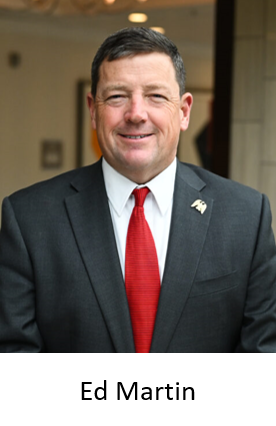
By Ed Martin, President, Phyllis Schlafly Eagles
Home for Christmas
Originally recorded as a radio commentary, December 22, 2021, and posted on PhyllisSchlafly.com
The moment I hear Bing Crosby start to sing the classic Christmas song “I’ll Be Home For Christmas,” I can’t help but think about the deep connection between America’s favorite holiday and the great American institution of the family. But why is it that so much of our Christmas celebrations seem to revolve around family? It certainly can’t be because every Christmas with family features “snow, mistletoe, and presents on the tree.” Something about family reaches past all the external circumstances and into the very heart of every man, woman, and child.
The answer can be traced all the way back to the very first Christmas, when Jesus was born to the Virgin Mary as Joseph stood guard over them. If you think about it, it did not have to be that way. Jesus is God, the ruler of the universe. He knew his earthly mother and his adopted earthly father before time began. Yet, our infinite God chose to enter this world in the arms of a loving family. He humbled himself as a mere babe and demonstrated for all how family can help us through hard times. He proved that the love and warmth of family can be felt in a lowly stable as much as in the palace of a king.
That is why we still celebrate Christmas with family today. The bond of family helps develop us into responsible citizens in our formative years and gives us a place of refuge when life gets tough. At Phyllis Schlafly Eagles, we proudly call ourselves a pro-family organization because we believe the family unit is still the best place for men, women, and children to prosper. We want a government that does not hinder the familial bond honored by the newborn Messiah.
Whether or not your Christmas celebration features “snow, mistletoe, and presents on the tree,” it is my prayer that you will be surrounded by the love of family as you remember the night that hope incarnate came to dwell among us.
On behalf of myself and the entire staff of Phyllis Schlafly Eagles, merry Christmas and may God bless you in the New Year.
The Christmas Miracle of José Feliciano
Originally recorded as a radio commentary, December 23, 2021, and posted on PhyllisSchlafly.com
In the spirit of the Christmas season, I would like to tell you a truly heartwarming story from the writer of one of the most popular Christmas songs of the last century.
The singer, José Feliciano, is best known for his iconic Christmas anthem “Feliz Navidad.” Few people know that he is also a bold defender of the unborn. The Catholic Feliciano says that he does not like to inject politics into his music because he does not think people respond well to celebrities who tell them what their politics should be. Certainly, the elites of Hollywood could learn a thing or two from him. However, in an interview with the National Catholic Register, he declared that the one political issue he will be vocal about is being pro-life.
Mr. Feliciano was not always a defender of the unborn. He even said that he previously “would have called [himself] pro-choice.” What do you think could have caused such a radical transformation in the life of someone constantly surrounded by the leftist dogma of the mainstream music industry?
The great Christmas miracle of José Feliciano came from his unborn daughter, Melissa. As he put it, “when I heard Melissa’s little heartbeat on the monitor, I said, ‘Well, wait a minute. Even if there is a heartbeat, that’s life.’”
Feliciano’s story should give hope to all pro-life Americans who worry about the future of our movement. If the man who wished the world “a merry Christmas from the bottom of [his] heart” can see life in a heartbeat, no one is beyond hope.
The heartbeat laws that have taken America by storm capitalize on the innate truth we all accept that where there is a heartbeat, there is life. You too can make this truth a part of your message. The abortion industry would like nothing more than to suppress the fact that unborn children have detectable heartbeats as early as three weeks after conception. We must spread this scientific fact to anyone who will hear. Who knows? Sharing that simple truth in a respectful dialogue with your pro-abortion friend might be enough to cause another Christmas miracle like it did for José Feliciano.
Education Related Links