Community Schools: Orwellian Takeover of Education
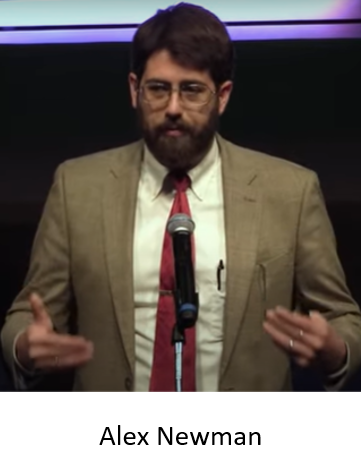
“It’s criminal activity hiding in plain sight,” says journalist, speaker, educator, author, and consultant Alex Newman in his new presentation on the state of public education in America. “Your kids are dumb as a box of rocks,” he contends, “not according to Alex Newman, but according to the U.S. government itself.” Newman is referring to the dismal results of the National Assessment of Educational Progress (NAEP), the most recent findings of which Education Reporter described in its July issue. Newman adds: “What they [NAEP researchers] have found is that less than one-third of the victims in public schools are proficient in anything,” meaning any core academic subject.
In 2015, Newman wrote an article in The New American magazine describing an Obama Administration plot “to unconstitutionally commandeer local schools and turn them into full-service community schools — government centers that will usurp vast new responsibilities over children that have traditionally been handled by parents and families.”
What are community schools? According to policies being implemented under the Full-Service Community Schools Program, these are “government-run elementary or secondary schools that participate in a community-based effort to coordinate and integrate educational, developmental, family, health, and other comprehensive services through community-based organizations and public and private partnerships.”
This Orwellian concept authorizes schools to provide “services” both before and after school, on the weekends, and during summer vacation. Included are “home visitation services by teachers and nurses; early childhood education; primary health and dental care; mental health counseling services; nutrition services; remedial education activities, enrichment activities,” and more.
The Institute for Educational Leadership website (IEL) indicates that many states “are looking to expand full-service community schools in 2023, with 17 states and Washington, DC having introduced 45 bills in support of such expansion.” In Maryland, for example, 8 bills are under consideration “that seek to allocate $100,000 for technical assistance, fund additional professional development opportunities for Community Schools, teachers, and staff, and provide clarity within current statutes to allow Full-Service Community Schools to access more funding streams and additional personnel resources, such as school counselors.” Minnesota has five bills pending that request “a total of $104 million to fund the planning and implementation of Community Schools across the state,” while Oklahoma is working on a pilot program.
In New York, five such bills have already passed. Resolution 555 provides “$450,000 in funding to United Community Schools and adds $105 million to the state funding formula for community schools.” IEL and the Coalition for Community Schools have expressed excitement for “the work being done on the local and state level to advocate for the advancement of the Full-Service Community Schools strategy and look forward to seeing what the rest of 2023 has in store for the Community Schools movement!”
The community schools scheme is not new; it embodies the “cradle-to-grave” education system Phyllis Schlafly warned about as far back as 1995. What’s new is the accelerated effort to substantially increase the current nationwide total of approximately 8,000 community schools in the wake of the COVID-19 pandemic “as a preferred reform strategy.” And if any further evidence is needed that Alex Newman may be on to something when he says community schools aim to replace parents, one of the concept’s strongest supporters is the National Education Association (NEA), which for decades has opposed the right of parents to oversee the upbringing and education of their children.
Brookings Institute report
In March 2022, The Learning Policy Institute, the Center for Universal Education at the Brookings Institute, a left-leaning think tank employing a staff that reportedly supports Democrat candidates 90 percent of the time, published a policy memo for the U.S. Department of Education pushing for more community schools, using the familiar excuse of COVID-19’s negative effect on education. The Brookings memo argues that the federal government should “turn to community schools as a response to the U.S.’s persistent failure to provide for the well-being of the most vulnerable children and families—a reality exacerbated [by the pandemic].”
The memo advocates for community schools, “not as a substitute for other much-needed policy changes in support of children and families, but as a way to employ a long-standing whole-child approach to schooling that coheres with a growing body of research about how all children learn…. Educators, children- and family-serving partners, and decisionmakers across the country are looking to long-standing community school strategies as a promising approach to mitigate the social and learning impacts of COVID-19.”
But no grandiose plan for more government control over the education system is complete without cries for “expanded funding,” and the Brookings memo calls for just that. While acknowledging that states have had access to Coronavirus aid through various federal acts passed between 2020 and 2021, the memo adds that “the $75 million investment in the Full-Service Community School Expansion Act Grant Program for FY 2022 [is] the most explicit investment in community school strategies in the history of the grant program.” At the same time, the memo notes that in 2022 “California invested $3 billion specifically in the California Community School Partnership Program (CCSPP) with the goal of ensuring that all of the state’s Title I schools operate as community schools.” Thus, funding for community schools involves federal, state, and local tax dollars.
The Brookings memo argues for a “consensus vision” for community schools that covers the gamut “of children’s development across multiple domains— including academic, physical, psychological, cognitive, social, and emotional learning….” It acknowledges that “[t]he community schools’ strategy is grounded in an ecosystem approach, meaning the goal is to improve the interrelated web of a child’s life at each level: individual, family, school, community, and society….”
Much of the Brookings document is couched in upbeat language emphasizing that community schools are “locally grown through a democratic co-creation and co-design process that is grounded in trusting, collaborative relationships among students, educators, families, community leaders, and other community-based partners.” But it also acknowledges that “students are enabled to understand their own rights and responsibilities in school, their community, and in society, and feel empowered to act as agents in their own and community wellbeing.” As Alex Newman predicted in 2015: “In other words, these ‘schools’ will expand and accelerate the ongoing usurpation of the role of families and parents in raising the next generation of Americans.”
Community schools are also about data collection, which has been part and parcel of education in varying degrees for decades. Among the data collection principles included in the Brookings memo are the following:
- Community schools are “data sources”… “from different levels of stakeholders involved in community schools, including students, parents, teachers, leaders, coordinators, and partners. Data collected and assessed must reflect all of these voices.”
- “Whole child metrics of student success,” which means not only measuring academic performance, but also the subjective “21st century cognitive and metacognitive skills, mindsets, and habits….” [Emphasis added.]
- “Multi-level wellbeing,” which refers to tracking and assessing “student behavior, trusting relationships, socioemotional learning, and a positive school climate and culture.”
Number 5 on the list refers to the collection of both quantitative and qualitative data. “Community schools are relationship-centered and data collection should reflect this,” the memo states. “Administrative data and descriptive statistics can only be one piece of a multifaceted evaluation, as perceptions, attitudes, engagement, and collaboration best captured in surveys, focus groups, interviews, and observations are key to understanding the impact of the community schools strategy.”
The memo further admits: “Additionally, it is important to frame community schools as a comprehensive school transformation strategy.” [Emphasis added.]
A Philadelphia story

A Facebook source had this to say about the community schools’ model as it is being implemented in Philadelphia, Pennsylvania: “It’s dangerous, and [the city of] Philadelphia is pushing it. When it comes to education, they prey and experiment on lower income [children and families] before they spread it to the rest of the nation.”
Philadelphia’s community schools are a partnership between the city, the Philadelphia School District, and “school communities to remove barriers to learning and support the success of each student.” The city’s website uses a lot of upbeat, flowery descriptions of what the schools accomplish through grants for projects such as “Out-of-School Time activities, family and community engagement opportunities, and safe zone projects.” One such project involves students working at a community farm to help feed local needy families; a noble activity in and of itself, but some parents worry that these activities replace actual academic learning.
The website further describes the Philadelphia model:
- At its very core, the Community Schools model embodies the old phrase “It takes a village to raise a child.” And not only is this village big, it is constantly growing. This year, Community Schools engaged in over 700 partnerships to provide resources to students. Among these partnerships, there were over 300 programmatic partnerships and over 280 resource partnerships.
School-based health centers
The Ohio-based online newspaper Lobbyists for Citizens cautions that “public schools are becoming community centers.” Writer Brian Massie noted on July 31, 2023 that “the role of the public schools is morphing into a community center that will ultimately control the lives, bodies, and minds of our children.”
Massie was specifically referring to the 2022 announcement by Ohio Governor Mike DeWine about the allocation of $25.9 million in taxpayer funds “for 136 new or expanded School-Based Health Centers” throughout the state. The purpose? To “provide primary care services and preventative care in the school setting.” Some of these clinics provide dental, vision, behavioral health services, and more.
The official excuse for this government overreach is that such health initiatives “help ensure students are in school, healthy, and ready to learn through a school or district’s partnerships with health care providers and other community organizations.” It’s also a clear vindication of the Philadelphia Facebook mom’s concern that the rights of lower-income parents are the first to be usurped, with all others set to follow.
But as Brian Massie wrote: “Academic proficiency continues to drop in public schools while they ensure that the children can select which pronoun and bathroom they want to use, what sex they want to be, and which sports [teams] they want to play on. History is being modified, while the ‘love conquers all’ mantra is used to groom them for the LGBTQ+ lifestyle and the pedophile miscreants so prevalent in our sick society.”
Alex Newman is more direct: “Get your children out of public schools now!” he says, “then run for school board.” He adds: “They don’t care about your guns, they have your children. It’s not going to make any difference how many AR15’s or ammo you have stockpiled. When your kids show up on your front porch to confiscate them, you will do nothing.”
Such a scenario is a frightening prospect, but potentially not as far-fetched as the average American may once have imagined.
The Hazards of School-Based Health Centers
In lockstep with the federal and state level push to expand community schools is the effort to increase the number of school-based health centers (SBHC). This development has conservatives and parents’ rights advocates understandably alarmed.
While health interventions in public schools have been occurring for years, the new SBHCs will provide “comprehensive healthcare,” including “behavioral and mental health services, reproductive counseling, lab and prescription services, various medical screenings, immunizations, and disease management.”
To pay for all this government intrusion, the cost burden has shifted from primarily private sector foundations during the Clinton Administration to government entities using taxpayer dollars in recent years.
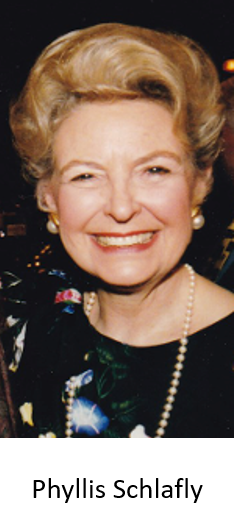
On January 1, 1997, Phyllis Schlafly addressed what she called the medicalization of the public schools in her first newspaper column of that year. Phyllis wrote that private foundations had “a game plan to turn the public schools into delivery centers for all kinds of health services, including physical examinations, treatment and medication of children, with or without their parents’ knowledge or consent.” The scheme she described then to change the schools’ mission “from academic learning to social services dispenser” has come to full fruition in 2023.
According to critics including the Children’s Health Defense (CHD), a major concern with SBHCs is that “children will receive, or be pressured into receiving, unnecessary or unwanted medical interventions — including vaccines …” unbeknownst to their parents. Georgia attorney Nichole Johnson, a consultant to the CHD legal team and co-director of the Georgia Coalition for Vaccine Choice, fears that parents “are being left out of the equation” when it comes to making medical decisions for children at these clinics.
“It’s scary,” Johnson said in an interview with CHD’s online publication, The Defender, “because these health centers sound really good. In some of the rural and poor communities especially, this is going to seem like a really good way for children to get this care. And while there may be some conveniences, there are so many concerns with allowing medical exams and treatments at school.”
Cornering the market
Another concern is that “parents may not be aware of the broad range of medical and behavioral services being provided in their children’s schools.” For example, the pharmaceutical giant Merck, which produces the Gardasil HPV vaccine, “is one of the funders of the School-Based Health Alliance, a large networking organization that ‘works on policy, standards, data, and training issues’” for SBHCs. Thus, one of the chief makers of a vaccine that is almost certain to be administered in a school-based health clinic is financially supporting a key outlet for its product.
In a number of states such as New York, lawmakers are considering legislation that would allow HPV and other treatments for sexually transmitted diseases to be given to minors without parental knowledge. The Defender referenced a report dated July 2022, produced by Harvard University’s Center for Law and Policy Innovation and the University of California Davis Comprehensive Cancer Center, which admits that “school based vaccination programs decrease barriers to access by partnering with health care providers to provide vaccinations during school hours on school campuses.”
This report recommends the HPV vaccine for 11- and 12-year-olds despite years of negative publicity about the safety of these vaccines. Even the leftwing Slate.com reported in 2020 on research showing that “HPV vaccine trials put safety on the back burner,” and noting that the researchers found “significant flaws in the manufacturer’s attempt to vet its product’s risks.” Slate further described how “while not conclusive, the findings do spotlight potential signs of rare neurological harms that outside experts say warrant a comprehensive look at the raw data, and they paint a damning picture of how the manufacturers evaluated their products’ safety.”
The Slate article acknowledged that these vaccines “didn’t cut the rate of cancers in the trials” because “most HPV infections are cleared by the body without causing any harm; the few that remain and trigger malignant growths typically take decades to do so, and most trials lasted no more than a few years.”
But Slate nonetheless defended the push to vaccinate young teens and pre-teens, noting: “While they [the researchers] found much to criticize, their study ultimately revealed no solid evidence of serious side effects.”
Stacking the deck against parents
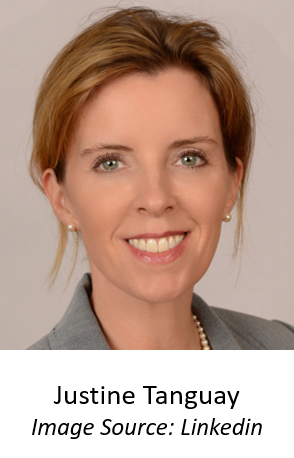
Justine Tanguay, an attorney who has advocated for children in various areas of the law for 20 years, told The Defender that parents need to be aware of the “blanket consent-to-treat forms” many schools will be sending home this school year, which will allow schools to provide all the aforementioned medical care and more…. “[There are] so many pitfalls,” warns Tanguay … “so many ways for someone else to be making parental decisions” for children.
Parents who take issue with SBHCs are up against a formidable foe. The Centers for Disease Control (CDC) advocates for these centers, and the Biden Administration and Congress have rubber stamped their expansion with passage in June 2022 of the Bipartisan Safer Communities Act. Section 11003 supports “access to health care services in schools,” and the law provides $50 million in HHS (Department of Health and Human Services) grants to “implement, enhance, or expand the provision” of healthcare services in SBHCs using Medicaid or the Children’s Health Insurance Program (CHIP). This means children covered by those programs can be reimbursed for health services administered in their school’s health center.
As if all this weren’t enough, the American Academy of Pediatrics issued a policy statement affirming SBHCs and providing “recommendations that support the coordination of SBHCs with pediatric primary care providers and the pediatric medical home,” which suggests that pediatricians will partner with schools to establish the SBHC “as an extension of their practice or by supervising the care.”
No regulatory oversight
Attorney Tanguay cautioned that SBHCs operate “without proper regulatory oversight.” And the organization Stand for Health Freedom echoed this warning in a July 12, 2023 article describing SBHCs as “the next threat to health freedom taking place in schools throughout the nation,” due at least in part to the absence of regulation.
The article further stated:
- SBHCs are intended by the Biden-Harris administration to be the “medical home” for your child, including primary health care services, reproductive counseling, dental care, and mental health counseling, replacing what the child would typically receive from providers outside of the school. Even worse, the Department of Education (DOE) has proposed changing the process for students with Individualized Education Plans (IEPs), removing the requirement for schools to receive parental consent before submitting Medicaid claims for reimbursement on behalf of their children.
-
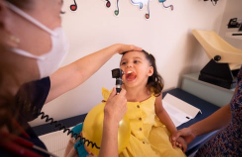
[T]here’s no set standard for who employs the providers, which services are offered, whether the services are provided to only students or also the community at-large, or how parental presence and parental consent are handled. Most schools are only asking parents to sign a single form at the start of the school year for their child to be seen in the SBHC anytime (and for any reason) throughout the school year. Other schools in states with minor consent laws are not only bypassing parental consent, but also intentionally withholding information in the name of “the student’s privacy.” There are also questions about which laws (if any) govern this health data since FERPA regulates student data, HIPAA regulates health data, and loopholes exist for both.
Stand For Health Freedom contends that parents and concerned citizens “don’t have to sit idly by as predatory policy is passed around us, leaving our children vulnerable,” and they invite everyone to visit their website for more information on how to fight back. “After all,” the group points out, “parents are the solution.”
The Mad Mad World of Child Sexualization in the Schools
Dr. Duke Pesta, a tenured professor of English at the University of Wisconsin Oshkosh, executive director of Freedom Project Academy, writer, speaker, and host of the Dr. Duke Show, has a lot to say about the lack of academic education and the prevalence of comprehensive sex education in public schools.
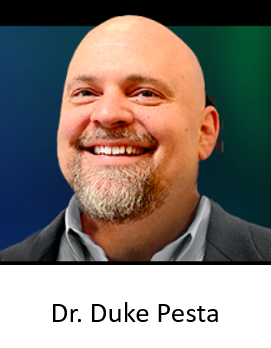
“LGBT education is required in the now politicized school system,” Pesta asserted on his radio show, “which is high on lower-level standards, directed by the federal government, and which embraces collectivism and one-size-fits-all education.” Pesta cited Oregon and Colorado as examples of where teaching comprehensive sex education to young children is happening whether parents want it or not.
“West coast schools,” he contends, “which cannot educate kids to read or do math at grade level despite all the money we have thrown at public education, are teaching sex in geography class, in civics class, in English class, math class, and physical education class. They are quite literally spending hours every day teaching kids about homosexuality, transgenderism; sexualizing your kids in every subject area.” In 2023, this teaching has permeated schools in most other states as well.
Six states have passed laws mandating LGBTQ+ inclusive curriculum in the public schools, including California, Colorado, Illinois, Nevada, New Jersey, and Oregon. The Nevada law, which passed in June 2021, goes so far as to require the indoctrination “starting in kindergarten.” In contrast, five states, including Alabama, Louisiana, Mississippi, Oklahoma, and Texas have laws forbidding such teaching.
Another pornographic library book
More recently in Pesta’s home state of Wisconsin, a book titled Let’s Talk About It is showing up in middle school libraries and being recommended for kids ages 13 and up. On the cover, the book bills itself as “The Teen’s Guide to Sex, Relationships, and Being a Human.”
Classical Alternative:
Freedom Project Academy
Dr. Duke Pesta is the executive director of FreedomProject Academy, a fully accredited K-12 Judeo-Christian Classical online alternative to the indoctrination and subterfuge of the public schools. It may be a practical and cost-effective educational option for parents.
Freedom Project offers several academic tracks:
- Live Academy — a fully accredited, live online school “rooted firmly in the Judeo-Christian values as promoted in the Constitution by our Founding Fathers.” Classes are delivered online through interactive classrooms to students in all 50 states and a dozen foreign countries in order to serve missionary and military families overseas.
- Anytime Academy — a self-paced series of pre-recorded courses available on demand 24/7. Students may view each class at their own pace and complete the required homework, quizzes, and tests within the academic window for each class. Students have access to an academic advisor for support and may attend weekly live Teacher Talk sessions along with students from live classes.
- Homeschool Track — This option provides a combination of instructional engagement in recorded lesson content with parent-determined pacing and assignment adjustments as needed. The Homeschool Track allows students to advance at a pace that promotes their success and builds confidence by focusing on learning rather than due dates/deadlines. It is designed for parents who prefer a more traditional homeschool program which allows for greater flexibility in homework and may be beneficial for students whose needs may not be met in Live classes.
FreedomProject Academy’s website provides more information about all the programs, course offerings, pricing, contact information, and additional details.
On his Dr. Duke Show, Pesta said the book “not only encourages sex to kids, but kink on the internet,” and described it as pornography containing “graphic descriptions” with “cartoon images” of sexual acts. His guest on this episode, Vicki McKenna, a former Marxist turned conservative media personality and host of her own Vicki McKenna Show, observed that Pesta could not “put up screen shots of the book” to show his audience because the content is “that graphic.”
Incredibly, Let’s Talk About It describes, as McKenna put it, “the necessity of kids utilizing ‘kink porn’ and even paying to look for ‘pornographic influencers’ online for guidance….” She added: “I don’t know what it’s going to take to get people to recognize that this is ubiquitous, this is everywhere … this is in the schools … it’s what education is — radical sexuality — and even includes implementing vulgarity into English lessons.”
Pesta showed a video clip of a local NBC news affiliate’s report on Let’s Talk About It, which stated that after a review by a local committee of school librarians was determined appropriate to remain on school library shelves in the “teen” collection. A parent had complained to the school board about the book saying, “If that book were in my school, I would by law have to report it,” presumably because of the intensely obscene content, which includes playing with excrement and use of bodily fluids during sexual activity. A former local official requested the review following parent complaints.
The news story failed to mention or show these extreme aspects of the book, including the graphic visuals, and suggested that parents should be monitoring what their children are reading or viewing. However, as Pesta noted: “So parents are in charge of what their kids watch or read, but we’re going to keep [this book] in the school library so middle schoolers can check it out without their parents knowing?”
McKenna added: “By the way, if [parents] speak up and say ‘you’d better tell me if you’re trying to groom my kid,’ the school will say, ‘no, you’re not in charge. Children of 13 years and older have specific rights.’” She advises parents and concerned citizens to access the book for themselves if they have any doubts about the content, “because that news station was not permitted, nor would they have chosen, to show the images that we can’t show either.”
Playing devil’s advocate, Pesta pointed out that the librarians did at least admit the book “might not be to your taste,” which he called “unbelievable.” He added: “We’ve said on this show many times that as bad as the teachers can be, as bad as the principals and superintendents can be, there is no more radically dangerous group in education today than librarians. They are more likely to look you in the eye and lie. They say parents have this right [to oversee what their children read], but only if they approve. If they don’t, suddenly none of it matters.”
McKenna agrees that these objectionable books are being chosen by the librarians and by the teachers who use them in class. They are “rubber-stamped” by superintendents who are being advised to do so by the state department of education, at least in Wisconsin, and doubtless in other states as well. “If you complain about it,” McKenna says, “you’re a problem … the lavender mafia, the ‘glitter cult’ will descend on your life if you’re one of those who wants to stand up to this.”
Both McKenna and Pesta insist that “everyone is affected” by the intrusion of these deviant books and sex ed lessons in the public schools. Conservatives denounce the fact that when parents object to pornographic books and demand that they be removed from school library shelves, they are accused of book banning, even as their microphones are cut off during school board meetings because board members find the content too obscene to be read aloud.
Sex assignments in English class
As Pesta has pointed out, assignments in other disciplines, such as English classes, have also been sexualized. He described an assignment administered in a grade 10 English class in the Eau Claire, Wisconsin public schools. “It’s a gender identity and sexual orientation worksheet that the kids have to fill out in order to complete the assignment,” Pesta explains. “Students can’t escape these assignments; they can’t ‘opt out’ of English class.”
Pesta said that for this assignment, the students had to “know what every letter means in LGBTQ.” They had to define “coming out” as “the process of accepting human sexual identity, so in other words, the mainstreaming of homosexuality and transgenderism is simply accepting without any question what and whatever people say they are, and it goes on and on and on.” He lamented that this is what students are doing in English classes instead of reading Shakespeare or the great classics, or even “learning how to read actual books.”
McKenna agrees that this type of instruction counts as “English” instruction today. She explains:
- They’re going to learn that gender is a social construct. They are going to learn about pronouns. They are going to learn about radical sexuality; that “coming out” means accepting…. They will learn that sex and gender are different things, and that your gender is whatever you say it is regardless of your biological sex. Your gender is your identity and it is primary. Nothing regarding sexuality or gender is going to be described in biological terms any longer, which is why, when you ask a Progressive what is a woman, they can’t answer the question.
McKenna knows from experience of what she speaks. Progressives have been taught “in their Maoist struggle sessions,” she says, “that the idea of biology is supremacist; it is colonialist,” and that biological truth is merely “a vestige of the patriarchy.” Therefore, it must be deconstructed and rejected in order to “complete the revolution.”
Pesta adds that as a university professor, he is painfully aware of the lack of reading skills of young people, that their “attention spans” are short, and that their comprehension levels are “really low,” which makes it easier for even the most bizarre ideologies to take hold.
Fortunately, the number of parent activists and pro-parent groups continues to rise, and more and more children are being pulled from the public schools. (See the “Freedom Project Academy” sidebar in this article for information about one of the many educational alternatives available to parents.)
Helping Gender Dysphoric Kids Thwart Parents
There is a growing effort by teachers, school administrators, and mental health support personnel to quietly help gender dysphoric kids to “transition” without telling their parents. In June 2023, the Daily Mail Online reported about a virtual workshop where “dozens” of teachers “traded tips on helping trans students change gender at school without their parents’ knowledge, while criticizing a raft of new Republican laws on sex and identity.” The sponsoring organization, the Midwest and Plains Equity Assistance Center (MAP), is funded by the Department of Education.

The Daily Mail wrote that it had “gained access to [the] online session,” which lasted four hours, and reported that some teachers discussed using “subversive” tactics. These teachers claimed their own personal “code of ethics” superseded any laws. They further discussed how to “hide” transgender students’ new names and identities from their parents, and how, along with help from the appropriate school departments, to prevent certain online information screens from being visible to parents.
According to the pro-LGBT activist organization Human Rights Campaign “more than 75 anti-LGBTQ+ bills have been signed into law this year alone, more than doubling last year’s number, which was previously the worst year on record.” The organization overlooks the fact that this is music to concerned parents’ ears, and that, given the outrageous tactics of participants in the MAP-sanctioned workshop, for example, many of these same parents are pushing their state legislators to stop the indoctrination.
The Daily Mail’s report included an alarming example of the workshop’s content from Ohio-based trans educator Shea Martin, author of a “socialist, feminist, and anti-racist blog called Radical Teacher.” Martin spoke about “teachers addressing ‘sexuality’ with elementary students,” who are aged between 5 and 10. “When talking about men, women, playground crushes, love, and marriage with youngsters,” Martin said, “teachers should be wary of treating ‘reinforced heterosexuality as the norm.’”
The Mail further noted that not once during the workshop “did any teacher say parents might know what’s best for their own kids, nor question whether affirmation-on-demand was the only way to help a trans-identified student.”
Parents Defending Education compiles list
The influential national organization Parents Defending Education (PDE) is compiling a list of school districts in each state that “have Transgender/Gender Nonconforming Policies” which openly advocate “that district personnel can or should keep a student’s transgender status hidden from parents.”
PDE lists each school district on the “Investigations” page of its website, and invites parents who learn of a district policy that is not included on the list to submit the information online so the district can be added. Currently, 1,040 school districts are listed in 38 states, impacting a total of nearly 11 million students.
This type of investigative reporting by a grassroots pro-parent organization is key to resisting the harmful transgender agenda that seeks to automatically transition questioning or troubled youth without parental notification or consent.
State attorneys general oppose parents
The efforts of the MAP workshop attendees and personnel in school districts across the country to thwart parents appear to be allied with those of 16 state attorneys general, who last month “filed an amicus brief opposing parents’ rights and supporting policies where schools hide information about children’s sexual identity confusion from their parents.”
Focus on the Family’s Daily Citizen reported that attorneys general from California, Colorado, Connecticut, The District of Columbia, Hawaii, Illinois, Maine, Maryland, Minnesota, New Jersey, New York, Oregon, Rhode Island, Vermont, and Washington jointly filed the brief in opposition to parents.
The brief supports school officials in Ludlow, Massachusetts, who allegedly concealed the gender-identity struggles of two 11-year-old students and were subsequently sued by their parents. The lawsuit was filed in April 2022 in the U.S. District Court of Massachusetts Springfield Division, by plaintiffs Stephen Foote and Marissa Silvestri, and named the Ludlow School Committee and Lisa Nemeth, interim superintendent of Ludlow Public Schools, as defendants. Later, Foote and Silvestri were jointed by fellow parents Jonathan Feliciano and Sandra Salmeron, whose children had not been harmed but who were fearful for their future welfare.
The parents charged that school officials “ignored clear warnings to the school by participating in conversations with their children about mental health issues,” for which the parents had already engaged outside help. Unfortunately, U.S. District Judge Mark Mastroianni dismissed their case last December, but the parents appealed the decision to the U.S. Court of Appeals for the First Circuit.
The lawsuit contends that the school violated the parents’ constitutional rights in a number of ways. First, they “exceeded the bounds of legitimate pedagogical concerns and usurped the role of the Plaintiffs….” Secondly, “the Defendants’ protocol and practice of concealing from parents information related to their children’s gender identity and efforts to affirm a discordant student gender identity at school violates parents’ fundamental rights under the United States and Massachusetts constitutions and violates children’s reciprocal rights to the care and custody of their parents, familial privacy, and integrity.”
The defendants countered by citing the Massachusetts Department of Elementary and Secondary Education (DESE) Guidance, which suggests that schools “should accept a student’s assertion of the gender-related identity when there is ‘consistent and uniform assertion of the gender-related identity….’” It goes on to assert that “if the gender-related identity is sincerely held as a person’s core identity,” then the only reason a school can reject it is if “school personnel have a credible basis for believing that the student’s gender-related identity is being asserted for some improper purpose.” But parents might reasonably question whether “school personnel” are either capable of interpreting or have the authority to interpret the purpose of a minor child’s gender dysphoric behavior.
The Daily Citizen observed that the 16 attorneys general obviously think that meeting secretly with minor children “to engage in counseling and advocacy related to mental health and discordant gender identity without parental notice and consent” is okay. They further imply that “deceiving parents by using one set of names and pronouns when communicating with them and another at school,” and “nurturing distrust for parents through secret meetings in which parents’ decisions and ability to provide for their children are questioned by school personnel,” is also perfectly fine.
According to the article, the AGs’ brief claimed that the plaintiffs “broadly frame their argument around the notion that they — and not schools — bear sole responsibility for making decisions regarding a child’s well-being.” Well, okay, yes, most parents would agree with that statement.
Manhattan Institute brief supports parents
Manhattan Institute Fellow Leor Sapir, Ph.D. submitted an amicus brief in support of the parents’ position and urging the U.S. Court of Appeals for the First Circuit to overturn the lower court’s decision. The MI brief opens by stating:
- The fundamental right to direct the upbringing, education, and care of one’s children is among the most important liberties protected by the Constitution, one that the Supreme Court has upheld repeatedly. Amici believe that public-school teachers and staff, as state employees, are legally required to respect parents’ directions regarding their children’s health, including those related to gender and social transitioning.
It further points out that decades of research “has consistently shown that most children with gender dysphoria (GD) and most clinically referred children with gender-variant behavior come to terms with their natal sex (‘desist’) by adulthood.” It describes the dangers of transitioning children as “an active intervention.”
Parents may wish to avail themselves of the important information in this thoroughly cited and well written brief. Its conclusion states: “When school staff make decisions about social transition in secret, they usurp the authority of parents and violate their well-established constitutional rights. Most importantly, they put the mental and physical health of minors at risk.”
Mallard
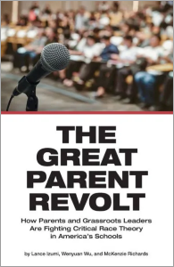
The Great Parent Revolt: How Parents and Grassroots Leaders are Fighting Critical Race Theory in America’s Schools
By Lance Izumi, Wenyuan Wu, and McKenzie Richards, Ph.D., Pacific Research Institute, 2022, BarnesandNoble.com
This inspiring book, published by the Pacific Research Institute and penned by Lance Izumi and co-authors Wenyuan Wu and McKenzie Richards, not only describes what’s wrong with public education in the pandemic era, but demonstrates how ordinary, real-life heroes are fighting to take it back. The authors set out to showcase the grassroots efforts of concerned parents and citizen activists, and to inspire others to join their struggle.
As the subtitle suggests, The Great Parent Revolt focuses primarily on critical race theory (CRT) and “race-based instruction” in the schools, and tells the stories of those working to remove it.
As most readers will recognize, CRT is cloaked in deceptive terms, such as “social justice, equity, diversity training, anti-racism, culturally responsive pedagogy, anti-bias, inclusion, and more.” It purports to promote “justice” and “inclusion” but as the authors show, “students of all ages are being taught racism” under the guise of these lofty-sounding ideals.
 This book describes thirteen different examples of bold citizen interference in the plans of the Marxist proponents of Critical Theory in general and CRT in particular. Izumi explains: “Other books on this topic have analyzed relevant scholarly aspects, with their authors rightfully warning the readers about the inherent contradictions of the theory’s Hegelian logic, Marxist underpinnings, and illiberal impulses. Our work departs from the intellectual debates and seeks to document a grassroots movement in the United States that started in late 2020 to challenge the cultural dominance of race-based thinking and public policy making.”
In Chapter 1, the authors present “a scholarship review” of the history of CRT, including the “moralistic assault” on the Founding Fathers and the “American political traditions of constitutional neutrality, rationalism, and equality under the laws,” which began decades ago and has only grown stronger. The authors cite as examples the 1619 Project, “which rationalizes that American history is a story of Black struggle against white supremacy and that America’s founding ideals of liberty and equality were false when they were written.” They also point to Ibram X. Kendi’s teachings that “the only remedy to past discrimination is present discrimination. The only remedy to present discrimination is future discrimination.”
Chapter 2 describes “CRT’s many shifting practices from DEI reforms (Diversity, Equity, and Inclusion) to the critical ethnic studies movement and social emotional learning.” While readers may be familiar with some of this information, it provides a helpful review and sets the stage for the real-life stories that follow. As the authors note: “DEI is intricately connected with CRT … [it] is part of a growing sociopolitical movement that is introducing contentious transformative changes based on fringe social theory to our institutions and throughout our culture, and enacting policies with almost no resistance or checks.”
Following this dismal observation, the authors tell the true stories of those seeking to derail critical theory in its various forms. Many of these individuals will be familiar to readers of Education Reporter, others will not, and the anecdotal details of their backgrounds and personal struggles make for both fresh and encouraging reading. These are people who have taken bold action, some individually and some partnering with others in founding effective pro-parent organizations.
The authors introduce Gabs Clark as their first profile, an African-American mother who had suddenly found herself widowed, disabled, and poor shortly after her eldest son was born. Originally from Houston, Clark was living in Las Vegas, Nevada when the charter school in which she had taken great pains to enroll her son and daughter was “taken over by the Democracy Prep charter school network, which operates in various states across the country.”
It wasn’t long before she and other parents began noticing changes in the curriculum, particularly civics, which underwent “a radical transformation across the school, especially in high school, from social studies to a highly controversial new approach with deeply divisive programming around race, religion, and sexuality.”
Soon, Clark became aware of other CRT-related issues. Her husband, who was white, had died when her son William was very young, and the child was light skinned and blue-eyed. One of William’s lessons “categorized certain racial and religious identities as inherently ‘oppressive,’ singling out these identities in bold text, and instructed pupils including William, who fell into these categories, to accept the label ‘oppressor’ regardless of whether they disagreed with the pejorative characterization of their heritage, convictions, and identities.”
Despite William’s mixed-race background and low-income status, Clark said her child “was viewed as ‘a dirty, filthy oppressor’ since ‘he’s a straight white male, [with] Judeo-Christian values, [and] all that stuff.’” In contrast, she said her daughter, whose father is Black, and who is part of the same family unit as her half-brother, is viewed as “oppressed.” These labels enraged Clark, who said her daughter “is more accomplished than all of my sons and myself … My daughter got a $100,000 scholarship to the ballet academy at eight years old … She’s won science fairs … She’s a genius … But she’s in the suppressed submissive category….”
In 2021 Clark filed a federal lawsuit “to strike down school-imposed CRT requirements.” In April 2022, the school backtracked and agreed to address her main issue, which was that her son William was denied his graduation diploma for refusing “to proclaim in class and in assignments his race, color, sex, gender, and religious identities for which he in turn would receive official, derogatory labels.” The school’s about-face, however, did not stop Clark from pursuing the lawsuit, which she and her legal team have amended from the original complaint to acknowledge the school’s capitulation and to include the demand for a jury trial.
Izumi writes: “The federal judge’s preliminary view of the case is of immense importance. If the Clarks’ lawsuit were to be successful on the constitutional grounds cited by the judge, then the entire bottom would drop out from under the CRT/intersectionality classroom indoctrination movement. Instead of haphazard and often ineffective state bans on CRT, such indoctrinating instruction and curriculum would become, in most cases, constitutionally impermissible.”
It’s interesting to this reviewer that so many of the stories in this book highlight the activism of immigrant parents and other minorities who fight valiantly against the tenets of CRT. These parents seek the preservation of America as it was founded and recognize that this country remains the best hope for freedom and opportunity.
Such is the profile of Jewish-American immigrant Elana Fishbein, the founder of the pro-parent organization No Left Turn in Education. Mentioned in the October 2021 issue of Education Reporter, Fishbein was born to a Jewish family in an Arab country. She learned all about discrimination when her family was forced by the hostile political climate to flee to Israel. As Sephardic Jews, meaning those who speak the language of their native country rather than Yiddish, they were considered second-class citizens. “I grew up in extreme poverty,” she recalls, “and during a time of discrimination between European ‘Ashkenazi’ Jews and Sephardic Jews. It’s very different in Israel today, but that’s how I grew up.”
Fishbein was educated in the U.S. and returned at age 49, married, and started a family. When her oldest son entered first grade, she began to notice the politicization in his school. Later, her younger son came home “talking about transgenderism,” as the curriculum became more intensely political. “Just before school ended that year, [after] George Floyd died and national protests erupted,” she said, “the school determined to capitalize on the incident to implement a radical CRT curriculum.” Racially charged books followed, including Not My Idea: A book About Whiteness, which contained “radical teachings” that would cause division in classrooms and families.
Fishbein realized that “such skewed teaching about race and U.S. history could extend to skewed teaching about Israeli history as well,” note the authors, with the result an overall poisoning of our culture. She wrote a letter to the district superintendent outlining her concerns, and when she received no response, she posted the letter to the school’s parent Facebook group. She was attacked by some parents, but many others reached out privately in support.
Ultimately, after being ignored by the school district, she “felt compelled to launch a movement of her own, and No Left Turn in Education” was born. The authors write that, to Fishbein, “it was obvious she needed to ‘impact those centers of power.’” They add that her group “was the first to organize parents to speak out at their local school board meetings against the radical curriculum changes — whether that be critical race theory, the 1619 Project, gender ideology, or changing STEM standards….” Their work centers on what they call the four “E’s — Education, Empowering, Engaging, and Eradicating.”
Fishbein’s organization has taken off, with media appearances and local groups becoming active across the country. No Left Turn was the first to provide “model legislation on its website” to ban CRT in schools. Volunteers take the model legislation with them when they meet with state legislators. Her leadership has resulted in significant pushback against CRT, radical gender indoctrination, and pornographic and racist books in school libraries. She recognizes that “this is not an overnight thing, but there are a lot of committed people around the country who want to work together to protect kids from harmful teachings.”
Indeed, there are, and The Great Parent Revolt covers them nicely, from the leadership of Asra Nomani, a Muslim immigrant from India “who has become one of the country’s key parent leaders fighting race ideology in schools,” to Elina Kaplan, Lia Rensin, and their Alliance for Constructive Ethnic Studies (ACES), which are among the most active opponents of CRT and Liberated/Critical Ethnic Studies in California. Then there is Tiffany Justice, the mom and former school board member who became a grassroots organizer. Justice co-founded the highly successful and nationally recognized Moms for Liberty, which boasts of active chapters in most states throughout the U.S.
The Great Parent Revolt is a worthwhile read. Izumi and his co-authors do a masterful job telling the stories of the successful, influential activists they profile. They hope many more parents and concerned citizens will be inspired by reading these stories, and follow in their footsteps by opposing the Marxist, Maoist revolutionaries who are destroying education and tearing our country apart.
To read the entire book, go to BarnesandNoble.com to order!
Education Briefs

In an apparent win for students and parents, Libs of TikTok (LoTT) announced on August 24 that the Cobb County School District in Georgia will remove two pornographic books from its school library shelves. In another of their famous exposés, LoTT contacted school district officials by email on August 19 stating that they were “gathering information for a story about the pornographic books your district currently has available for students to view, use, and check out from your libraries.” The email provided the book titles: Me and Earl and the Dying Girl, which LoTT said was available in four schools, and Flamer, available in “a large amount of schools.” Attached to the email were screen shots of a few of the more egregious pages in the books. (Education Reporter mentioned Flamer’s obscene content in its August 2022 and March 2023 issues.) Two days later, on August 21, LoTT heard back from Chief Strategy and Accountability Officer John Floresta, and described his response as “what all parents should want to hear!” It read: “Any book, video, or lesson which contains sexually-explicit content is entirely unacceptable and have [sic] no place in our schools, period. Over the weekend, we have removed both books from all of our schools.” When school district officials are confronted, they typically deny all knowledge of the offending books or lessons, which proved to be the case in this instance. Floresta thanked LoTT “for alerting us to these books,” and claimed that “we weren’t aware … until your email….” He further stated that the district would “unapologetically” hold the staff accountable “to only use content which is aligned to Georgia standards, our Board’s policies, and the Law.” Parents should nonetheless remain vigilant and hold these officials’ feet to the fire.

The Harrison County School District in Mississippi has adopted a new dress code requiring students to wear clothing consistent with their biological sex. The Western Journal reported on August 4 that the new rules appear in the district’s updated policy manual for grades 7-12, and mandate that students “follow the dress attire consistent with their biological sex” as it appears in their permanent record. The rules stipulate that “boys must wear shorts or pants and shirts and footwear according to the dress code” of the district, and that “girls must wear dresses or skirts or shorts or pants and shirts or blouses and footwear according to the school district’s dress code.” The policy also forbids the wearing of hoods “indoors or on school buses.” The new rules apply to the 2023-2024 school year. The Journal noted that the new code reinforces the Harrison County School District’s “recent decision to forbid a boy who insists he’s a girl from wearing a dress to his high school graduation.” In May, a transgender student “filed a motion to compel the Harrison Central High School to let him wear a dress and high heels to his school graduation.” In its own court filing, the district countered that “walking in a graduation ceremony is not a fundamental right, especially since the boy already finished the school year and [was] therefore no longer a student.” A Trump-appointed judge upheld the district‘s decision and denied the student’s motion, which was filed by the ACLU, and he has since filed a lawsuit claiming his civil rights were violated. The Journal doubtless echoed the sentiments of many parents when it opined: “The problem with our educational system is that many schools are churning out students who can barely read or write. Instead of educating children, schools have devolved into partisan bureaucracies that indoctrinate students with left-wing propaganda that fetishizes transgenderism and race-based ‘equity.’”

The 25,000-member National Council of Teachers of English (NCTE) wants to replace state literacy standards with “anti-racism,” “race,” “anti-Blackness,” and “LGBTQIA+” teaching in public K-12 classrooms. Fox News reported in June that the “influential organization released a report in May to promote ‘Culturally and Historically Responsive Education’ as an alternative curriculum to current English instruction in the pursuit of anti-racism and anti-oppression.” Instead of teaching traditional literacy, which these critics complain is from “a white male perspective,” the new curriculum would “focus on teaching ‘pursuits,’ one of which is to encourage America’s youth to ‘understand power, oppression, antiracism, and other anti-oppressions,’ in classrooms as young as pre-kindergarten.” The goal, they say, is “to shift gears toward a new way of teaching in K-12 schools by encouraging English teachers to take a number of classes aimed at ‘unpacking their ideologies, bias, and internalized oppression.’” In other words, critical race theory (CRT), which public schools continue to insist is not being taught in America’s classrooms, would indeed be taught, at least in English literacy classes. Fox News cited a Manhattan Institute (MI) Study of 1,500 18-20-year-olds, conducted early this year, which found that, as most observers already know, CRT and CSJ (Critical Social Justice) concepts are in fact being taught in the schools. The study showed that 93 percent of the young adults surveyed had heard “at least one of eight Critical Social Justice (CSJ) concepts from a teacher or other adult” during their school years, including “white privilege,” “systemic racism,” “patriarchy,” or “the idea that gender is a choice unrelated to biological sex.” Additionally, 90 percent of those surveyed “had heard about at least one CRT concept and 74 percent about at least one radical gender concept.” The MI report emphasized that “CSJ appears to have a significant impact in shifting children to the political left.” If the NCTE has its way, any remaining semblance of the authentic teaching of English and literacy will be replaced with Marxist indoctrination.
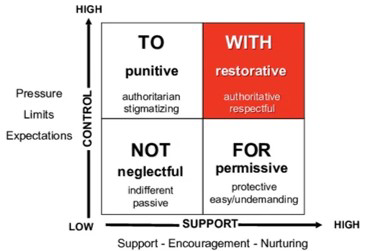
Dangerous re-education is taking place for kids who “misgendered” a classmate in the Glendale, California Unified School District (GUSD). Last month, the New York Post reported that two students were suspended for five days “after a misgendering incident took place, and then subjected them to a ‘training’ called ‘restorative justice,’ according to an email reviewed by Fox News Digital.” Former Herbert Hoover High School Principal Jennifer Earl sent the email, which was brought to light by the Facebook group GUSD Parents Voices. Earl claimed the students (who were not identified) “misgendered a transgender student then ran away as the teacher attempted to correct them.” She said the teacher involved asked her “to educate [the offenders] on transgender” and said that “restorative justice” would happen after the suspension. Restorative Justice is “a re-education of students and gaining control over a situation based on the perceived wrongs they committed.” Apparently conducted in “a restorative justice circle,” these sessions involve asking leading questions of the kids, such as “If you could smash one thing… what would you smash?” and “Describe the ideal family.” The district’s website states: “When there is harm or conflict within the established community, restorative responses help to repair the damage. This is done through processes that bring harmed and harmers together to address root causes of the conflict, support accountability for those responsible, and promote healing for impacted individuals….” Many parents were outraged at this blatant attempt at brainwashing. One responded by stating: “Not playing along with their fantasies of being the opposite gender is not bullying. Bullying is teachers and people in power forcing us to defy facts and logic as to not hurt the feelings of the mentally ill.” Another commented: “This is forced speech and forced Marxist ‘reeducation.’ This is what our country has become under the godless radical Marxist Democrats.” Another wrote: “This is insane. Get your kids out of government schools and get out of California,” although these activities are occurring in other states as well.
Window dressing? Some universities appear to cut DEI — but quietly keep it
Efforts in Texas, Arkansas and Florida to cut diversity, equity and inclusion programs may not be all that they appear, as some observers argue the attempts amount to window dressing while DEI remains behind the scenes. In one method, it appears campus leadership simply reworded a job title to eliminate DEI verbiage.
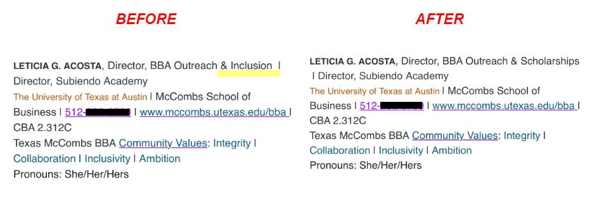
At the University of Texas-Austin (UT-Austin), the formerly titled “Outreach & Inclusion” director in the university’s business school has been relabeled “Outreach & Scholarships,” as screenshots show.
The word “inclusion” was deleted to appear compliant with a new state law that bans DEI offices, argued one professor who asked to remain anonymous for fear of retribution.
“The UT-Austin administration has no intention of truly complying with SB 17,” the professor said in an email to The College Fix. “They will use whatever loopholes they can find to continue as much of the objectionable programming as possible, especially by hiding such programs as ‘teaching’ and ‘research,’ which were carved out as exceptions.”
Student groups are pushing the university to do just that.
“Workaround in terms of language to keep things like the multicultural engagement center, gender, and sexuality center open and keep DEI-related staff from losing their jobs,” Jake Holzman, president of UT-Austin’s chapter of Students for a Democratic Society, told KXAN-TV.

In addition to UT-Austin, the University of Arkansas has dissolved its DEI department and will be relocating DEI staff to human resources, student success offices, and other divisions. “This topic is so charged that when you say, ‘We’re dissolving DEI,’ half the people hear, ‘The University of Arkansas hates Black people’ and the other half say, ‘What are you doing? This is a travesty,’” Stephen Caldwell, chair of the university’s Faculty Senate, told Inside Higher Ed.
He made the comments in the June 21 article headlined: “Dissolving a DEI Office to Save DEI: The University of Arkansas is reallocating all DEI staff and resources to other campus offices. Is it a capitulation to right-wing demands or a savvy defense tactic?”
“Neither of those two sides realize what’s actually happening, which is that all of the people on our campus doing that type of work are going to stay and will continue doing that type of work, just reporting to different people,” Caldwell said.
Neetu Arnold, a fellow at the National Association of Scholars, told The Fix that Caldwell’s comments indicate the school is seeking to dodge a potential state ban on DEI departments at public colleges and universities. “Higher ed is committed to continuing DEI. So we shouldn’t be surprised when they will even defy state lawmakers to continue the practice behind closed doors,” Arnold said.
In Florida, Gov. Ron DeSantis signed legislation to defund and eliminate DEI at state universities after a state investigation found these institutions spent over $15 million annually on DEI and CRT-related initiatives.
Chris Rufo, a conservative activist who led the state’s anti-DEI push, alleged in a July interview that the University of Florida (UF) significantly underreported the presence of DEI on their campuses to the state to save certain programs from being defunded. “I’ve discovered through public records requests and the threat of litigation that the University of Florida, which is under the purview of a Red state legislature, explicitly lied to the governor in its official response to his request about their DEI programs,” Rufo told the Daily Mail.
Rufo argued [that] UF’s conduct is indicative of a broader trend. “What we see over and over in America’s institutions is that the leaders have been captured by radical left wing DEI ideology. And then when they’re discovered, they make every attempt to hide, obfuscate, and conceal the true nature of what’s happening inside their institutions,” Rufo said.
UF spokesman Steve Orlando declined to comment on the allegations to the Daily Mail.
Education watchdog Louis Bonham recently argued that banning DEI will be meaningless without enforcement. “These administrators face no downside for intentionally violating any anti-DEI law. Indeed, doing so allows them to virtue-signal and gain street cred among the wokesters for their willingness to ‘resist’ what they see as the ‘wrong’ kind of law,” Bonham argued in a July 19 piece for the Martin Center for Academic Renewal.
Whether it is the new constitutional bans on affirmative action in admissions, long established (but oft-ignored) bans on racial preferences in hiring, or laws prohibiting DEI practices, history teaches that absent concrete legal consequences for violating the law, university administrators will simply wink at the legislature while continuing to follow what they consider to be the path of moral righteousness.
Student contributor David Glasser attends Florida State University where he is studying political science and economics. He begins law school this fall (2023).