Abuse of Power:
Feds Promise Crackdown on Parents for Speaking Out
U.S. Attorney General Merrick Garland’s October 4 memo accusing parents of “harassment, intimidation,” and “threats of violence” for speaking out at school board meetings would be laughable if it didn’t carry the weight of the federal government.
Garland’s memo pledged the DOJ’s commitment to “using its authority and resources” to discourage these threats, identify them when they occur, and prosecute them when appropriate.” It promised to announce “a series of measures designed to address the rise in criminal conduct directed toward school board personnel.” To date, no such threats have been identified except for a lone, ostensible, and widely publicized arrest that occurred during a June 22 school board meeting in Loudoun County, Virginia.
The unprecedented threat of FBI investigation of law-abiding American citizens under the Patriot Act and various other laws for daring to protest offensive and often secretive curricula in public schools is allegedly based on a request by the far-left National School Boards Association (NSBA) in a letter to President Biden. The NSBA is an umbrella organization for state school boards across the country, but not all of them march in lockstep with the national group.
As The Daily Signal opined: “Most of the letter is the National School Boards Association clutching its pearls, aghast that justifiably angry parents are zealously advocating for their children’s interest. The tactics thus far employed certainly are nothing compared to the riots of the summer of 2020 that destroyed over a billion dollars in property and resulted in multiple deaths.” The NSBA evidently has no problem with this actual violence as opposed to the mythical violence taking place at school board meetings.
It’s anyone’s guess whether Attorney General Merrick Garland’s tough stance against parents will collapse under the weight of his obvious conflict of interest uncovered by Parents Defending Education (PDE) and reported by Fox News, among other outlets. Garland’s son-in-law is co-founder of Panorama Education, “a company that promotes the type of content parents are opposing in their ongoing battle with local school boards.”
After Garland’s memo became public, Asra Nomani of PDE tweeted “Merrick Garland has declared a war on parents. His daughter is married to the cofounder of @PanoramaEd which is under fire for its multimillion contracts with school boards. At @DefendingEd, parents sent us tips. We raised the alarm. Now Garland is trying to silence parents.”
According to Fox, “PDE previously flagged a $1.8 million contract for Panorama to conduct social and emotional learning (SEL) monitoring in Fairfax County [Virginia’s] Public Schools (FCPS), resulting in data on students. Earlier in September, that number was bumped up to more than $2 million as part of a contract addition with Panorama.”
Some State School Boards Disagree
The Washington Examiner reported on October 11 that school boards associations in Louisiana and Virginia have denounced a letter “sent to the Justice Department by the National School Boards Association, contending local law enforcement is well equipped to handle any threats directed at school board members.”
A witness who has been following the school board confrontations told the Examiner: “Generally speaking, from what I’ve seen, the only time there’s any level of violence is where somebody is at the microphone and the school board cuts them off, and the school board calls in the police to remove a person. I’ve not seen reports of school board members being attacked, and if they were, it shouldn’t happen.”
The North Carolina State Board, however, issued a press release that appeared to agree with the NSBA’s letter. The text reads in part: “As educators, as parents and as concerned citizens, we respect the rights of our fellow citizens to share their concerns and voice their opinions. However, this must be done without the use of intimidation or intentionally inspiring fear. Every one of us has a responsibility to instill in our children their first amendment rights and responsibilities, but we have an even greater responsibility to model good behavior while doing so.”
A local pundit uploaded the press release on Twitter noting: “Reasons parents are getting so hostile: boards ignoring complaints, limited in-person meetings, shutting down public comment, CRT, and masks.”
Another Twitter user responded: “Add [to that] board members mobilizing union members to silence or shame parents. There doesn’t seem to be an uproar when NCAE [North Carolina Association of Educators] members bully students and their parents. I’m tired of people like [North Carolina Public Schools Superintendent Catherine Truitt] @CTruittNCDPI turning their backs on the people that voted them into office.”
“This is such a red herring,” Phyllis Schlafly Eagles Researcher Gwen Kelley agreed in reference to the press release. “But parents are so frustrated. We need to encourage them to win back the school boards.”
What’s it really about?
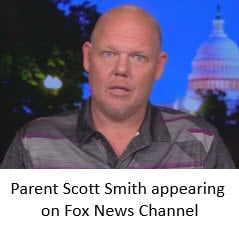
The NSBA used the arrest of Scott Smith during the Loudoun County School Board’s June meeting as the basis for its letter to the Biden Administration. Smith became the “poster child” for alleged parental violence at such meetings when he reacted to a hostile attack by a pro-transgender activist. The discussion at the meeting was focused on a plan to expand special protections to transgender students, which many parents spoke out against. Smith later said he and his wife attended the meeting out of “practical concerns.”
Unbeknownst to others at the meeting and to the public at large, Smith’s ninth-grade daughter had been sexually assaulted in a high school bathroom by a boy wearing a skirt just the previous month. The May assault against Smith’s daughter included rape and forcible sodomy, and the student was later charged.
The school notified the Smiths immediately following the attack, but did not call police, and the board covered up the crime at the June meeting. Board member Beth Barts claimed: “Our students do not need to be protected.” District Superintendent Scott Ziegler stated: “To my knowledge, we don’t have any record of assaults occurring in our restrooms.” He added: “I think it’s important to keep our perspective on this, we’ve heard it several times tonight from our public speakers, but the predator transgender student or person simply does not exist.”
But at least one predatory student did indeed exist, and the fact that there was a second assault by the same student has recently become public. Smith said that when he tried to confront the board about the crime against his daughter, the pro-transgender activist accused him of fabricating his story and questioned his daughter’s mental health. As the exchange became heated, a police officer grabbed his arm, and a scuffle ensued.
Apparently, the right of citizens to express their concerns does not apply to parents who object to irrational mandates that threaten the mental and physical wellbeing of their children. Nor are progressive activists expected to adhere to the rules of behavior that apply to these concerned parents.
Particularly critical here, many believe, is the coverup of an alleged crime in order to advance a radical political agenda. The goal was evidently to pass the additional special protections for transgender students, which Loudoun County officials did on August 1, before the sexual assault by the presumed “transgender” student became public knowledge.
On October 6, the same teen was charged with attacking another female student in an empty classroom. The Smiths’ court date was rescheduled for October 25 to accommodate the two separate charges now leveled against the student.
In a special report, Dailywire.com provides more detail about the Smith family’s ordeal. The report notes: “School administrators attempted to deal quietly with the matter in-house, and then school board members denied it even happened. Smith was then bloodied and arrested for speaking out, and the county’s normally lenient prosecutor threw the book at him. The Smith family then learned their daughter’s rapist allegedly sexually assaulted a second girl. Now, the NSBA is using the Smith family’s tragedy as justification for mobilizing the federal government against concerned parents.”
Conversely, Scott Smith has been given a voice to tell his story on the Fox News Channel’s Tucker Carlson Tonight and Laura Ingraham Angle shows. Smith said the tragedy of the past five months has “inspired” him to become involved in local politics, even though he previously had no interest whatsoever in politics.
Some observers fear that the DOJ’s threats to unleash the FBI on concerned parents will silence them or at least make them more hesitant to speak out, which is the Biden Administration’s presumed goal. Others believe the government “is making a mistake vilifying these parents,” as Bill O’Reilly told Glenn Beck recently on Beck’s radio show, and that the move will backfire.
Finally, the Daily Signal stated on October 5: “[P]arents need not be afraid. It is their constitutional right to push back in legal ways against schools teaching children critical race theory” and other radical ideology. “Go forth to the school boards and make your voices heard.”
UPDATE: As we are about to release this issue of Education Reporter Online, the National School Boards Association has apologized to its members for calling parents “domestic terrorists” and expressed “regret” for its letter to President Biden. In another development, the student accused of sexual assault in the Loudoun County, Virginia School District has been found guilty. More on both these stories next month.
Time for School Board Transition and Renewal
Perhaps the injustice faced by Scott Smith and others at the hands of hostile school boards will empower ordinary citizens to wrest control from left-wing ideologues and chart a new course for their public schools. A great example can be found in the city of Canby, Oregon, just south of Portland; the Canby School District has a secret weapon in the person of Board Member Stefani Carlson.
Education Reporter recently caught up with Carlson, who provided valuable counsel and encouragement for parents and citizens wishing to take an active role in their communities.
Carlson admits that she became interested in running for the school board when the culture of her town began to change. “I’m a homeschooling mom,” she says, “and I never envisioned getting involved with the public-school system.” But when she witnessed an unwelcome cultural change in her community as it drifted leftward, she felt she had to do something.
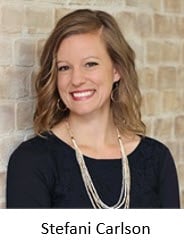
The catalyst for her decision to become more active was the Canby City Council’s proclamation of a “Transgender Day.” Carlson spoke out against this designation at a city council meeting, believing that sexuality is a personal matter and not part of a city’s legitimate business. She was attacked and called a “bigot” on social media, particularly on Facebook. “It was problematic for my family’s small businesses,” she says, but because she “wanted to please the Lord,” she was determined to stand her ground.
In the midst of the uproar, Carlson decided to run for the Canby School Board. Two years later, she’s still not sure how or why she won, except that it was obviously God’s will. “I continued to be attacked on social media and in person during the campaign,” she recalls. “People came to my home and my business to harass me. I prayed about it and even tried to withdraw from the race.” But she discovered that she could not withdraw; her name was already locked in as a candidate.
“I was running against a well-known eight-year incumbent, and I told myself I could not win anyway, so why worry about it? I continued to pray, and against all odds, I won.”
Since her election, Carlson has worked to help other conservatives get elected; two that she’s proud to say have been quite good. She’s convinced of the value of helping like-minded citizens win elections to various offices, and that “building a network” is critical in the battle against the Left.
Practical Advice for School Board Candidates
Carlson believes most people can run for their local school boards. “It doesn’t require a lot of money,” she explains, “but personal effort and face-to-face contact is very important.”
Since it’s an elective office in the vast majority of school districts, she believes door-to-door campaigning is a must. “Conservative candidates need to reassure voters that they are in favor of basic skills instruction and solid academics, and making that case is more impactful face-to-face. Be sure you have a clear message that you want your district schools to return to the fundamentals of reading, writing, and arithmetic. Have some cards or flyers ready to hand out, and don’t forget to enlist a small team of volunteers to go out and campaign on your behalf.”
Carlson favors eliciting the support of like-minded groups such as right-to-lifers, and says there are “micro-groups popping up all over that support conservative candidates.” She says those considering a school board run should “be cognizant of who else is running and for what positions. It’s important that conservative candidates are organized and on the same page.”
Another powerful message she says will resonate with voters is to advocate “the wise use of school budgets.” Most voters believe there is excessive waste of their tax dollars, and conservative candidates need to emphasize fiscal responsibility.
Carlson acknowledges that running for elective office is tough, but insists that “it’s a lot harder once you’re there. You must have a backbone to stay on target. It is a spiritual battle more than anything else. Go into it knowing you will be attacked for doing the right thing.”
School Board Member Responsibilities
A school board member’s basic responsibilities include overseeing the district superintendent, reviewing school policy, and overseeing budgets. “It’s important to understand the power structure,” Carlson notes. “You will be told the lie that you work for the superintendent, but the truth is that the superintendent works for the school board. School board members work for the citizens who elected them.”
She points out that board members need to be familiar with district policy because they can influence those policies as well as the budgets. “Funding can be complex,” she says, “and budgets can be raised. So, it’s important to dig in and not be afraid to ask questions, especially legal questions.” She adds that it’s a good idea for board members to have their own legal resources to whom they can reach out. “There are so many layers to work through, but you will be much more effective if you become familiar with them.”
Reiterating the importance of networking and moral support, Carlson recommends that conservative school board members form a group or join an existing group to share ideas. “One thing our neighboring Newberg School District did that we supported was to prohibit any flags in classrooms except for the American flag.” She explained that the intent was to limit controversy, but “instead all hell broke loose.” A simple, practical decision created an uproar that, among other mayhem, nearly caused the chair of the Newberg School Board, who is a tennis coach in Carlson’s district, to be fired. She offers it as an example of how important support from like-minded elected officials can be when introducing a potentially divisive, even if sensible, policy.
Another responsibility of the school board is to approve curricula. “State law governs the curriculum,” Carlson concedes, “but there are ways around that.” For example, she recommends that boards authorize an “opt in” alternative to the typical “opt out” recourse for parents. That way, students actually need parental permission to attend an objectionable class such as comprehensive sex education rather than relying on the school to follow the parents’ wishes and opt the child out. “Partial sections of curriculum can also be removed,” Carlson says. Savvy board members can use state law to their benefit to circumvent the bad laws.
Parents’ Rights
Carlson stresses the truism that parents have the right to address their school board. “They should be able to bring up whatever topic they want with regard to their schools, including curricula, budgets, and anything directly related to their child’s education. It is not okay to deny parents their First Amendment right to speak.”
How to Reclaim the School Boards
As Education Reporter published last month, parents and citizens interested in changing the course of their public schools can start by finding out how their state and local school board members are selected, and then running for school board themselves or identifying suitable candidates.
An October 15 article in The Daily Citizen, an online publication of Focus on the Family, points out that state legislatures “establish departments of education from their state constitutions and laws,” but that “much of that state authority is delegated to local school boards.” The article emphasized the importance of school boards as “one of the most important places where parents and concerned citizens can make a difference in children’s education.”
The article also states that “90 percent of voters don’t vote in school board elections,” a sobering statistic given the critical role school boards play in curriculum selection, policy, and budgets. As the Citizen observes: “An individual vote has greater weight here than in elections for president, congress or state offices.”
So where to begin? The website of the Education Commission of the States includes a list of both the K-12 School Board Governance by State and the K-12 State-Board-of-Education Governance by State. These lists show how school board members are selected in each state and cite the applicable laws governing the board member selection process in each state.
Most states have organizations that provide information and/or assistance with becoming a school board candidate. These organizations, such as the Missouri School Boards Association (MSBA), for example, typically take liberal “advocacy positions” but provide helpful information such as candidate filing dates, tutorials, and instructional videos about how to become a candidate in various districts around the state. Conservative candidates can avail themselves of the useful information.
The conservative Leadership Institute (LI) provides online training for persons interested in running for their local school board. LI acknowledges that “many school boards around the country are captured by the left. This includes large urban districts where leftists would be expected to control local politics, as well as more suburban areas where the ‘non-partisan’ nature of school board elections lead many conservative voters to cast ballots for leftist candidates.” The teachers’ unions and other left-wing groups, who are well-trained and experienced in politics, back school board candidates that share their ideology. LI observes that they often win elections “because conservative candidates are ill-prepared or do not run at all.”
LI has “42 years of experience in training conservatives to win.” Their training program includes how to raise funds for a successful campaign, and provides “briefings and background information.” The website is currently offering free enrollment in this training for a limited time.
Also worthy of mention is the Family Research Council’s FRC Action arm, which features the organization’s School Board Boot Camp and FOIA webinar “to help empower parents to engage in public education.” FRC’s latest publication, A Concerned Citizens’ Guide to Engaging with Public Schools contains valuable information and resources, and is available for download free of charge.
Leftists Cry Foul as Parents Challenge Children's Indoctrination
More and more parents are rebelling at school board meetings against the radical indoctrination of their children, and some leftists are crying crocodile tears. “The nation’s school boards are under attack,” trumpeted writers for a group called Popular Information LLC in an article on Substack. The article lists a number of alleged atrocities committed by parents across the country, including disorderly conduct, rude language and hand gestures, and of course, the infamous Scott Smith incident, to which the authors alluded but did not specifically identify. They whined that in one instance: “Unmasked protesters” forced their way into a California school board meeting “in violation of COVID protocols.” Lions and tigers and bears, oh my!
The article predictably supports the National School Boards Association’s (NSBA) September 29 letter to the Biden Administration. “Alongside the chaos and violence,” the authors state, “there is a parallel effort to replace incumbent school board members with right-wing ideologues who oppose public safety measures and teaching students about racism.” They opined that in 2021 “there were at lease 80 efforts to recall 207 school board members.” Hooray! Concerned citizens applaud these herculean efforts by ordinary, fed-up parents.
But there’s nothing to see here, folks, right? Just a bunch of right-wing crazies trying to unjustly disrupt and commit violence at school board meetings. Tell that to the concerned parents who have been speaking out. On September 23, a mother in Fairfax County, Virginia, testified at a Citizen Participation School Board Meeting that her daughter’s high school library reading material included “pedophilia,” “sex between men and boys,” explicit sex acts, and graphically offensive text. One book included pornographic visuals which she displayed before the board.
But rather than show alarm or even embarrassment that such books are readily available to impressionable teens, they reacted by cutting off the mother’s microphone and refusing to allow her the balance of her time to speak. “There are children present,” the board chair disingenuously stated, as if those same children, had they actually been present (there were no children at the school board meeting), could not avail themselves of the pornographic trash this brave mother was trying to bring to light.
Blaming ‘Right-Wing Political Operatives’
Perhaps most alarming about the Popular Information article is not the left’s manufactured hysteria over alleged parental violence at school board meetings, but the reframing of the central issue, which is that parents do not like the objectionable curricula being served up in their children’s classrooms. Particularly since the Covid lockdowns, the mask is off, and there is no putting that genie back in the bottle. Therefore, blame must be assigned elsewhere in order to maintain the charade.
The writers contend: “The sudden interest in school boards is not an organic grassroots movement of angry parents. Rather, it is an effort orchestrated by seasoned right-wing political operatives who have formed a constellation of well-funded groups dedicated to disrupting school boards. With the help of conservative media, they’ve already succeeded in pushing school boards into the center of political debates.” And this may well be key. Due to the fact that left-wing political ideology has been taught in public schools for at least several decades and is finally coming to light in a big way, school boards cannot continue to promote it largely in secret, and so a blameworthy phantom must be identified to explain away legitimate dissent.
Perhaps in hindsight the teachers unions should not have been so adamant about keeping students out of the classroom during the pandemic; the educational horrors might have continued to remain hidden from the inquiring eyes of parents. As some observers might say, they brought it on themselves.
The article goes on to blame school board unrest on the grassroots group Parents Defending Education (PDE), which has grown in size and effectiveness by helping parents discover what their children are learning despite the efforts of many schools to deny them that right. (Education Reporter featured the work of PDE in its May 2021 issue.)
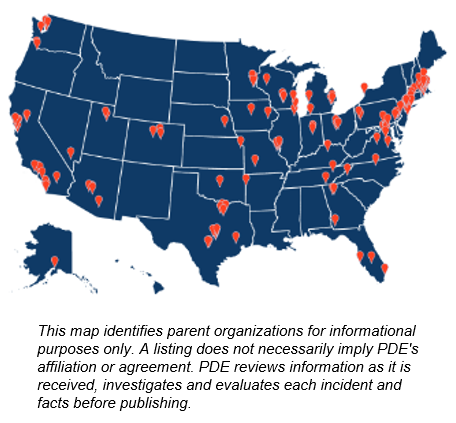
PDE’s ingenious and informative IndoctriNation Map, an online tool that connects parents with grassroots organizations in their states and identifies school districts where objectionable curricula are being taught, has put a burr under leftist saddles. The Popular Information writers discussed this map at length and added a helpful hyperlink, which just might move readers of their tripe to get a clue. PDE is further accused of having become “suspiciously well-organized” during the short time since its founding. Imagine that! Smart parents with a brilliant idea and a worthwhile mission have succeeded in creating a non-partisan, crackerjack organization by teaming up with like-minded parents to fight for the future of their children.
Also blameworthy is No Left Turn, a grassroots organization started by immigrant mom Elana Fishbein, who was repulsed by the indoctrination of her children with CRT. The Popular Information writers moaned that after Fishbein appeared on Tucker Carlson Tonight, her small group’s Facebook page “shot up from fewer than 200 followers to 30,000 overnight,” which should serve as yet another illustration of the dissatisfaction among parents who want propaganda-free schools where basic skills are actually taught. The article also points a finger at “Koch-funded organizations” and Fox News for helping these groups, while failing to mention the likes of George Soros on their side and their champions in the mainstream media.
Liberal Parents Also Concerned
One important aspect of the school board controversy not mentioned in the Popular Information article is the fact that liberal and non-political parents are among those protesting. A self-confessed liberal mom and former school board member named Maud Maron of New York City wrote a letter published on Substack’s “Common Sense with Bari Weiss,” in which she objected to the fact that “the FBI is considering using the Patriot Act against me.”
Maron wrote: “Many of the parents who are on the receiving end of the federal government’s chilling message are new to school boards, new to speaking up and, to say the absurd part out loud, clearly not domestic terrorists. The combination of extended Covid-related school closures; mask mandates; an increasingly extreme race- and gender-focused curriculum; and the removal of tests, honors classes, and merit-based admissions has created a bumper crop of engaged—and, in many cases, enraged—parents rightfully concerned about what is happening in their children’s schools.”
She admitted that she too has “actively participated in many raucous school board meetings where board members, and even the New York City school chancellor, have been shouted down by parents who refused to be ignored. I have never raised my voice to make a point, but I have sat next to those who have. They are sincere parents exercising their civil liberties.”
Maron concedes that as a school board chair, she was “harassed, smeared, and subjected to online campaigns demanding my resignation. Activists who disagreed with me regularly showed up at my school board meetings to give me a piece of their minds…
“It is not fun to listen to people call you names or falsely accuse you of racism. But when you are an elected board member you have an obligation to listen to everyone—everyone—at public meetings. So, I listened. It was often painful. Yet never in my wildest dreams would I ever have considered their activism to be something best handled by the FBI.”
Like most Americans, Maron believes actual violence “should be condemned without reservation, and that school board members can and should immediately call the police in the event of a crime or a credible threat.” But she contends that the incidents cited by the NSBA “are not criminal and they definitely do not warrant federal intervention…”
Maron adds: “Perhaps the most outlandish aspect of all is the NSBA’s risible complaint that parents are spreading lies about Critical Race Theory being taught in school. [Their] letter states: ‘This propaganda continues despite the fact that critical race theory is not taught in public schools and remains a complex law school and graduate school subject well beyond the scope of a K-12 class.’
“Are you kidding me?”
Canceling Christopher Columbus
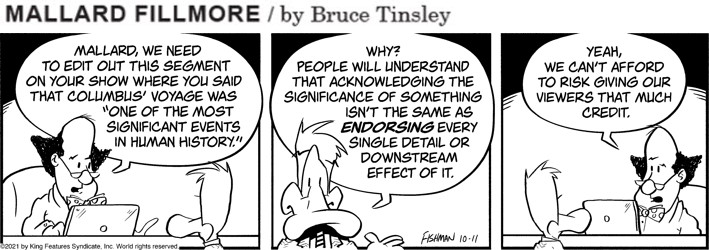
One of the cancel culture’s most vicious attacks on American history involves the Italian explorer Christopher Columbus, who for more than half a millennium was revered for his discovery of the “New World.” While Columbus Day has remained a federal holiday since 1937 — celebrated this year on October 11 — many cities across the country have expunged it from their calendars and instead proclaimed “Indigenous Peoples Day.”
Statues and monuments honoring Columbus have been vandalized or torn down in many locations throughout the land. In New York City’s Central Park, the 76-foot tall statue of the explorer in Columbus Circle must be under constant police guard due to activists who want it torn down.
Jarrett Stepman of The Daily Signal described the basis for these threats in 2017: Activist historians in the late 20th century began concocting “a new narrative of Columbus as a rapacious pillager and a genocidal maniac.” He was portrayed as a rapist and relentless treasure seeker.
Howard Zinn, one of the most influential and destructive of those historians, was immensely successful at tarnishing the legacy of Columbus in the minds of an entire generation. Stepman wrote: “Zinn not only maligned Columbus, but attacked the larger migration from the Old World to the new that he ushered in. It wasn’t just Columbus who was a monster, according to Zinn, it was the driving ethos of the civilization that ultimately developed in the wake of his discovery: The United States.”
Sullying the legacy of Columbus is part of a broader scheme to do away with America’s storied past and replace it with a socialist fantasy of darkness and evil. At the core of Zinn’s wrath against Columbus, for example, is hatred of the American system of free enterprise. Zinn tellingly wrote: “Behind the English invasion of North America, behind their massacre of Indians, their deception, their brutality, was that special powerful drive born in civilizations based on private profit.”
In reality, Columbus’ voyages were about spreading Christianity and for discovering a new route to the far east, specifically China. Historian Carol Delaney, professor emerita at Stanford University, says most people criticizing Columbus today “know very little about the man and are blaming him for things he did not do.”

Delaney’s research shows that Columbus’ true motive for seeking profits from trade with China was to “finance a crusade to wrest Jerusalem back from the Muslims before the end of the world.” For whatever reasons, Columbus believed the world had very little time left.
Both Stepman and Delaney describe the immense dangers Columbus and his men faced as they crossed the Atlantic in search of what Columbus thought was a route to Asia. The hardship and dangers were immense. After the Santa Maria went aground its first voyage, Columbus had to return to Spain to obtain a rescue ship, leaving 39 men behind. Delaney wrote that Columbus had befriended the indigenous natives, especially the chief, Guacanagari and that he “left strict orders that they respect and obey Guacanagari, that they not go marauding and raping.
“[Queen] Isabella sent him back with 17 ships and hundreds more men. A gruesome sight awaited them — all 39 men were dead and spread out on the beach. The incoming sailors wanted revenge on Guacanagari but Columbus said no. He learned that the men had gone against his orders, went marauding to another group of natives and that group came and killed them. He remained friends with the chief but had a difficult time with the incoming men.”
Stepman wrote: “The world was a much bigger place than most had imagined, and although Columbus never personally realized the scope of his discovery, he opened up a new world that would one day become a forefront of human civilization.
“This is the man and the history that earlier generations of Americans came to respect and admire.”
Stepman further noted that previous attempts to diminish Columbus occurred in the 19th century by “anti-Catholic and anti-Italian groups like the Ku Klux Klan.” He adds that, in our own time, “it would be a tragic loss for our generation and those of the future if the actions of far-left groups prevail who want to see his legacy buried forever.”
Professor Delaney described a little-known fact about the motives of Columbus, that he not only believed Jerusalem had to be in Christian hands so Christ could come again to save all believers, but that when he encountered the natives, he wanted them to be saved as well, and he kept asking Isabella to send more priests to teach and baptize them.
According to Delaney’s years of research, when Columbus returned to Spain for the last time, “he became a lay Franciscan monk and is said to have worn the robes for the rest of his life. Columbus the monk! Whoever heard of this?” she asks.
It appears that the truth about Christopher Columbus is that he was, after all, what many Americans have long believed: a hero for the ages.
Daily Signal Podcasts; Providence Journal.com/2020/10/07; TheCity.nyc/2021
Mallard
The Education Invasion: How Common Core Fights Parents for Control of American Kids
by Joy Pullmann, Encounter Books, 2017
In The Education Invasion, Joy Pullmann blows the lid off Common Core’s cloak-and-dagger origin and its far-reaching tentacles in her copiously annotated, well-written book. She defines Common Core as “a 640-page set of blueprints for K-12 math and English curriculum and tests,” and shows how it’s a major shift even from the No Child Left Behind Act, which required standardized tests in math and reading but left it to the states to formulate them. “Common Core goes further,” Pullmann writes: “It specifies what a set of unelected committees thought every child should ‘know and be able to do’ at each grade level.”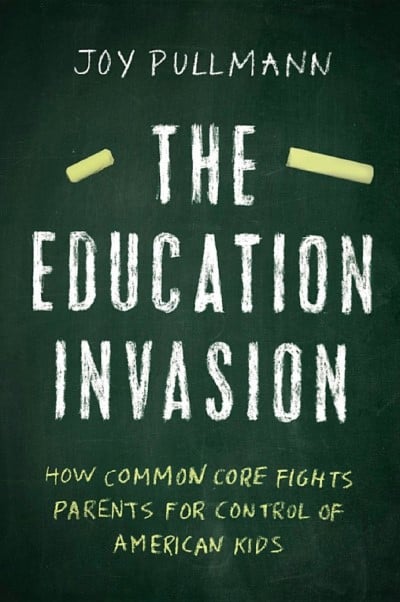 Common Core fails to teach traditional knowledge and instead fosters the notion of a “living work,” which means the standards can change at the whim of current cultural trends. As Pullmann notes: “It serves up cumbersome process requirements wrapped in obscure jargon.”
In day-to-day classroom instruction, this means students no longer read and digest classical literature, but instead are given so-called “informational texts” in a piecemeal fashion. Pullmann uses as an example the fact that an appendix to the standards “does mention elements of cultural knowledge that are central to a classical education, but it mangles them. For example, it selectively quotes the Bill of Rights, and then recommends blatantly biased secondary materials to interpret it as a racist, sexist document.” She adds that many of the fiction books on Common Core’s recommended reading list contain disturbing themes and graphic depictions of sex, pedophilia, violence, and rape.
As for Common Core math, fuzzy does not begin to describe it. While math fads have come and gone, and Education Reporter has covered them all, the Common Core math standards have provoked the single greatest pushback among parents and teachers because they require cumbersome and confusing processes instead of simple, proven arithmetic.
The Education Invasion makes it obvious that the object of Common Core is not to educate children, but to put them through a long and painful process that ends with their learning next to nothing of real cultural or practical value. Teachers must “teach to the tests,” a practice Phyllis Schlafly often warned about, and legions of children have struggled with the sheer number of tests that are required.
How did we get here? The author describes the invention of Common Core as “nationalizing education under the radar.” The biggest myth about the project is that it was “state-led,” because nothing could be further from the truth. Due to the fact that Americans have consistently opposed federal control over education and the U.S. Constitution grants it no such power, “Common Core’s originators ran it through a series of private nonprofit organizations, trying at the same time to make it appear ‘state-led.'”
Although Bill Gates and his foundation funded almost the entire project, Pullmann writes that the concept was actually born in “the nationalization strategy a Brookings Institution paper recommended in 2000.” This paper “suggested a backdoor approach: nonprofit organizations could assert a national interest in education without having to defend themselves against the charge of wanting to become a national school board.”
Common Core had two chief architects: David Coleman and Gene Wilhoit; the latter served as president of the private networking and lobbying organization called the Council of Chief State School Officers (CCSSO) while, as Pullmann describes, “it midwifed Common Core.” Coleman and Wilhoit approached Gates in 2008, and his foundation provided an initial $10 million grant to bankroll the project.
Since 2009, writes Pullmann, “The Gates Foundation has given millions to state and federal departments of education for Common Core, and to national teachers unions. It has spent hundreds of thousands to assist state education agencies in tying teacher evaluations to Common Core. It has spent millions to sponsor forums where advocacy groups lobbied governors, state school board members and lawmakers, local school board members, business leaders, teachers, and other key groups in promoting Common Core. It created a shadow bureaucracy to promote and implement the project.” Despite all this, most parents and members of the general public initially remained unaware of Common Core.
Although her book was originally published in 2017, Pullmann’s anecdotes about parents being denied their First Amendment right to speak out in public forums are eerily predictive of the situation facing parents today. The reader can clearly see the connection between Common Core standards and everything parents are complaining about in 2021.
For example, the author relates how a concerned dad in Baltimore was arrested “after standing up at an informational public meeting attended by the state superintendent, to complain that Common Core had dumbed down his kids’ instruction.” Pullmann recounts how, speaking in a calm voice, this parent asserted that “the goal of the Common Core standards is not to prepare kids for full-fledged universities, it’s to prepare them for community college.” Pullmann confirms the accuracy of this observation, writing: “That is the plain truth, as one of Common Core’s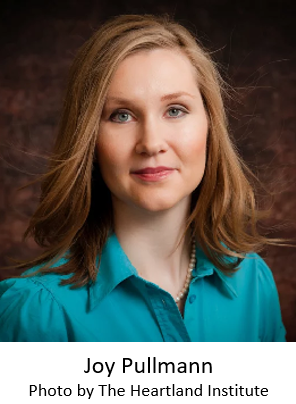 lead writers acknowledged in public testimony.”
Pullmann describes how, as the audience applauded, the parent raised his voice a little and continued to speak, but meeting officials demanded he ask a question. When he failed to do so but continued to “calmly but emphatically” voice his concerns, he was forcibly removed by a security guard. “He was arrested and charged with second-degree assault of a police officer and disrupting a school function,” Pullmann writes, adding: “The video of the incident netted a million views on YouTube — and then the charges were dropped.”
Similarly, a New Hampshire father was arrested after going over his allotted two minutes while complaining to his local school board about his daughter’s sexually graphic literature assignments, which came from the recommended list in the Common Core standards’ appendix. This too was caught on video and posted on YouTube. Pullmann writes that the parent’s voice was agitated, and he interrupted a school board member who talked over him and tried to shut him down, but he didn’t shout or even stand up or show any physical aggression. He just expressed his annoyance in an annoyed tone, and then he got arrested.”
As Pullmann notes, these scattered arrests for constitutionally protected speech, “combined with other tactics of crowd control and intimidation, underscore that Common Core has been imposed upon an unwilling citizenry… Common Core is soft coercion, occasionally reinforced by harder coercion.” When parents began to discover the radical changes taking place in their children’s classrooms, they pushed back, voicing their concerns to state lawmakers and boards of education. A groundswell of opposition to Common Core arose, and movements to repeal the standards blossomed in many states.
Indiana was the first to move against Common Core, with the legislature voting in 2013 to suspend implementation for a year “and submit it to a review and revision.” But Pullmann writes that then-Governor Pence’s “first mistake was delegating the revision to career education bureaucrats instead of teachers and college-level content experts.”
Ultimately, the hands steering the wheel to replace Common Core in Indiana belonged to the same types of people who wrote it and/or openly supported it. After a series of machinations and back-and-forth bickering, the new standards, which were essentially the same standards parents had been fighting to replace, were approved with Governor Pence’s blessing.
Indiana’s battle was repeated to varying degrees in at least 23 states in 2014. Some, such as Arizona, merely renamed the standards. Others, like Florida, went through the motions entirely for show, although Florida did remove “some appendices to Common Core that were already optional.” Just four states passed bills to outlaw Common Core: Indiana, Missouri, Oklahoma, and South Carolina. None succeeded in making substantive reforms.
Since Common Core’s implementation, many good teachers have resigned once they realized they were no longer in control of their classrooms and were increasingly burdened by federal regulations. Many parents have sought alternatives in homeschooling, charter schools, and private educational options. But Common has also infiltrated some charter schools, private schools, and parochial schools. Along with the many true stories and testimonies of teachers, parents, and other opponents of Common Core throughout her book, Pullmann describes the experience of Phyllis Schlafly Eagles President, Ed Martin, who discovered some years ago that his children’s Catholic school had been invaded by Common Core. Martin eventually transferred them to a classical school, which Pullmann quotes him as saying was “intellectually and pedagogically safe, not just physically safe, and that changed our lives.”
Pullmann acknowledges that Common Core “surprised a lot of people when it began popping up in their children’s schools,” but says we shouldn’t have been surprised, despite the fact that its creators and supporters deliberately imposed it by stealth means. “It’s just the next logical step in America’s century-long progression toward a nationalized education system.”
She concludes by noting: “Common Core maintains its hold on our children only if we let it. The question is how much it matters to [us].”
Education Briefs
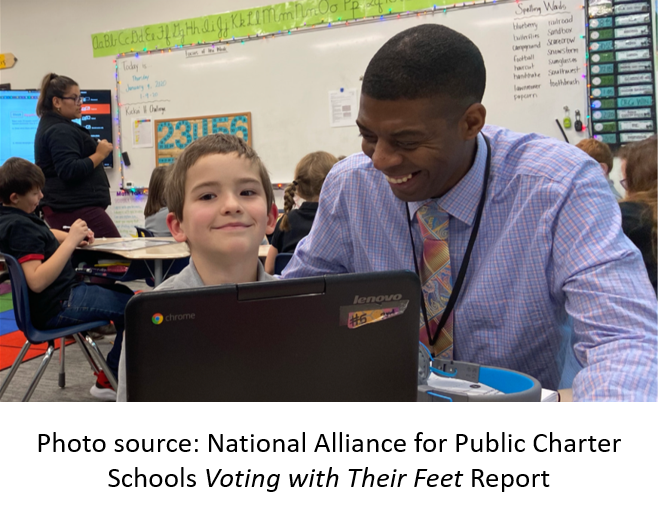
A report titled Voting with Their Feet released last month found that 1.4 million students were removed from traditional public schools during the first full school year since the pandemic, with nearly 240,000 students enrolling in charter schools. According to new data compiled by the National Alliance for Public Charter Schools, “charter school enrollment increased during the 2020-21 school year in at least 39 states, the only segment of the public education sector to grow during the COVID-19 pandemic.” In reporting on the data, an article in The Christian Post stated: “The lockdowns on public education prompted many parents to consider alternatives, as many states exempted private schools and other venues from government lockdown mandates.” The report acknowledged that “it is premature to draw any conclusions about why charter school enrollment grew while enrollment in district public schools declined. And yet the pattern among states in this report is undeniable.” The study found, as data from other sources have also shown, that “the trend of decline in public school enrollment began before the pandemic.” The Post article concluded that clearly in the “unprecedented environment of the past 18 months, families are seeking solutions that will reliably meet their health and safety needs, their childcare needs, and the learning and socio-emotional needs of their children.”
Public Charters.org
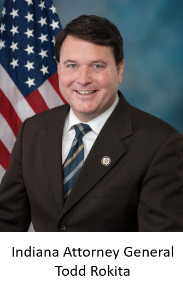
Seventeen state attorneys general have signed a letter to President Biden and Attorney General Merrick Garland opposing the Justice Department’s criminalization of dissent by parents who advocate for their children at school board meetings. They reject Garland’s “Memorandum” and his promised “series of measures” designed to address the alleged “crisis.” Their letter asserts that Garland’s memo and its threats against the free speech of parents “are based upon a flawed premise, i.e. that there has been a nationwide spike in ‘threats of violence against school administrators, board members, teachers, and staff'”; that they “violate the First Amendment rights of parents to address school administrators, board members, teachers, and staff on educational matters by seeking to intimidate parents into silence”; and that they “intrude on the well-recognized First and Fourteenth Amendment rights of parents and guardians to direct the upbringing and education of their children.” These attorneys general charge that Garland’s memo “appears to be based solely on a September 29, 2021 letter from the National School Boards Association (NSBA) to President Biden calling for him to invoke ‘the PATRIOT Act in regards to domestic terrorism,’ arguing that as ‘acts of malice, violence and threats against public school officials have increased, the classification of these heinous actions could be the equivalent to a form of domestic terrorism and hate crimes.'” The attorneys general conclude by requesting that Garland “immediately withdraw the October 4, 2021 Memorandum, to immediately cease any further actions designed to intimidate parents from expressing their opinions on the education of their children,” and they demand that Garland “respect [parents’] First Amendment rights to freedom of speech and to raise their children.” Indiana Attorney General Todd Rokita initiated the letter, and he was joined by his peers in Alabama, Arkansas, Arizona, Georgia, Kansas, Louisiana, Mississippi, Missouri, Montana, Ohio, Oklahoma, South Carolina, South Dakota, Tennessee, Texas, and Utah.
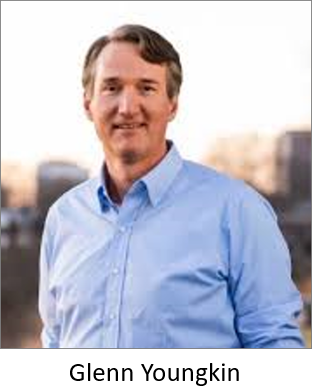
Virginia Republican Gubernatorial Candidate Glenn Youngkin says blame for the present chaos in the state’s schools lies squarely at the feet of his 40-year career Democrat opponent, but also “at George Soros-backed allies in the left, liberal, progressive movement that have inserted political operatives into the system disguised as school boards.” Youngkin made his comments at a campaign appearance in Burke, Virginia, adding that parents and families have the right to speak out and that “we should have much more to say about what our children are taught.” Youngkin has gone on record multiple times in support of Virginia parents who want critical race theory banned, and promises to do so as governor, despite repeated insistence by Virginia school officials that CRT is not being taught. Even the Washington Post admitted: “Some have acknowledged that initiatives like anti-bias trainings employ similar vocabulary such as the terms ‘white supremacy’ and ‘systemic racism,’ but say it doesn’t mean the theory is being taught.” Youngkin says parents know better, and that he wants to teach students how to think rather than what to think. He would also push for a strictly merit-based admissions process at schools like Fairfax County’s prestigious Thomas Jefferson High School for Science and Technology, and favors reinstating more rigorous testing. Youngkin believes students should be in the classroom five days a week and that only parents should make the decision as to whether their child should wear a mask. Election day is November 2, and concerned parents should make their voices heard. WUSA9, 10-20-21
On Parents, Biden Sticks to His Foregone Collusions

The federal government isn’t exactly a bastion of efficiency. In fact, entire late-night comedy routines have been written about the glacial pace of Washington. So how is it that Joe Biden’s Justice Department managed to snap to attention and mobilize against parents within hours of the National School Boards Association’s complaint? That’s simple, one legal group says, if it was the president’s idea to begin with.
How much did the White House know about the NSBA’s campaign against local parents — and when did it know it? That’s the question on everyone’s minds as more people debate the attorney general’s unusually rapid and over-reaching response. “I can tell you from firsthand experience at the Department of Justice,” former Trump official Gene Hamilton said, “working with prior attorneys general in other senior levels of government… that type of a timeline simply does not happen ever. Organizations send letters. Members of Congress send letters all the time to the Department of Justice [and] to other federal departments and agencies. No one ever responds. No one ever reacts within a matter of a few days and issues departmental guidance based on the contents of a request from an outside organization.”
Hamilton’s organization, America First Legal, smelled a rat. They’re so convinced that the timing of the DOJ’s announcement is fishy that they’re pressuring the inspector general to investigate. In a letter to Michael Horowitz, the group points out that the NSBA’s letter to the president (which compared outspoken parents to “domestic terrorists”) was dated September 29 — five days before Attorney General Merrick Garland unleashed the full force of the FBI on local communities. The government doesn’t even process mail that fast! “Nothing ever moves in the government that quickly,” Hamilton agreed, especially when you’re talking about “massive cabinet agencies.” “Clearly, there was some amount of coordination involved here,” he warned. No one gets that kind of special treatment “without some kind of understanding or agreement beforehand.”
According to the people Hamilton’s group consulted from the inside, “Biden administration officials developed a plan to use a letter from an outside group (‘not the usual suspects’) as pretext for federal action to chill, deter, and discourage parents from exercising their constitutional rights and privileges,” they write to Horowitz. Even though the DOJ’s own staff warned that the federal government didn’t have the authority to punish parents, they were told that “this was a White House priority and a deliverable would be created.” Either the entire matter was precoordinated, America First Legal argues, “…[or] the normal clearance process and standard order both within the department (including legal sufficiency review by the Office of Legal Counsel, the Civil Rights Division, the Criminal Division, the Office of Legal Policy, and other components), and between the department and the White House Counsel’s Office and the Office of Management and Budget, were bypassed or corrupted.”
The only way the federal government could justify meddling in these local school board meetings was for someone to call for it. The NSBA’s letter, asking the administration to jump into the debate and crack down on parents, was exactly the excuse they needed. Deep down, the Democrats — including Joe Biden — know that radicalizing education is a losing issue for them. With every school board meeting, every irate parent, every administrative cover-up, their grip on the classroom is slipping — and they know it. The only way to stop the bleeding is to put an end to this uprising. If that means weaponizing the DOJ against moms and dads, they’ll do it. If it means abusing their power and ignoring the plain language of the Constitution, they’ll do that too. They’ll do anything because they know — the future of their party’s extremism depends on it.
“Garland knows this is dangerous nonsense,” NRO’s Andrew McCarthy pointed out. Anyone with his background and experience understands that the principle of free speech doesn’t yield to anything and or anyone. But then, McCarthy argues, “[the AG’s memo] was not a good-faith effort to inform. It was an abusive effort to intimidate.”

And let’s not forget: this isn’t Biden’s first rodeo when it comes to collusion. Remember, back when Barack Obama was president, the Democrats turned local retaliation against parents into an art form. In Minnesota, when moms and dads protested the radical LGBT indoctrination in their district, the Southern Poverty Law Center not only labeled the organization a “hate group,” they sued the parents and got Obama’s DOJ involved. As FRC’s Meg Kilgannon explained on Monday’s “Washington Watch,” “There are all kinds of organizations that are putting tremendous pressure on schools. We’ve talked about the Southern Poverty Law Center a lot over the years, and they have a tremendous influence… but organizations like the National Association of School Boards also contribute to that.”
At the end of the day, this isn’t about violence or threats of violence. (If it were, Senator Josh Hawley, R-Mo., pointed out, the president would be taking America’s real crime problem much more seriously.) This is about shutting up parents so that the Left can continue treating schools like indoctrination camps. “There’s not even a half-hearted attempt to suggest that this was done for a legitimate law enforcement purpose,” Hamilton’s colleague, Stephen Miller, said. “It seems quite obvious that it is meant to chill free speech and intimidate parents into silence and into obedience.”
Fortunately, parents — as everyone but the Left seems to know — have no intentions of going quietly. And neither should anyone who cares about the future of this great nation.
Tony Perkins is president of the Family Research Council. His Washington Update of Oct. 13, 2021 is reprinted by permission.