NEA Convention Lunacy Covers Everything but Education
For the first time in two years, the National Education Association (NEA) held its annual convention, or Representative Assembly (RA) as the union calls it, in person in Chicago over the July 4th weekend. Union president Becky Pringle acknowledged that the NEA moved the RA out of Dallas, Texas where it was originally scheduled to take place, but declined to call it a boycott.

Longtime observer of the NEA’s annual shenanigans, education researcher and expert, Mike Antonucci, called this “a half-truth.” He tweeted on July 7 that according to an NEA board member speaking about the decision to move the conference: “Several other states had already decided to boycott the [convention] in Texas.” Some members argued at the board meeting in November 2021 that “we should show up and support the progressive forces that stand too lonely in the Lone Star state. Others noted the severe repression of reproductive rights, the assault on voting rights, and the astonishing state laws that allow guns at public meetings. But it was the unwillingness of Texas to vaccinate and address the pandemic in a rational, safe fashion that carried the day.” Apart from the NEA faithful, many observers applaud the state of Texas for those very reasons.
Concerned parents and citizens owe many thanks to the North Carolina-based John Locke Foundation for posting the (NEA NBIs) and Mike Antonucci’s Education Intelligence Agency for exposing the NEA’s extreme agenda, which has everything to do with promoting radical leftwing plans and almost nothing to do with teaching academics.

Dr. Terry Stoops, director of the Locke Foundation’s Center for Effective Education, told the Washington Examiner: “It is unsurprising that the NEA tried to conceal their meeting documents,” adding that “they contain embarrassingly little about overcoming learning loss sustained by children attending schools that adhered to masking and reopening recommendations championed by the NEA leaders during the pandemic.”
He added: “NEA leaders claim that they remain focused on the needs of public-school children and educators. Instead, meeting documents show that the NEA is nothing more than a pathetic assemblage of social justice warriors struggling to be relevant in an era of unprecedented parental empowerment.”
Stoops’ assessment may not be far off. Nationwide, parents have been rising up against progressive school boards and curricula, and some are removing their children from public-school classrooms. Public school teachers are leaving the profession for a variety of reasons, and there is currently a shortage of both full-time teachers and substitutes. The increasingly radical politics of the NEA factor into these developments.
NEA New Business Items (NBIs)
The NBIs considered at the 2022 NEA RA ran the gamut of intrusive, non-academically related topics, and some of the more objectionable NBIs follow here.
NBI 15 vows that the NEA will conduct research “to create fact sheets about the largest 25 organizations actively working to diminish a student’s right to honesty in education, freedom of sexual and gender identify [sic], and teacher autonomy.” This means the NEA intends to publish and disseminate everything they can about organizations that strive to protect children from inappropriate sex education programs and transgender grooming, including the names of their leaders, their funding sources, and more. According to Mike Antonucci, this NBI “is the latest in a long history of creating enemies lists.”
NBI 29 states: “The NEA will publicly denounce current and forthcoming Anti-LGBTQ+ legislation.” The national organization “will work with state affiliates to conduct letter-writing campaigns to state legislators, “filing amicus briefs where appropriate,” organizing lobbying efforts, and educating its members and state governments “about the harm anti-LGBTQ+ bills have on LGBTQ+ students and members and showcase work [that] affiliates and members are doing to organize around defeating these bills.” Evidently, Florida’s Parents Rights in Education law and similar acts in other states have struck a nerve with the NEA as they have with leftwing activists across the country.
NBI 34 pledges that NEA “will publicly stand in defense of abortion and reproductive rights and encourage members to participate in activities including rallies and demonstrations, lobbying and political campaigns, educational events, and other actions to support the right to abortion…” The union’s “rationale” for this NBI reads verbatim: “NEA is a social justice union that is a majority female and trans and gender non-conforming folx who will fight against these attacks on our members, students, families, and communities. The reproductive rights of all persons who are able to.” In commenting on this NBI, the Gateway Pundit observed: “The leftist organization doesn’t even seem to recognize its heterosexual male membership…”
NBI 37 calls for “mandatory masking and COVID vaccines in schools, as well as high-quality virtual education for immuno-compromised students and all families who want it by publicizing successful virtual education programs in public schools throughout the nation in existing media outlets.” The rationale for this NBI includes: “Mandatory masking, vaccines, and access to virtual education are necessary policy measures to reduce COVID danger.” The NEA obviously rejects the many reports that show masking doesn’t work, that virtual education was for the most part ineffective and even harmful to students, and that vaccines are unnecessary and potentially risky for children. (See Biden Administration, NEA Push Mandatory Vaccines for Kids.)
NBI 39 reads: “The NEA will demonstrate its support for right to asylum for migrants from Venezuela and Central America now arriving at the U.S. southern border, and demand an end to Title 42 and the Trump ‘Remain in Mexico’ policies by working with affiliates to publicize the impact of such policies on students and families in their communities.”
NBI 40 asserts: “NEA will work with state affiliates to oppose the attempts by school boards and politicians across the country to ‘downsize’ school districts and close campuses permanently. Specifically, the NEA will use existing media channels to publicize and oppose such school closure plans, support direct community actions to keep them open, and advocate for smaller class sizes and public schools in every neighborhood.” This may be difficult even for the NEA to pull off if public-school enrollment continues the decline that began during the COVID-19 pandemic.
As if NBI 29 weren’t enough, NBI 41 attacks Florida’s pro-parent law more directly: “The NEA will take all necessary steps to defeat and overturn the ‘Don’t Say Gay’ law in Florida and other homophobic and antitransgender laws and attacks throughout the country. We will demonstrate this by publicizing our support of and participation in mass actions for LGBT rights and Pride. The NEA will publicize our continued commitment to LGBT youth and all young people’s right to learn about and develop their own sexual orientation and gender identity. The NEA will demonstrate its support for the independent mass actions of youth to defend their existence, dignity, and rights of the LGBT community by encouraging membership participation in rallies, pickets, etc. The NEA will take action to vigorously defend educators who support LGBT youth and who teach about the existence, dignity, rights, mass actions, history, and pride of LGBT people.” Whew! This is in keeping with Becky Pringle’s rant during the convention, in which she practically screamed the union’s support of LGBT rights and its dedication to promoting them.
NBI 47 seeks to turn up the heat on the biased topic of “personal finance standards related to historical reasons that have exacerbated the racial wealth gap in the United States, so that state affiliates may best push for legislation or language in standards that acknowledge this matter.” In other words, the NEA wants to increase divisiveness among educators and students according to ethnic origins and skin color, harking back to slavery and “New Deal era policies that segregated lower income people of all races integrating housing projects.” The rationale for this NBI is to teach students “about the systemic barriers to wealth” so they can “make fully informed decisions and understand the implications of their personal financial situations.” The intent of this NBI is apparently to complement CRT by making white students feel guilty regardless of the financial status of their families, while making non-white students feel victimized, regardless of the financial status of their families.
NBI 53 reads: “NEA shall create a policy task force to develop strategies for placing the intersectionality of climate justice and environmental racism at the center of all relevant conversations and business. We have a moral obligation to model climate engagement and be active visionaries for the future of our planet.” The stated rationale is that “if we truly care about our children, their future, and all future generations, we need to center all our work around intersectional justice predicated within the broader context of the health and well-being of our planet.”
NBI 62 expands on NEA’s radical abortion stance by declaring: “The NEA will use all means at our disposal to defend reproductive freedom and Roe v. Wade, including working with affiliates to organize and support marches and rallies for women’s rights and support clinic defense in cities where abortion clinics are under attack by the right wing. The NEA will defend its members and students who need access to abortions and birth control. The NEA will issue a press release calling on the Biden administration to increase the number of Supreme Court justices, and/or to impeach the justices who went against their sworn testimony to not overturn Roe v. Wade. The NEA will issue a press release calling for an end to the Senate filibuster that is being used now, as it has in the past to block progressive legislation. The NEA will also publicize the above actions through our existing media outlets.” The rationale predictably condemns “the three Trump appointed Supreme Court justices,” charging that they “constitute a far right-wing coup inside the nation’s highest judicial body. The new civil rights movement must defeat these attacks through organizing mass actions to defend women and all Americans from this attack.”
NBI 63 promises to “inform states and locals of the following sample language that may be put in contracts that is LGBTQIA+ inclusive. The language will be as follows: ‘Parental leave’ instead of ‘maternity leave,’ ‘parent’ instead of ‘mother’ or ‘father,’ ‘birthing parent’ instead of ‘mother,’ and ‘non-birthing parent’ instead of ‘father.’ The rationale for this nonsense: “Using this contract language, members need not worry about how a Board of Education/solicitor defines ‘maternity leave,’ ‘mother,’ and/or ‘father’; the language is an inclusive reflection of how LGBTQIA+ members build their families.”
NBI 65 shows NEA’s support for gun control laws. It reads: “NEA, using existing resources, will encourage members and others to wear orange every Tuesday during September and October to show support for common-sense gun safety laws.” The rationale: “To show elected lawmakers and other officials the public’s support for passing stringent gun safety laws, a position that surveys show is held by 80 percent to 90 percent of U.S. voters.” NBI 66 builds on the gun control theme by promising to “post U.S. senators’ and representatives’ positions on NEA-supported gun safety laws” to ensure that “NEA members know where their federal lawmakers stand” on these laws.
The NEA also saw fit, in its near-total exclusion of anything connected to academic teaching, to voice its support of Ukraine. NBI 72 states: “NEA will use existing digital communication tools to educate members and the general public about the illegal Russian invasion, as determined by the United Nations, of Ukraine, which includes the atrocities that occurred from the bombing of residential areas including schools, hospitals, and major cultural sites, causing over 14,000 civilian deaths. Sources should include but not be limited to Education International and other NGOs such as CARE, Project Hope, and the Ukraine Humanitarian Fund.”
Lest the NEA not be clear enough on its positions regarding the LGBTQIA+ community, NBI 82 further clarifies: “The National Education Association shall acknowledge the existence in our country of institutional homophobia and transphobia–the societal patterns and practices that have the net effect of imposing oppressive conditions and denying rights, opportunity, and equality based upon sexual orientation and gender identity. This inequity manifests itself in our schools and in the conditions our students and educators face in their communities.
“In order to address institutional homophobia and transphobia, the National Education Association shall lead by: 1) spotlighting systemic patterns of inequity–homophobia and transphobia–that impact our students and educators; and 2) taking action to enhance access and opportunity for our students and educators. NEA will use our collective voice to bring to light and demand change to policies, programs, and practices that condone or ignore unequal treatment and hinder student and educator success.” The NBI continues with a list of ways the union plans to do this. The rationale states that “it is time to acknowledge and address the systemic homophobia and transphobia taking place in our great public schools. NEA has an obligation to be at the forefront of dismantling an oppressive system full of hate, misinformation, and fear mongering.”
Other NBIs include an attempt to initiate a merger with the American Federation of Teachers (AFT), an effort that has failed in the past, and multiple NBIs calling for more mental health resources and socio-emotional learning (SEL). Most of the proposed NBIs will require additional funding to implement, with an estimated budget of $140,625 needed to fund NBI 15 alone.
While it’s unclear how many of these NBIs were actually approved at the conference, the NEA did issue a press release promoting its approval of a new policy on school policing to “ensure safe, just, and equitable schools.”
NEA reverses policy on school policing
On July 5, Education Week reported on the NEA’s adoption of “a new policy statement calling for an end to the ‘criminalization and policing of students’—but stopped short of urging the removal of armed officers on school campuses.” The article stated: “During the NEA’s representative assembly this week, delegates voted by a wide margin—93 percent in favor—to approve the policy statement, which advocates for restorative justice, culturally competent professional development, family and community engagement, and the elimination of inequities in student discipline and the policing of students on campus.”

The new policy grew out of a task force created by the union last year, and essentially reverses its previous policy of favoring school resource officers (SROs). In a June 23 article posted on The 74 website, Mike Antonucci wrote: “While the policy does not call for an outright ban on police in schools, it makes numerous arguments against their presence, and demands limits on the growth of the school resource officer workforce.”
Antonucci explains that the NEA now views school policing “as a racial justice issue, stating that ‘Native, Asian, Black, Latin(o/a/x), Middle Eastern and North African, Pacific Islander, and Multiracial students, including those who identify as LGBTQ+, have disabilities, and/or are English language learners are in greater jeopardy in schools with a presence of police and law enforcement.” He adds that the union’s communications policy “requires the listing of these groups in this exact order, rather than using a collective term,” apparently to make clear that only white students whose native language is English are unlikely to be targeted in some unjust way by police in school settings.
The NEA report notes specifically that “the presence of uniformed, armed law enforcement and security personnel on school campuses has the effect of criminalizing students. The task force asserts that ‘there is no proof that SROs prevent school shootings,’ and that ‘SROs have shot and killed students, tasered students, tackled and punched students in the head, sprayed students with pepper spray, choked students, thrown students to the ground, and thrown students against walls and lockers.'” One must assume, based on the wording of the NEA’s new policy, that none of the students allegedly so treated were white English speakers.
Antonucci writes that, even as the NEA’s policy on school policing has changed, it also contends that schools are unsafe for NEA members. “An article from March 2022 cites a study claiming ‘one-third of teachers report that they experienced at least one incident of verbal harassment or threat of violence from students during the pandemic.'”
Antonucci allows that the task force report makes “one small nod toward accountability,” noting that educators tend to use SROs to handle student misconduct. He quotes the report as stating: “Most often, it will be educators — administrators, counselors, teachers, ESPs, and other adults on campus — who precipitate the criminalization of school behavior.”
The NEA stopped short of admitting that violence against teachers by students is a major factor in teacher decisions to leave the profession.
Biden Administration, NEA Push Mandatory Vaccines for Kids
We have seen that the NEA’s New Business Item 37 calls for “mandatory masking and COVID vaccines in schools,” both of which have been a source of controversy for two years. In late June, just prior to the start of the Representative Assembly (RA), Biden Administration officials called for teachers of America’s youngest children to urge their parents to have them vaccinated against COVID-19.
Newsmax reported on June 29 that Education Secretary Miguel Cardona and Health and Human Services Secretary Xavier Becerra co-signed a letter to early childhood teachers and staff which read in part: “As trusted messengers, staff of ECE programs and schools play a vital role in spreading the good news that COVID-19 vaccination is available for our youngest children. You are essential in encouraging parents and guardians to learn about and access vaccines for all children six (6) months of age and older, which will be available free at no cost. [sic]”
Included in the letter were exhortations for teachers to “encourage parents to connect with healthcare providers, share information about COVID-19 vaccines with parents with eligible children,” and “partner with local healthcare providers to host vaccination clinics at their facilities or neighborhoods.” HHS announced there are “ample funds” available for the jabs through its We Can Do This campaign using the American Rescue Plan Act’s Elementary and Secondary School Emergency Relief Fund.
Some parents and doctors refuse the ‘good news’
Not all parents and physicians regard the announcement that young children are now eligible to receive COVID-19 vaccines as “good news.” Newsmax noted that in February, the CDC’s own estimate was that “75 percent of unvaccinated children and teenagers in America had already acquired antibodies” to repel or diminish the effects of the virus. Nonetheless, the FDA approved the Pfizer and/or Moderna vaccines for very young children with the CDC’s blessing.
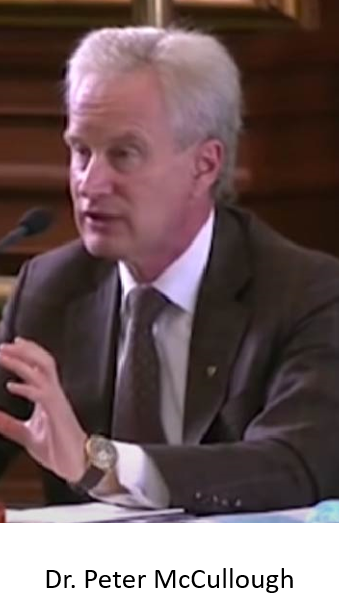
As Dr. Peter McCullough, chief medical adviser to the Truth For Health Foundation told Newmax: “I think it was a mistake for the FDA to approve it, and clearly the CDC recommendation probably won’t be followed by a lot of parents. Children have a very mild syndrome,” he added. “It’s not like with our senior citizens, who are at risk. The coronavirus is easily managed by children.”
Dr. Pierre Kory, Pulmonary and Critical Care Medicine Specialist, President and Chief Medical Officer of the Front-Line Critical Care Alliance, tweeted on June 18: “They’re fast rolling out 10 million vaccines for U.S. toddlers. There is NO science to support this. None. Parents, protect your babies from this pharma campaign. I am begging you. I don’t want more patients, I’m drowning in the care of vax-injured as it is.”
U.K. Diagnostic Pathologist, Dr. Clare Craig, described by health activist and osteopathic physician Dr. Joseph Mercola as a “lover of data,” summarized how “Pfizer twisted its clinical data for young children” to justify its approval of the vaccine for that age group. Craig contends that “the perspective of a pathologist is critical to understanding the problems with data collection.” Her analysis shows that of 4,526 children ages six months to four years who participated in Pfizer’s trial, 3,000 did not make it to the end of the trial. This typically indicates that the side effects were too severe for the participants to continue. She explained that “we don’t know why two-thirds of the participants were eliminated, and on that basis alone, this trial should be deemed null and void.”
Robert Kennedy’s Children’s Health Defense news website, The Defender, reported on a recent op-ed by Dr. Marty Makary that appeared in Newsweek. Makary is an author and professor at Johns Hopkins School of Medicine. His op-ed criticized the government’s decision to “move ahead with vaccinations for children despite ‘no outcomes data’ in this age group.”
Makary wrote: “People don’t trust the CDC,” citing the agency’s decision to recommend COVID-19 booster shots for children ages 5-11, despite a Pfizer spokesperson admitting that its own study of 140 children did not determine the efficacy of the booster in 5- to 11-year-olds.
“That didn’t matter to the CDC,” Makary noted, adding: “Seemingly hoping for a different answer, the agency put the matter before its own kangaroo court of curated experts, the Advisory Committee on Immunization Practices (ACIP). I listened to the meeting, and couldn’t believe what I heard. At times, the committee members sounded like a group of marketing executives.”
Politicians and celebrities push back
Dr. McCullough and his fellow physicians are not the only ones finding fault with the FDA’s decision to vax infants and toddlers. Texas Republican Senator Ted Cruz and Wisconsin Republican Senator Ron Johnson, along with two other Republican Senators and 18 members of Congress, demanded answers in a letter to the FDA regarding its approval of the vaccines for infants and young children.
Among the questions asked by the bicameral group:
- If approved and widely used among children ages five and under how many lives does the FDA estimate will be saved in this age group over the next year? Given the injuries reported in the FDA’s own VAERS system, how will the FDA evaluate potential tradeoffs of serious vaccine injuries versus serious COVID outcomes?
- How many healthy children ages five and under without pre-existing medical conditions have died or been hospitalized from COVID or its variants?
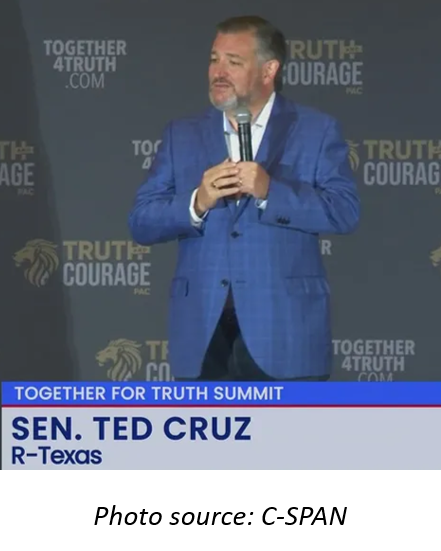
In reference to the letter, Cruz said: “We are in our third year with COVID-19, and we know vastly more about the virus now than we did in 2020. One of the most important things we know is that this virus poses minimal risk for children. Before the FDA approves an Emergency Use Authorization for a children’s vaccine, parents should be able to see the data and paperwork they would use to justify this decision.”
Cruz later caused a stir when he criticized PBS and HBO for using the Sesame Street character Elmo to push for vaccinating children five years and under, without providing scientific evidence that the vaccines are either needed or that they will be effective and safe. “You have Elmo aggressively advocate for vaccinating children under five, but you cite ZERO scientific evidence of this,” Cruz tweeted in a tweet that can no longer be found on Twitter.
Celebrity comedian Russell Brand also had an issue with using the beloved children’s character to push coronavirus vaccines. “Just because there’s a cuddly puppet involved with Band-Aids on it doesn’t make me feel any more assured,” Brand said. He continued: “When it starts getting into complex territory that involves the power of the state, the influence of pharmaceutical companies, the impact of coronavirus on young children — these are not issues I want resolved by members of Elmo’s family.”
Brand then asked: “Have they become so desperate to indoctrinate that they’re willing to infiltrate the world of puppets in order to convey messages about a decision that, I think, is as yet not totally underwritten with scientific data?”
What’s it really about?
With many parents, physicians, politicians, and concerned citizens wondering why the FDA voted unanimously to give three doses of the COVID-19 vaccine to the youngest Americans when there is no compelling reason to do so, Robert Kennedy Jr. offers an explanation.
Products must satisfy four criteria in order to get an EUA (Emergency Use Authorization):
- There must be an emergency
- A vaccine must be at least 30 to 50 percent effective
- The known and potential benefits of the product must outweigh the known and potential risks of the produc
- There can be no adequate, approved, and available alternative treatments (drugs or vaccines)
“Unless all four criteria are met, an EUA cannot be granted or maintained, yet here we are. COVID, by any reasonable measurement, is no longer an emergency, there are plenty of adequate alternative treatments, and the potential benefits in no way, shape, or form outweigh the potential risks — especially not in infants and children under five. That’s three out of four criteria that, clearly, are not met.”
He continues: “The short answer to the question, ‘Why are the CDC and FDA acting so irrationally?’ is that both agencies are corrupt to the core and are no longer in the business of protecting public health. They are securing profits for the drug industry, and getting EUA for infants and young children is a crucial step toward securing permanent legal indemnity for the drug makers.”
Multiple voices have suggested that the goal is to get the COVID-19 vaccine into the mandatory shot record for infants and children. As Kennedy explains: “They need this last remaining age group to be included under the EUA, because once the emergency is finally declared ‘over,’ the next phase of liability shielding requires that the shots receive approval by the CDC’s Advisory Committee on Immunization Practices (ACIP). Once the vaccine is on the childhood vaccination schedule, the vaccine makers are permanently shielded from liability for injuries and deaths that occur in any age group, including adults.”
Like dutiful lapdogs, the Biden Administration, the NEA, and various others continue to demand that parents vaccinate their children, including babies and toddlers. Let’s hope many consider the risks long and hard before giving in to such a questionable demand.
Is the NEA Still Relevant?
Many readers of these pages may be wondering why Education Reporter continues to devote time and effort to chronicle the National Education Association’s (NEA) annual leftwing convention follies, as it has done at least since 1986. It’s a fair question. After all, the NEA’s Representative Assembly (RA) attendance has been trending downward for years. On July 14, Mike Antonucci posted an article on The 74 website noting that this year’s RA attracted just 5,071 delegates, down even from last year’s remotely held RA, which drew nearly 6,000 virtual delegates.
During the NEA’s heyday of the 1990s, attendance at the RA grew, swelling to nearly 10,000 delegates by 1998. But the NEA chooses to ignore the growing loss of interest among its members, including the overall decline in membership, while tirelessly pursuing an ever more radical agenda, the details of which it now protects from the general public as if it were top secret. For example, only one reporter, Madeline Will of Education Week, was allowed onsite at the 2022 RA, whereas during the 1990s and into the 2000s, the NEA issued a number of press passes. Phyllis Schlafly managed to slip in a representative for a number of years, and Mike Antonucci attended for 19 years before his media credentials were denied in 2017.
But despite all this, the NEA remains the largest labor union in the United States with approximately three million members, and is a powerful lobbying force for liberal Democrat candidates and causes.
Many conservative education experts and researchers recognize that the teachers’ unions “control everything.” In his new book, Battle for the American Mind, author and Fox News pundit Pete Hegseth writes: “[T]he powers that be in modern American education — mainly teachers unions at this point — control not just the politicians, but the teachers and the entire educational pipeline. Not just the classrooms and curriculum and teachers’ colleges, but also the PTAs and the school boards.”
Former teacher Rebecca Friedrichs explained in Standing Up to Goliath, her exposé of the NEA and its tactics, that the unions control teachers by creating “an atmosphere of fear, intimidation, and isolation,” all to protect their power and keep the dollars flowing into union coffers.
Perhaps most chilling is the NEA’s influence at the highest levels of American government. In 1976, the NEA endorsed a presidential candidate for the first time, Jimmy Carter, and at the Democratic National Convention that year, NEA had more delegates than any other group. When Carter won the election, he rewarded the teachers’ unions by creating a national Department of Education, an entity they had lobbied for when endorsing Carter.
The NEA has subsequently endorsed Democratic nominees for president exclusively, and two Democrat presidents have addressed the annual RA since 1976: Bill Clinton in 1993 to thank the union for their help in getting him elected; and Joe Biden in 2021. During his address last year, Biden called the NEA “one of the nation’s indispensable organizations.” Appearing with her husband, educator and NEA member Jill Biden acknowledged the union’s powerful voting bloc by saying: “Well here we are. You helped make this real, so thank you NEA.”
Phyllis Schlafly often called the NEA “the most dangerous organization in America,” and warned about the ominous power and political influence of the largest teachers’ union. In the September 1994 issue of her popular Phyllis Schlafly Report, she wrote that the NEA’s legislative success could be attributed to “the effectiveness of its Congressional Contact Team (CCT) program.”
Phyllis explained that in its publication, Advancing NEA’s Legislative Agenda, the union bragged: “[The] NEA, with an average of nearly 5,000 members in each of the nation’s 435 Congressional Districts, is in a unique position to use at-home lobbying efforts … NEA’s Political Advocacy program is responsible for the operation of NEA’s political action committee (NEA-PAC) … In the last election cycle, NEA-PAC ranked third among more than 4,000 political action committees in spending …” All these efforts were in support of liberal Democrats and causes.
Today, the “NEA Legislative Program” appears to have replaced the CCT, and the union continues to advance its political agenda through lobbying and advocacy efforts in Congress as well as at the state and local levels of government. In 2012, Reason magazine wrote of the NEA that our public schools are failing “because the machine that runs the K-12 education system isn’t designed to produce better schools. It’s designed to produce more money for unions and more donations for politicians.”
So while the NEA and its sister union, the American Federation of Teachers (AFT), may appear to have weakened in recent years—they suffered a blow in 2018 when the U.S. Supreme Court ruled in Janus v. AFSCME that non-union workers could not be forced to pay money to public-sector unions—their influence over all things related to education persists.
Concerned parents and citizens will do well to remain aware of their plans and policies.
Mallard
Battle for the American Mind, Uprooting a Century of Miseducation
by Pete Hegseth with David Goodwin, Broadside Books, 2022
If prospective readers think author and television news pundit Pete Hegseth’s new book is just a fluff piece, or worse yet, a regurgitation of other exceptional works about our modern American educational nightmare, such as Alex Newman and Sam Blumenfeld’s Crimes of the Educators, they would be mistaken.
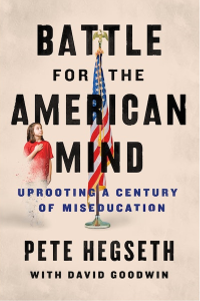 Battle for the American Mind offers a different take on how American education evolved from a biblically based, Western civilization-oriented, parent-directed endeavor to the state-mandated, disordered, secretive mess we see in today’s public schools. As co-author and researcher Goodwin notes on the very first page: “[T]his book is not just about education. It is about freedom, our culture, and our families — and the quiet peril inflicted upon all three.”
Hegseth begins with acknowledgement of how the COVID-19 pandemic opened the school room doors, exposing the propaganda and misinformation being fed to children in public education across the country, including the 1619 Project and CRT, the redefinition of gender, and climate fatalism. Parents saw in full view that their children were being turned into activists. “It was the ‘woke’ versus the newly awake,” Hegseth writes. “You might call it the COVID (16)19 effect.”
But the radical new concepts left many newly awakened parents and observers wringing their hands. As the author admits of himself, they did not understand where all this was coming from. He concedes that his previous books “were unabashedly conservative and pro-American, but the result was impotency,” but believes that Battle for the American Mind gets to the heart of the matter. “Opening this book,” he writes, “you probably thought, as I did, that the problem in our schools is what is being taught. It’s not. The problem is what has been systematically, if quietly removed. (Emphasis in original.) Unless you understand the hidden backstory of this heist, you will almost certainly underestimate what once happened in American schools. The Progressives are counting on the fact that we never remember.”
He recounts the familiar tale of the overarching results of leftist ideology and cultural Marxism on every aspect of curriculum, along with the common concession that “the unions control everything.” He describes the federalization of curriculum in 2010 with Common Core, the influence of Howard Zinn, and the diminution of classical education replaced by training children for the workforce. (Phyllis Schlafly often warned about such training, citing in particular the “School to Work” program advanced by the Bush Administration in the early 2000s.)
After assessing the current situation, Hegseth offers his thesis for how we’ve arrived at this dark hour in American education. He begins by asking the question: “How did the Left get in such a dominant position?” The answer: “With American conservatives mostly preoccupied with defending economic freedom and military might, American Progressives knew that social control was far more powerful than economic control. As such, they set out to gain direct national control of the ‘commanding heights’ of America’s schools. A project set in motion more than one hundred years ago is today leveraged through 16,000 hours of government instruction.”
He then introduces the little-known Greek word “paideia” (pronounced pai-day-uh), which has no direct English translation but from which the word “pedagogy” stems. Pedagogy was the work a paidagogos did in ancient Greece—meaning “a leader who walks with students and trains them in manners, academics and virtue.” As Goodwin points out in the book’s Forward, “if you had to define paideia in a single word, it would be ‘enculturation,’ not teaching. Pedagogy is the act of formulating a culture in children. There’s a clue here. What culture is the Left trying to form?”
 Simply defined, paideia “represents the deeply seated affections, thinking, viewpoints, and virtues embedded in children at a young age, or, more simply, the rearing, molding, and education of a child,” Hegseth writes. (Emphasis in original.) “Classical Christian education creates a paideia unique in all of human history—one that enabled freedom.” Losing that cultural force over time, he contends, created a vacuum that was filled by constructing a new paideia steeped in a new form of religion that replaced the Western Christian Paideia (WCP).
Hegseth may be onto something. While most conservative Christians love their country and are proudly patriotic, is it possible we were deliberately led down the patriotic path to draw us away from focusing on the eternal God and his kingdom, which in turn bred a greater focus on the worldly, even if for the ideals of freedom and personal responsibility?
This reviewer concedes that it could be so. Hegseth cites the work of author Lawrence Cremin, who wrote a Pulitzer Prize-winning “magnum opus on American Education.” Cremin made a compelling case that “from its earliest beginnings, the Progressives were establishing a new paideia to replace the old Western Christian Paideia. He points out that they sought to replace Christ with ‘democracy’ or ‘America’ as the object of education. Specifically, they promoted a view of the good life in progressive America, with religion separate, compartmentalized, personal, and eventually nonexistent.”
Not to decry aspects of our love of country, Hegseth writes that these affections were “co-opted” by Progressives through their American Paideia: “American exceptionalism, the pledge of allegiance, a strong affinity for the flag, and patriotism were the carriers they used early on to supplant the WCP. That does not make these things ‘evil’ today — I revere them all — but an honest reckoning with their origins helps us understand the progressive plot.”
He shows how, with the WCP destroyed, the new American Progressive Paidaia (APP) could be twisted and morphed into any culture the Progressives wanted because it was a human invention. In contrast, the WCP was based on inerrant Scripture and 2,000-years of biblical moral ideals that were unchangeable.
The culture that gradually replaced the APP was “the Cultural Marxist Paideia (CMP),” which rose to maturity just after the turn of the twenty-first century. “With the WCP gone,” Hegseth writes, “the Progressives spent the rest of the twentieth century, post-1965, formulating a new paideia based in ‘critical theory’ that villainized Christianity and the West.”
Most interesting to this reviewer is Battle for the American Mind‘s in-depth history of the WCP. Surprisingly, the seeds for America’s subversion were planted during its founding. “The WCP is a singularity in history,” the authors show. “It was the innovation of a classical world dedicated to freedom and freedom-loving people. It was created specifically to sustain republics more than two thousand years ago. Our founding fathers leaned heavily on the WCP in their debates as they formed the American Republic.”
 But the book contends that Benjamin Franklin and Thomas Jefferson did not have Christian intentions. “They both saw America as a new order—a sort of redemptive force in itself that would become a new promised land. Their imagery conflated the kingdom-purpose of Christianity with America. In the end, the creators of America’s seal prevailed with the Latin phrases Annuit Coeptis (He has favored our undertaking) and Novus Ordo Seclorum (A new order of the ages has begun). The seal’s design had moved to a Roman-inspired eagle, with the Deistic symbol of the all-seeing eye on the reverse. We no longer needed a Christian kingdom, or a symbol of the cross, but a new order under a generic God, vested in a nation based on new ideas. America’s destiny as a City on a Hill, inspired by John Winthrop’s speech of many decades earlier — ‘A Model of Christian Charity’ — was reimagined with America as the light of the nations, not Christ.”
Because there were many Christians among America’s Founding Fathers, including Patrick Henry, John Jay, Samuel Adams, and others, Hegseth observes that “this mixture of Deists and Christians established America on a firm foundation through our Declaration of Independence and Constitution. Both groups realized the danger of tyranny, especially on religious liberty, and thus sought to limit the powers of government.” He clarifies, however, that “the diminished role of Christ’s Kingdom in America’s founding would unintentionally create structural vulnerabilities that Progressives eventually exploited.”
So, what can be done at this late date? Hegseth’s answer is a return to classical Christian education, which the book describes in detail, noting: “Classical Christian schools reject the social studies schema and the progressive educational institutions that govern education, both public and private… Christianity is essential to the classical school model.” To make this happen, Hegseth believes: “Our only chance is to become educational insurgents in our own country.” He provides an anecdote about his personal experience with studying insurgency in Afghanistan. “The Taliban controls Afghanistan today,” he points out, “and America is gone from that battlefield. Insurgencies can work if they are executed properly.”
Battle for the American Mind chronicles the inroads classical schools have already made during their 40-year history in the U.S., and provides a variety of specific examples of their success. (Education Reporter has showcased this movement in past issues and included individual examples.)
Hegseth concedes that, obviously, “our struggle is not military, but instead politico-cultural. We are not looking to topple our government, but instead to defeat the monopoly of government-run schools — and the leftist unions who are their occupying power. In the meantime, we increase our control by building an alternative education model.” He follows with a description of the three phases he believes are essential to success. Finally, he offers an exhortation to parents and grandparents “to choose a different path for their children without shaming them for how, and where, their kids have been educated thus far.
“If we don’t keep Christ the King as the center of our earthly efforts, our insurgency will never leave Phase One,” he states. “America will need a spiritual revival to undergird an effort of such magnitude; so, after you read this book, join us in prayer as we run this race together.”
This reviewer encourages Christians to do exactly that.
To read the entire book, go here to order!
Education Briefs
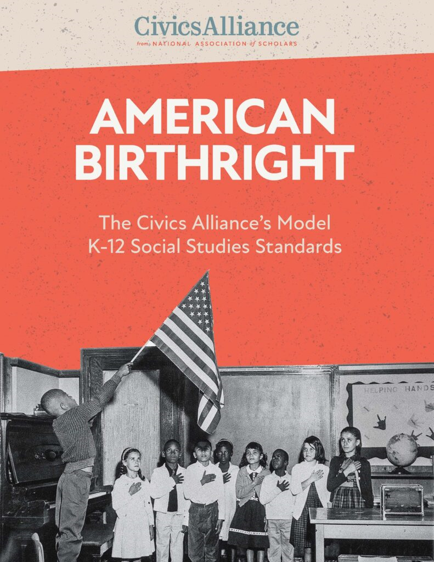
In late June The Civics Alliance, a coalition of organizations, individuals, and policymakers dedicated to improving civics education for American students, released new model social studies standards. The standards resulted from the coalition’s new project called American Birthright: The Civics Alliance’s Model K-12 Social Studies Standards. The Alliance released the model standards a week prior to the July 4th holiday to honor the nation’s annual Independence Day celebration. Civics Alliance Executive Director David Randall stated in a press release: “Every American student should be educated to be another Harry Truman—a high-school graduate who, without ever graduating from college, has a solid grasp of history and is capable of serving as an officer, a judge, a senator, and president.” The press release denounced the efforts of some state education departments for being “set on imposing state social studies standards that combine misguided pedagogical theory, low academic standards, and anti-American animus. Too many Americans emerge from our schools ignorant of America’s history, indifferent to liberty, and estranged from their country.” The coalition’s goal is to provide standards that “teach America’s foundational history of liberty” by providing “the comprehensive content knowledge in history, geography, civics, and economics that should be taught in each grade from pre-K through high school.” American Birthright also teaches “about the expansion of American liberty to include all Americans; the contributions that Americans from every walk of life have made to our shared history of liberty, and America’s championship of liberty throughout the world.” A distinguished panel of expert consultants crafted the new standards using material adapted from sources that “did a particularly good job of providing structure and content for social studies instruction.”

Never one to avoid controversy, Florida Governor Ron DeSantis joined the chorus of voices opposing COVID vaccines for very young children. Royal Patriot.com reported in June that Florida was the only state in the country that did not preorder the vaccines for children under five years of age. DeSantis responded to the inevitable criticism by explaining that “state officials believe the risks of vaccinating young children outweigh the benefits.” He added that while Florida won’t be promoting the vaccines for kids under five, neither will they be banned, and that parents are free to have their children vaccinated if they so choose. The governor pointed out the low risk of COVID for the very young, and blamed “media hysteria” for frightening parents into believing their children are in danger. “They’re scared,” DeSantis said, “because of a lot of misinformation.” The state does recommend COVID vaccines for children five and older.

Tony Kinnett, a science coach in the largest school district in Indiana, explained on his Twitter feed that “here’s what we mean when we tell you that we aren’t teaching Critical Race Theory.” Kinnett uploaded a video he recorded in which he stated: “When we tell you we’re not teaching Critical Race Theory, that it’s not in our standards, that’s misdirection. We don’t have the quotes and theories as state standards per se; we do have Critical Race Theory in how we teach. We tell our teachers to treat students differently based on color. We tell our students that every problem is a result of ‘white men,’ and that everything Western Civilization built is racist; capitalism is a tool of white supremacy.” He asserted that such points come verbatim from Kimberlé Crenshaw’s book, Critical Race Theory, The Key Writings That Formed the Movement, and that these themes are included in all classes; math, history, science, English, and the arts. He added: “All teaching is political, with reality and facts taking a back seat,” from Dr. Gloria Ladson-Billings, “who outlined how she saw Critical Race Theory being fleshed out in public schools in 1995.” Kinnett said that “when schools tell you they’re not teaching Critical Race Theory it can mean only one thing: ‘Go away and look into our affairs no further.’ It isn’t about transparency, it isn’t about cultural relevance, it’s race essentialism, painted to look like the district cares about students of color. We call it ‘anti-racism,’ so you’ll feel bad if you disagree with our segregationist pedagogy…. Parents, when we tell you we aren’t teaching Critical Race Theory, we’re lying.” Kinnett also posted a few visuals to show the veracity of his statements. As may be expected, his video was attacked, but some Twitter users were in agreement and thanked him for his post.
Betsy DeVos Sparks Backlash With Education Proposal — but the Idea Is Far From Crazy
The vicious backlash to DeVos’s remarks actually reveals a broader lesson about just how difficult it is to scale back government once it is expanded.

Former Education Secretary Betsy DeVos was one of the most controversial members of former President Trump’s cabinet. Few officials in the entire administration earned the same level of mainstream media ire and social media nastiness as the secretary. Yet over the weekend [of July 16-17], we saw that the backlash continues even now that DeVos has returned to private life.
DeVos went viral after calling for the abolishment of the federal Department of Education, of which she was previously secretary, during remarks alongside Corey DeAngelis at the right-leaning political convention FreedomFest. (At which I attended and spoke). DeVos took the same position at another conservative political gathering over the same weekend.
This isn’t actually the first time DeVos has taken this position, but for some reason, this time it truly gained widespread traction—and led to hysterical denunciation from political figures and media pundits.
Consider this statement from California Governor Gavin Newsom, a prominent progressive Democrat. “Republicans are trying to destroy public education,” tweeted Newsom. “Banning history. Banning books. Banning student speech. And now Betsy DeVos is admitting it.”
Or similarly hysterical commentary from a wide array of social media commentators:
- From Matthew Sheffield on Twitter (@mattsheffield) — “The Republican policy on public education is that it shouldn’t exist. Last month, Betsy DeVos admitted: ‘I frankly don’t think the Department of Education should exist.’ She is the former Republican Education Secretary.”
- The far-left organization Call to Activism made an obscene remark about DeVos (@CalltoActivism).
- From pitchforks, or passports — @BrandiLynn4Ever: “We got Betsy DeVos calling for the abolishment of the Department of Education. We got Michael Flynn calling on governors to declare themselves commander in Chief of their own State via National Guard and to tell Biden he has no power there. [sic] Do you all understand this is fascism?”
-
Finally, No Lie with Brian Tyler Cohen — @NoLieWithBTC posted:
- “Betsy DeVos just called for abolishing the Department of Education. She made the comments at an event in Florida plotting a far-right takeover of local school boards nationwide. https://floridaphoenix.com/blog/betsy-devos-calls-for-abolition-of-federal-education-department-she-once-led/”
First, let’s clear up some misinformation included in these attacks.
Ending the federal Department of Education would not, in any way, shape, or form, end or abolish public education. Almost all education is funded and provided at the state and local levels.
The Department of Education is simply a regulatory behemoth that issues rules and mandates that forcibly impose one-size-fits-all education on a diverse country. Removing the Department from the equation would not remove the government from education—not even close. It would simply localize more power and scale back an immensely wasteful and dysfunctional bureaucracy.
What’s so bad about that, exactly?
Of course, there’s room for debate about the proper role of the government in education. But the vicious backlash to DeVos’s remarks actually reveals a broader lesson about just how difficult it is to scale back government once it is expanded.
The Department of Education has only existed in its current form since 1980. And, according to Reason, it was created largely by former President Jimmy Carter to win the electoral support of teachers’ unions. But just a few decades later, the idea of its abolition is considered extreme and beyond the pale by huge swaths of the public.
That’s because once a new, vast government bureaucracy expands, it creates an entire class of beneficiaries—both political and financial—who rally support for it and fight like crazy for its preservation, including by misleading the public about what ending that department would entail. (i.e. falsely saying ending the Department would end public education).
That’s why, unfortunately, the Department of Education is unlikely to be abolished any time soon. While those who believe in limited government, federalism, and individual liberty can continue working toward that goal, we ought to take the lesson here and apply it more broadly.
We must be incredibly wary of expansions of the federal government’s power, even those initially proposed as temporary or modest in scope, because once it expands, any effort to scale it back will face tremendous resistance and vitriol.
Just ask Betsy DeVos.
Brad Polumbo (@Brad_Polumbo) is a libertarian-conservative journalist and Policy Correspondent at the Foundation for Economic Education (FEE).
This work is licensed under a Creative Commons Attribution 4.0 International License, except for material where copyright is reserved by a party other than FEE. It was originally published on the FEE Stories web page, July 19, 2022. Content remains as originally published by FEE.org.