
Blockchain in Education:
Building for Lifelong Tracking & Control
Blockchain in education is positioned as a decentralized digital database (or ledger) for the purpose of holding student transcripts, but which also includes personal information such as vaccine history and mental health data. As researcher, podcaster, and former IT professional Lynn Davenport explained in a July video interview with Catching Fire News, blockchain can be described as “blocks of data shared across a chain of computer systems or blocks stored in a virtual chain. It’s being sold as something great because it’s decentralized; it cuts out the centralized authority, or government, and it’s referred to as ‘decentralized ledger technology, or DLT.'”
Davenport calls the city of Dallas, where she resides, “a hotbed of blockchain enthusiasts.” During her interview with Catching Fire News, she detailed a pilot program involving the Dallas Independent School District (ISD) which shows that just the opposite of decentralization is actually taking place.
A single for-profit company called GreenLight Credentials was awarded what Davenport termed “a sweet no-bid deal through Dallas ISD, our regional [education] service centers, the Texas Education Department, and the Dallas Community College District.” She points out that “this one company holds all this information; all the transcripts, vaccine history, and it holds mental health data.” As many observers may imagine, much of the student mental health information is mined from intrusive questionnaires administered by public school districts such as the Dallas ISD.
Centralizing data and power
Davenport reiterates that “they’re centralizing power and authority over all this private sensitive information with one company,” in what GreenLight Credentials aptly calls the “Life Locker.” As Education Reporter described in its May 2022 issue, blockchain is a digital system that will be employed in other areas of life, such as “records of transactions made in bitcoin or another cryptocurrency maintained across a number of computers linked in a peer-to-peer network.”

While blockchain is a complex subject that appears to not yet be fully developed, it’s easy to imagine that a digital record established when a child enters preschool and maintained throughout his academic career is then used to track him for the rest of his life through employment, medical care, financial transactions, purchasing habits, etc. Davenport notes: “GreenLight’s ‘life transcript’ can expand beyond [academic] grades to include professional certifications, job experiences, verified skills, and more. According to Forbes, GreenLight is one of a handful of companies providing access to blockchain records.”
In researching what was happening with blockchain in the Dallas-Fort Worth area, Davenport discovered “the Commit Partnership,” founded by former Goldman-Sachs Real Estate Executive Todd Williams, whom she describes as having no education credentials but who was very successful. “Our mayor appointed him as his education advisor, and from there he grew in power with our Texas Education Agency, and then our governor appointed him to four boards and commissions.”
She adds: “This is important because he has access to multiple ISDs in the metroplex and has access to these data sharing agreements.” She relates that it was Williams and The Commit Partnership that chose Greenlight’s blockchain technology for the Dallas ISD pilot program. Other organizations are embedded in the data sharing agreements as well, and the question becomes, how many organizations actually have access to these volumes of student data?
As Davenport and other investigative researchers have noticed, the data sharing networks “are vast.” Some tentacles “are tied to ‘Teach for America,’ some to big investors such as Steve Ballmer, former CEO of Microsoft, and some to ‘machine learning’ and artificial intelligence (AI).” Davenport says she learned from fellow researcher Alison McDowell that “all this data is being fed into human capital markets and is also creating the digital twins of our children: you’ve got your virtual [avatar] self and your ‘real’ self and they are ‘learning’ you through massive amounts of data that can be commodified.”
Davenport asserts that the Dallas ISD is also experimenting with a “metaverse campus,” where students attend school virtually by entering into “a video game-like setting a couple of days a week” and for the remaining days attend classes in their regular school setting. The May 2022 issue of Education Reporter described a similar program being piloted at the University of Arizona.
Data sharing across the globe
During her discussion with Davenport, Catching Fire News host Lynne Taylor, a writer, speaker, and researcher in her own right as well as a tireless opponent of Common Core, noted that “all this data sharing has to comply with international data standards.” She cited a recently signed international agreement that will result in “all that data winding up at the United Nations.”
Once the digital blockchain system is fully in place, a child’s digital avatar and data ledger will determine his rewards and penalties throughout his life based on how well he conforms to established “norms,” and many can hazard a guess as to what those will be. Guidelines for acceptable ideas, beliefs, and practices will be uniform across the globe, and conformers will be rewarded while non-conformers will be penalized and/or punished.
Blockchain and school choice
A critical piece of this control involves harnessing school choice. But rather than viewing the school choice movement as a negative, Davenport believes the pushers of blockchain will use it to their advantage by tying the granting of education vouchers to government funding. “When [public] money follows the child,” observes Davenport, “so does the government and so do the strings. Parents who are trying to escape the public-school system will find themselves entangled in a new system of fraud, waste, abuse, and control.”

Taylor notes that this is already happening in Arizona with the state’s universal school choice program. “If you really look at it, there are so many parameters that are not included in Arizona’s constitution,” she observes. “There are so many red flags, one of which is that economists, not educators, are calling the shots.” She reports that Arizona parents must sign an annual contract agreeing to comply with all the program’s criteria. “If you don’t sign the agreement, you can be fined or even imprisoned.” The actual education dollars are doled out by the state on a “card” authorized and operated by a third party, so parents never see the funds in their bank accounts. Taylor says parents must “continually go to this third party and say ‘mother may I please.’ That’s not freedom; that’s not choice.”
The above sounds like a dismal, disappointing prospect for a movement that so many have held in such high and hopeful regard for so long. Both Taylor and Davenport agree that parents are so frustrated with the public schools and what they have become that any offer of school choice is attractive, even if it becomes yet another trap. “They just want to see the collapse of the public-school system,” says Davenport. “And they don’t care about the strings” that may be tied to vouchers.
She is convinced that Texas authorities plan to expand blockchain throughout the education system in the Lone Star State. “There are 5.4 million children in Texas education, and the Dallas program will be scaled throughout the state, and then nationwide. I have seen Department of Education documents indicating that they are absolutely watching what is happening in the Dallas ISD with Greenlight Credentials and with Dallas Community College, which has been involved in expanding the role of ‘The Commit Partnership’ at the state and local levels.”
Running for office
In an attempt to shine a light on the threat posed by blockchain technology, not only to children but which will eventually impact every American, Davenport ran for a seat on the Dallas College Board of Trustees for District 1. Three candidates faced off, one of which was an incumbent. “It was pretty much a David and Goliath situation,” she concedes. “But I ran in order to expose what I had learned. “
When the third candidate entered the race, she knew she was facing an uphill battle. Even though she ultimately lost the June 18 election, she says she accomplished two of her three goals in running. “We managed to bump out the incumbent, so that was one victory,” she says. “The other was to expose not only the blockchain implementation but other issues at the community college level, such as the adoption of U.N. Sustainable Development Goals.
Davenport received 36 percent of the vote and says she has no regrets about her decision to run. She encourages others to run for local offices in an effort to take back their communities. She urges potential candidates not to worry about winning, noting that “the idea is to engage the voters and encourage them to pay attention to what is going on, and that’s a really awesome opportunity.”
She reports having spent only $4,000 of her own money on her race, foregoing the fundraising and printing of signs and instead running a totally “organic” campaign. “You have to put your ego aside. I didn’t want to see myself or my name everywhere on signs. We shouldn’t put politicians on a pedestal; it breeds narcissism and corruption. My goal was to enlighten people about education and that’s what I focused on.”
Although she experienced four months of grueling campaigning, Davenport says she “truly loved the opportunity because it woke people up to things they just didn’t know were happening. They will go back to sleep, but at least now they can’t say they don’t know.”
Coming to a School Near You:
Environmental Social Governance
Although in development for decades, Environmental Social Governance, or ESG, has bloomed in business and higher education circles over the past two years. Like many draconian measures forced on American citizens and institutions since the start of 2020, purveyors of ESG are using the pandemic as an excuse to further their agenda. While the business sector and academia are already involved, K-12 education appears to be next on the list to be conquered.
As with all facets of socialist control efforts, ESG concepts are purposefully nebulous and vague. It is an international movement that appears to have begun in Europe and is spreading over the globe, having made inroads not only in Europe, but in parts of Africa and the Middle East, as well as in some U.S. corporations and universities. ESG invokes the familiar climate change fearmongering: global warming, rising sea levels, air pollution, sea pollution, child labor exploitation, and call for “a greener future.” Diversity and inclusion are also part of the picture.
The Global Goals for Sustainable Development work hand in hand with ESG. Seventeen stated goals for a global utopia include:
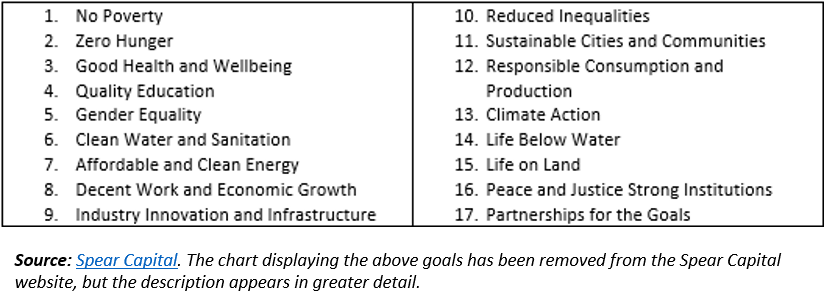
One may observe that these goals are not new; they persist from years past but may be accompanied by new rhetoric and new implementation tactics.
ESG in business
For businesses, ESG means becoming “carbon neutral” by a certain date, typically by 2030. It means meeting a plethora of other criteria; such as adherence to international “sustainability” standards, which begs the questions: Who determines the standards? Who measures compliance?
According to Deloitte.com (of Deloitte Touche Tohmatsu Limited), beginning in 2023, “almost 50,000 companies will now have to report on ESG issues.” Furthermore, the Hungarian Stock Exchange (BéT) “has issued a recommendation to all issuers that they develop an ESG reporting roadmap by the end of the year.”
This means that companies will be measured by how they operate in accordance with the international green agenda (the Green New Deal in the U.S.). Under the “Environmental” pillar, greenhouse gas emissions as well as water and ground pollution will be measured. Also to be assessed is whether recycled materials are used in the processing or manufacturing of goods, and whether or not a company’s end product is recyclable. Land use restrictions and “biodiversity disclosures” fall under this pillar.
Labor practices and employee development fall under the “Social” pillar. Without question, this pillar encompasses the entire spectrum of leftwing diversity and inclusion dictates. Under “Governance” are “shareholder rights, board diversity,” and the financial compensation of executives, which depends on how well they drive their companies’ “sustainability performance.”
ESG in education
A recent article in International Teacher Magazine contends that “the adoption of Environmental Social Governance codes by an increasing number of companies could — and should — be an example for school Boards.” Again, the COVID-19 lockdowns are invoked. As British Author Lisa Walsh writes: “We have missed being outside, becoming aware of the natural world in a way that pre-Covid, urbanized, air-conditioned and carbon-fueled society was not. And if we could not get our fix of outdoor life in the flesh during lockdown, we have had Sir David Attenborough’s A Perfect Planet to turn to.”

In case anyone is wondering, A Perfect Planet is a documentary series that imposes an importance and level of “perfection” on everything that exists in nature except for human beings, who are destroying it. The series intimates that nature would be in perfect balance if it weren’t for those pesky humans. But Christians know that God created everything in nature to be subject to man, who was created in His image and likeness, and that man is expected to be a good steward of creation. As man is a fallen creature, he is not always such, which gives those with no God but evolution, who seek power and control, a platform for their relentless push toward global governance.
What will ESG mean for schools? Teacher Magazine’s Walsh doesn’t get specific, but credits teachers with being “among the most environmentally aware social groups in the world.” What she doesn’t mention is that environmental propaganda is a staple at most teachers’ colleges.
She then admits that “environmental education has long been a staple of the curriculum,” i.e., environmental propaganda, but charges that not many schools’ guiding statements “are really environmentally and socially driven.” She predicts that school boards are “increasingly likely to be populated by members who are aware of, influenced by and motivated by ESG commitments.” She muses that we may be approaching a time when younger, more environmentally and socially conscious candidates may take over school boards, i.e. those who have been indoctrinated with the green gospel, CRT, and gender identity studies on their university campuses.
Walsh goes on to opine that school board members “must be accountable for planning their ESG strategy.” She asserts: “Children all around the world will be chomping at the bit to be involved with this because, just like Greta [Thunberg], they want (and deserve) a brighter future devoid of child labour, exploitation, corruption and worse.” She expects a “governance revolution” whereby schools are more widely linked to “business, NGO (non-governmental organization), municipal, regional, and national government communities.”
This is the familiar cradle-to-grave monitoring, and with the new developments in technology with blockchain and other means of digital tracking, the possibilities are indeed ominous. It’s up to informed parents and citizens to ensure this agenda does not become a reality in the U.S.
Going Global with Censorship:
WEF and UN to Police Online ‘Misinformation’
The World Economic Forum (WEF) continues its international mischief by setting its sights on electronic censorship, using what it claims is artificial intelligence (AI) to bolster the more fallible human intelligence. As Robert F. Kennedy Jr.’s Children’s Health Defense noted in its online news vehicle the Defender, one critic of the WEF’s plan, blogger Igor Chudov, suggested it “would globalize the search for wrongthink.”
As pro-family and other right-thinking observers might imagine, “wrongthink” refers to First Amendment rights, beginning with free speech. Most likely due to the fact that more and more people across the globe are becoming wise to the rhetoric of the progressive left and what it really means for the traditional Western standards of freedom and justice, the WEF distances itself from the article before the first sentence.
Titled “The solution to online abuse? AI needs human intelligence”, by Inbal Goldberger, it begins with the following warning to readers:
- Please be aware that this article has been shared on websites that routinely misrepresent content and spread misinformation. We ask you to note the following:
-
- The content of this article is the opinion of the author, not the World Economic Forum.
- Please read the piece for yourself. The Forum is committed to publishing a wide array of voices and misrepresenting content only diminishes open conversations.
The article quickly gets down to business, noting: “As the internet has evolved, so has the dark world of online harms. Trust and safety teams (the teams typically found within online platforms responsible for removing abusive content and enforcing platform policies) are challenged by an ever-growing list of abuses, such as child abuse, extremism, disinformation, hate speech and fraud; and increasingly advanced actors misusing platforms in unique ways.”
It’s of note to point out here that author Goldberger, as reported by the Defender, “is vice president of ActiveFence Trust & Safety, a technology company based in New York City and Tel Aviv that claims it ‘automatically collects data from millions of sources and applies contextual AI to power trust and safety operations of any size.'”
Of course, there’s nothing to see here — nothing but the desire of Goldberger and her company to safeguard “the children.” She is proposing “a system based on ‘human-curated, multi-language, off-platform intelligence’ — in other words, input provided by ‘expert’ human sources that would then create ‘learning sets’ that would train the AI to recognize purportedly harmful or dangerous content.”
Automating censorship
Igor Chudov, who authors the online Igor’s Newsletter on Substack, analyzed Goldberger’s article, writing on August 11 that “the WEF is becoming a little concerned. Unapproved opinions are becoming more popular, and online censors cannot keep up with millions of people becoming more aware and more vocal. The censorship engines employed by Internet platforms turned out to be quite stupid and incapable. People are even daring to complain about the World Economic Forum, which is obviously completely unacceptable.”
Chudov noted that Goldberger’s solution to reach beyond the platform-by-platform basis for digital regulation “would allow [the censors] to move beyond the major internet platforms in order to collect intelligence about people and ideas everywhere.” He continued that “such an approach would allow them to know better what person or idea to censor — on all major platforms at once.”
As the Defender reported: “The ‘intelligence’ collected by the system from its ‘millions of sources’ would, according to Chudov, ‘detect thoughts that they do not like,’ resulting in ‘content removal decisions handed down to the likes of Twitter, Facebook, and so on … a major change from the status quo of each platform deciding what to do based on messages posted to that specific platform only.'”
Chudov concluded that, in this way, “the search for wrongthink becomes globalized.”
Didi Rankovic of ReclaimTheNet.org writes that it’s all an effort to automate the censorship of what the left deems hate speech and misinformation. She wrote: “The WEF continues to beat the drum of the need to somehow merge AI and humans as a supposed panacea [for] pretty much any ill plaguing society and economy.”
According to Rankovic, the totally out-of-touch WEF would like to pretend that the burning issue for the world’s citizens is online “misinformation,” rather than skyrocketing inflation, fuel shortages, including the uncertainty of many to be able to heat their homes this winter, the increasing threat of food scarcity, and the myriad other problems facing humanity, both in the U.S. and around the world.
Rankovic points out that references to AI by the WEF and throughout Goldberger’s article is actually erroneous. “The WEF says it is proposing ‘a new framework: rather than relying on AI to detect at scale and humans to review edge cases, an intelligence-based approach is crucial.'” She summarizes Goldberger’s piece as a “techno-bubble word salad” that can ultimately be discerned to mean “simply pressuring social networks to start moving towards ‘preemptive censorship.'”
Gates Foundation-backed UN involvement
The Defender contends that “the WEF isn’t the only entity calling for more stringent policing of online content and ‘misinformation.'” The UN’s Educational, Scientific, and Cultural agency, UNESCO, has a “#ThinkBeforeSharing” initiative to “stop the spread of conspiracy theories.”

UNESCO opines that “The COVID-19 pandemic has sparked a worrying rise in disinformation and conspiracy theories. Conspiracy theories can be dangerous: they often target and discriminate against vulnerable groups, ignore scientific evidence and polarize society with serious consequences. This needs to stop.” They are obviously referring to the skepticism of many citizens who question the effectiveness of the lockdowns, the efficacy of masks, and the safety and effectiveness of the COVID vaccines.
UNESCO’s campaign is a partnership with Twitter, the European Commission and the World Jewish Congress. It is using Twitter to, among other things, dispel the notion that powerful forces are manipulating “secretly behind the scenes with negative intent.”
As the Defender described:
- The #ThinkBeforeSharing campaign provides a host of infographics and accompanying materials intended to explain what “conspiracy theories” are, how to identify them, how to report on them and how to react to them more broadly.
- According to these materials, conspiracy theories have six things in common, including:
-
- An “alleged secret plot.”
- A “group of conspirators.”
- “‘Evidence’ that seems to support the conspiracy theory.”
- Suggestions that “falsely” claim “nothing happens by accident and that there are no coincidences,” and that “nothing is as it appears and everything is connected.”
- They divide the world into “good or bad.”
- They scapegoat people and groups.
#ThinkBeforeSharing follows on the heels of previous similar UN initiatives to counter “misinformation” and “conspiracy theories.” These include a “plan of action to tackle disinformation, sponsored by the U.S., U.K., Ukraine, Japan, Latvia, Lithuania and Poland,” which “emphasizes the primary role that governments have, in countering false narratives,” and “the UN’s #PledgeToPause initiative, which was announced in November 2020, and was described by the UN as “the first global behaviour-change campaign on misinformation.”
These campaigns are part of a broader UN initiative, called “Verified,” that aims to recruit participants to disseminate “verified content optimized for social sharing,” stemming directly from the UN communications department. This means the UN will determine the propaganda to be disseminated uniformly and consistently across social media platforms.
According to the Defender, both “‘Verified’ and the #PledgeToPause campaigns still appear to be active as of the time of this writing.” It states: “The Verified initiative is operated in conjunction with Purpose, an activist group that has collaborated with the Bill & Melinda Gates Foundation, the Rockefeller Foundation, Bloomberg Philanthropies, the World Health Organization, the Chan Zuckerberg Initiative, Google, and Starbucks.” It adds that the UN “has been in a strategic partnership with the WEF” since 2019 based on six “areas of focus,” one of which is “digital cooperation.”
As with many digital initiatives underway at the behest of the WEF and other global forces, #ThinkBeforeSharing is advancing without the knowledge or approval of the general population.
Mallard
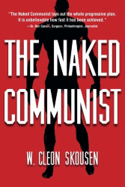
The Naked Communist
By W. Cleon Skousen, 1958 (Most recently reprinted by Izzard Ink Publishing, 2017)
Dr. Mary Byrne was one of the distinguished speakers at the 51st annual Phyllis Schlafly Eagles Leadership Conference held in St. Louis, Missouri on September 17, 2022. Dr. Byrne is an educational consultant and a co-founding member of the Missouri Coalition Against Common Core. With a doctorate in special education from Columbia University, she has spent the past 37 years in education at all grade levels.
 Dr. Byrne’s presentation included a list of the 45 Communist goals from W. Cleon Skousen’s powerful and still-relevant book, The Naked Communist. His comprehensive compilation of information and historical fact exposes the true face of communism, from its denial of evil in favor of expediency to its appeal to those who underestimate it or fail to understand its potential for ruthlessness and brutality. Over the years, many famous readers have lauded the book, from J. Edgar Hoover to Ronald Reagan to Dr. Ben Carson to Glenn Beck, and many others.
According to Dr. Byrne, the 45 goals derived from Skousen”s book “are well worth revisiting today in order to gain insights into the thinking and strategies of much of our so-called liberal elite.” Dr. Byrne explained that the ills plaguing education today “are all connected to each other—from feminism to transgenderism to Social and Emotional Learning to critical race theory,” and that they are a result of the fulfillment of nearly all 45 goals.” She added that these movements “have all been calculated, deliberate, and highly financed.”
 Education Reporter agrees with Dr. Byrne’s assessment that the Communist goals exposed by Skousen are important to know in order to understand the leftward progression of our education system and our culture, and therefore we are reprinting them in this issue.
Following are the 45 goals of Communism (with those Dr. Byrne considers most relevant appearing in bold):
- [The] U.S. should accept coexistence as the only alternative to atomic war.
- [The] U.S. should be willing to capitulate in preference to engaging in atomic war. [Note: These encapsulate the Kennan Doctrine, which advocated for the “containment” of communism. Establishment figures supporting the amoral containment policy at least implicitly worked with the communists in scaring the wits out of the American people concerning atomic war. President Ronald Reagan undid the doctrine when he took an aggressive stand against the Evil Empire by backing freedom fighters from around the world that were struggling against the left-wing communist jackboot. As a result, the Soviet Union and its satellites imploded, a considerable and unexpected setback to the international communist edifice.]
- Develop the illusion that total disarmament by the U.S. would be a demonstration of “moral strength.” [Note: The nuclear freeze advocates supported a freeze on American nuclear development only. Rarely were Soviet nukes or those of other nations mentioned in their self-righteous tirades. The same advocates now call for reducing American military might, claiming that there is something immoral about America preserving its military pre-eminence in the world.]
- Permit free trade between all nations regardless of Communist affiliation and regardless of whether or not items could be used for war.
- Extend long-term loans to Russia and Soviet satellites.
- Provide American aid to all nations regardless of Communist domination. [Note: Such aid and trade over decades contributed greatly to the left-wing communist liquidation of over 100 million people worldwide, according to the well-documented Black Book of Communism. This aid and trade marks a shameful chapter in American history. Without the aid and trade, the left-wing international communist behemoth would have imploded on its own rot a lot sooner and umpteen millions would have been saved from poverty, misery, starvation and death.]
- Grant recognition of Red China and admission of Red China to the U.N. [Note: Not only did President Nixon fulfill this goal but he also betrayed America’s allies in Nicaragua, El Salvador, Iran, Afghanistan, Angola and elsewhere.]
- Set up East and West Germany as separate states in spite of Khrushchev’s promise in 1955 to settle the Germany question by free elections under supervision of the U.N.
- Prolong the conferences to ban atomic tests because the U.S. has agreed to suspend tests as long as negotiations are in progress.
- Allow all Soviet satellites individual representation in the U.N.
- Promote the U.N. as the only hope for mankind. If its charter is rewritten, demand that it be set up as a one-world government with its own independent armed forces. [Note: There are still American intellectuals, and elected members of Congress, who dream of an eventual one-world government and who view the U.N., founded by communists such as Alger Hiss, the first secretary-general, as the instrument to bring this about. World government was also the dream of Adolf Hitler and J.V. Stalin. World government was the dream of Osama bin Laden and the 9/11 hijackers.]
- Resist any attempt to outlaw the Communist Party. [Note: While the idea of banning any political party runs contrary to notions of American freedom and liberty, notions that are the exact opposite of those held by the left-wing communists themselves, nevertheless these goals sought to undermine the constitutional obligation of Congress to investigate subversion. The weakening of our government’s ability to conduct such investigations led to the attacks of 9/11.]
- Do away with loyalty oaths. [Note: It is entirely proper and appropriate for our government to expect employees, paid by the American taxpayer, to take an oath of loyalty.]
- Continue giving Russia access to the U.S. Patent Office.
- Capture one or both of the political parties in the U.S. [Note: In his book, Reagan’s War, Peter Schweizer demonstrates the astonishing degree to which communists and communist sympathizers have penetrated the Democrat Party. In his book, Schweizer writes about the presidential election of 1979.]
- Use technical decisions of the courts to weaken basic American institutions, by claiming their activities violate civil rights. [Note: This strategy goes back to the founding of the American Civil Liberties Union by Fabian Socialists Roger Baldwin and John Dewey and Communists William Z. Foster and Elizabeth Gurley Flynn among others.]
- Get control of the schools. Use them as transmission belts for Socialism and current Communist propaganda. Soften the curriculum. Get control of teachers associations. Put the party line in textbooks.
- Gain control of all student newspapers.
- Use student riots to foment public protests against programs or organizations that are under Communist attack. [Note: The success of these goals, from a communist perspective, is obvious. Is there any doubt this is so?]
- Infiltrate the press. Get control of book review assignments, editorial writing, policy-making positions.
- Gain control of key positions in radio, TV & motion pictures.
- Continue discrediting American culture by degrading all form of artistic expression. An American Communist cell was told to “eliminate all good sculpture from parks and buildings,” substituting shapeless, awkward, and meaningless forms.
- Control art critics and directors of art museums. “Our plan is to promote ugliness, repulsive, meaningless art.”
- Eliminate all laws governing obscenity by calling them “censorship” and a violation of free speech and free press.
- Break down cultural standards of morality by promoting pornography and obscenity in books, magazines, motion pictures, radio and TV. [Note: This is the Gramscian agenda of the “long march through the institutions” spelled out explicitly: gradual takeover of the “means of communication” and then using those vehicles to debauch the culture and weaken the will of the individual to resist.]
- Present homosexuality, degeneracy, and promiscuity as “normal, natural, and healthy.” [Note: Today those few who still have the courage to advocate public morality are denounced and viciously attacked. Most Americans are entirely unwitting regarding the motives behind this agenda.]
- Infiltrate the churches and replace revealed religion with “social” religion. Discredit the Bible and emphasize the need for intellectual maturity, which does not need a “religious crutch.” [Note: This has been largely accomplished through the communist infiltration of the National Council of Churches, Conservative and Reform Judaism, and the Catholic seminaries.]
- Eliminate prayer or any phase of religious expression in the schools on the grounds that it violates the principle of “separation of church and state.”
- Discredit the American Constitution by calling it inadequate, old fashioned, out of step with modern needs, a hindrance to cooperation between nations on a worldwide basis.
- Discredit the American founding fathers. Present them as selfish aristocrats who had no concern for the “common man.”
- Belittle all forms of American culture and discourage the teaching of American history on the ground that it was only a minor part of “the big picture.” Give more emphasis to Russian history since the Communists took over. [Note: Obliterating the American past, with its antecedents in principles of freedom, liberty, and private ownership is a major goal of the communists then and now.]
- Support any socialist movement to give centralized control over any part of the culture — education, social agencies, welfare programs, mental health clinics, etc.
- Eliminate all laws or procedures which interfere with the operation of the Communist apparatus.
- Eliminate the House Committee on Un-American Activities.
- Discredit and eventually dismantle the FBI.
- Infiltrate and gain control of more unions.
- Infiltrate and gain control of big business.
- Transfer some of the powers of arrest from the police to social agencies. Treat all behavioral problems as psychiatric disorders which no one but psychiatrists can understand or treat. [Note: The Soviets used to send “social misfits” and those deemed politically incorrect to massive mental institutions called gulags. The Red Chinese call them lao gai. Hitler called them concentration camps.]
- Dominate the psychiatric profession and use mental health laws as a means of gaining coercive control over those who oppose communist goals. [Note: Psychiatry remains a bulwark of the communist agenda of fostering self-criticism and docility.]
- Discredit the family as an institution. Encourage promiscuity and easy divorce. [Note: Done! The sovereign family is the single most powerful obstacle to authoritarian control.]
- Emphasize the need to raise children away from the negative influence of parents. Attribute prejudices, mental blocks, and retarding of children to suppressive influence of parents. [Note: Outcome-based education, values clarification or whatever they’re calling it this year.]
- Create the impression that violence and insurrection are legitimate aspects of the American tradition; that students and special interest groups should rise up and make a “united force” to solve economic, political, or social problems. [Note: This describes the dialectical fostering of group consciousness and conflict, which furthers the interests of authoritarianism.]
- Overthrow all colonial governments before native populations are ready for self-government.
- Internationalize the Panama Canal.
- Repeal the Connally Reservation so the U.S. cannot prevent the World Court from seizing jurisdiction over domestic problems. Give the World Court jurisdiction over domestic problems. Give the World Court jurisdiction over nations and individuals alike.
Education Briefs
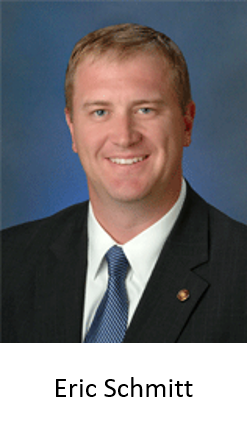
In an all-too-common occurrence, the Springfield, Missouri public school district conducted a teacher training session in August that forced teachers to identify their racial and sexual “privilege.” As writer/editor and senior fellow at the Manhattan Institute Christopher Rufo revealed on Twitter, the training promoted “identities such as ‘pansexual’ and ‘polyamorous,’ and warned that ‘misgendering a trans person is an act of violence.'” The session opened by recognizing “the Native and Indigenous Peoples whose land we currently gather on. Springfield Public Schools is built on ancestral territory of the Osage, Delaware, and Kickapoo Nations and Peoples.” While it’s unclear whether any tribal representatives were present (or cared enough) to witness this groveling, the slide stated: “In doing social justice work, it is important we acknowledge the dark history and violence against Native and Indigenous People across the world…” Rufo noted that the program included transgender activism by following “the basic principles of radical gender theory: that ‘gender is a universe'” and that “society has created a ‘heteronormative’ system that is inherently oppressive.” Training materials acknowledged that “the goal of the program is to subvert this system and affirm identities such as ‘trans,’ ‘nonbinary,’ ‘polyamorous,’ and ‘pansexual.'” The presenters shared a video featuring “genderqueer” and “nonbinary” children, claiming that some students “don’t have a gender,” and that “pronouns matter.” Unfortunately for the Springfield school district, this radical propaganda matters to Missouri’s conservative attorney general, Eric Schmitt, whose office is investigating the training program, and to the Southeastern Legal Foundation, which has filed a lawsuit in an attempt to shut it down. Rufo’s entire article on this subject can be found at City-Journal.org.

The Family Institute of Connecticut wants parents to “stop feeding the insanity at local schools” by first opting children out of school surveys. As Phyllis Schlafly often wrote, these surveys, or what she called “nosy questionnaires,” collect personal data on children that can be stored and shared. The Family Institute notes that the surveys “feed data about your child and family to school administrators, the State Board of Education, and external data collection agencies.” They report that the State of Connecticut “uses Panorama Education and other out-of-state companies to track your child as authorized by benign-sounding state laws. They use that information to justify, of course… 1) more surveys, but also 2) more administrators, 3) comprehensive sex-ed and accompanying sexually explicit books and materials, 4) categorizing and grooming of children, and more.” The Family Institute’s website contains information and suggestions for parents, including a “Parental Opt-Out Form” that can be copied, filled out, and presented to schools to protect children from controversial activities and programs. The form can be used in any state, for as the organization asserts: “There is no constitutional or moral authority for the federal government to create standards for attitudes, values, and beliefs of American citizens, conduct psychological research on them, and to keep this data in perpetuity in state longitudinal databases.”

A teacher’s union and parents are battling in Woodland Park, Colorado for control of the city’s public schools. The union wants to force-feed liberal propaganda to students while parents want to return to reading, writing, math, and science. The Epoch Times reported that last November, after a slate of conservative school board members won four seats on the local school board and immediately began delivering on their campaign promises, the Woodland Park Education Association, an NEA affiliate, instigated a recall effort “with help from its state and national allies.” According to citizen activist and Woodland Park resident, Jameson Dion, one of the new board members was harassed into resigning, and the recall petition is targeting the three remaining conservative members. Their crimes include opposing mask mandates and supporting school choice, higher teacher pay, and greater transparency, which are positions most parents support, and were the reasons the new board members were elected. Teachers received an 8.5 percent pay increase, the COVID-19 mask mandate was eliminated, and the new board created a “sensitive subject” policy to ensure that parents would be informed beforehand of any controversial or age-inappropriate programs. Woodland Park parents have been fed up for years, which prompted the creation of the classical charter school, Merit Academy, in 2021. (Education Reporter wrote about Merit and its resounding success last year.) In resisting the new school board members, Dion told the Epoch Times that the local teachers’ union was “using a playbook established by the NEA,” and that the NEA’s website contains an article on “How to Oust a Right Wing School Board” that describes a similar campaign undertaken a few years ago in the Jefferson County School District near Denver.
Countering disinformation about Critical Race Theory
Critical Race Theory (CRT) has over the last two years been a topic of enormous controversy. But what is it, exactly? Chapter 4 of my book All One in Christ: A Catholic Critique of Racism and Critical Race Theory is devoted to answering that question at length. I go on in chapters 5, 6, and 7 to spell out the many philosophical, social scientific, and theological problems with the view. (As this breadth of issues indicates, there is much in the book that will be of interest and value to non-Catholics.) But chapter 4 is entirely expository, and quotes extensively from CRT writers themselves, so that there can be no mistake about how extreme and dangerous are the views that the subsequent chapters go on to criticize.
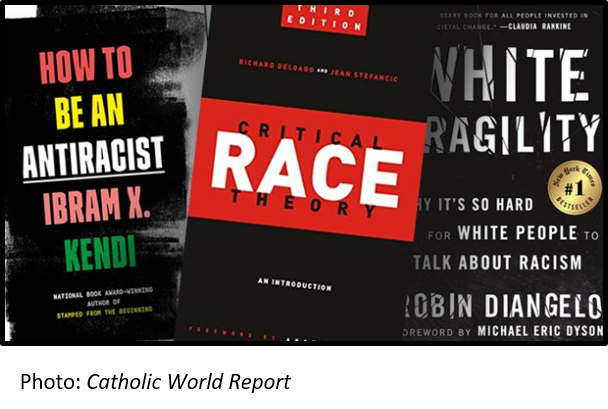
Some advocates of CRT have responded to the exposure of its extremism with what can fairly be described as a program of disinformation. We are told that CRT is merely an abstruse legal theory of little interest to anyone outside the university, and certainly irrelevant to anything being taught to children; or that insofar as it does have influence outside the academy, it is concerned with nothing more than teaching about the history of racism; or that in any event it has nothing to do with the ideas peddled in bestsellers like Ibram X. Kendi’s How to Be an Antiracist or Robin DiAngelos’s White Fragility. These claims are so easily refuted that it is hard not to see in them a cynical tactic of deliberate obfuscation.
Is CRT just an abstract legal theory?
Start with the first claim, about the nature and influence of CRT. Law professors Richard Delgado and Jean Stefancic are not only critical race theorists themselves, but the authors of Critical Race Theory: An Introduction, a well-known primer on the subject. They write:
- Although CRT began as a movement in the law, it has rapidly spread beyond that discipline. Today, many scholars in the field of education consider themselves critical race theorists who use CRT’s ideas to understand issues of school discipline and hierarchy, tracking, affirmative action, high-stakes testing, controversies over curriculum and history, bilingual and multilingual education, and alternative and charter schools.
(p. 7)
They then go on to cite “political scientists,” “women’s studies professors,” “ethnic studies,” “American studies,” “philosophers,” “sociologists, theologians, and health care specialists” as among the scholars, professionals, and fields influenced by, and applying ideas drawn from, CRT (pp. 7-8). Similarly, law professor Angela Harris’s foreword to Delgado and Stefancic’s book notes that:
- Critical race theory has exploded from a narrow sub-specialty of jurisprudence chiefly of interest to academic lawyers into a literature read in departments of education, cultural studies, English, sociology, comparative literature, political science, history, and anthropology around the country. (p. xvi)

Delgado and Stefancic also note that though CRT began as a movement in the law, the influences on its development extend well beyond that field, and include “radical feminism,” the Marxist thinker Antonio Gramsci, and the postmodernists Michel Foucault and Jacques Derrida (p. 5). And they emphasize that “unlike some academic disciplines, critical race theory contains an activist dimension. It tries not only to understand our social situation but to change it” and indeed “transform it” (p. 8). They cite the push for “reconstructing the criminal justice system” and the “‘Black Lives Matter’ movement” as among the practical applications of ideas associated with CRT (p. 124). I learned about prominent thinkers from the Western tradition — such as French philosopher Alexis de Tocqueville — who predicted some of our modern problems.
Another representative CRT work is the anthology Critical Race Theory: The Key Writings that Formed the Movement, edited by Kimberlé Crenshaw, Neil Gotanda, Gary Peller, and Kendall Thomas. In their introduction to the volume, they note that the Critical Legal Studies movement “organized by a collection of neo-Marxist intellectuals, former New Left activists, ex-counter-culturalists” and the like “played a central role in the genesis of Critical Race Theory” (p. xvii). They write that:
- By legitimizing the use of race as a theoretical fulcrum and focus in legal scholarship, so-called racialist accounts of racism and the law grounded the subsequent development of Critical Race Theory in much the same way that Marxism’s introduction of class structure and struggle into classical political economy grounded subsequent critiques of hierarchy and social power. (p. xxv)
And in another obvious echo of Marxism, they emphasize that CRT is an activist movement devoted to “liberation,” whose theorists “desire not merely to understand the vexed bond between law and racial power but to change it” (p. xiii).
Hence, when CRT’s critics portray it as far more than a mere academic legal theory and indeed as a wide-ranging revolutionary political program with Marxist and postmodernist influences, which has swept through academia and seeks radically to transform society through the educational and criminal justice systems, they are not manufacturing a bogeyman. They are simply repeating what CRT advocates themselves have explicitly said.
Is CRT merely about teaching history?
Again, another claim often made is that to the extent that CRT has any influence in schools and other contexts outside the university, it is concerned merely with teaching about the history of racism. When people uninformed about CRT hear this, they are likely to think that what it involves is teaching about slavery in the American south, Jim Crow laws, the Ku Klux Klan, and so on. But that is far from the truth. These are examples of what Delgado and Stefancic label “outright racism,” and as they emphasize, this is to be sharply distinguished from the far more subtle “white privilege” that CRT claims to identify and seeks to extirpate (p. 90).
This purported “white privilege” is so subtle that even if “outright racism” of the familiar sorts is entirely eliminated, white privilege would allegedly remain “intact” so that the “system of white over black/brown will remain virtually unchanged” and “we remain roughly as we were before” (p. 91). This unnoticed racism is nevertheless claimed to be “ordinary, not aberrational … the usual way society does business” (p. 8) and indeed is “pervasive, systemic, and deeply ingrained” to such an extent that “no white member of society seems quite so innocent” (p. 91). The purported “white privilege” of these members of society involves a “myriad of social advantages, benefits, and courtesies that come with being a member of the dominant race” (p. 89). The hostility of whites against non-whites is claimed to manifest itself in “implicit bias” or negative attitudes that are so elusive that whites are unconscious of harboring them (p. 143-44), and in “microaggressions” or racist acts so subtle that whites are unaware they are committing them.
Racism is held by CRT to be so “embedded in our thought processes and social structures” that it is not only conservatism that CRT opposes, but liberalism too (p. 26-27). Like Marxism, CRT stakes out a position far to the left of traditional Democratic Party politics. In place of liberalism’s commitment to “color blindness and neutral principles of constitutional law,” CRT writers advocate “aggressive, color-conscious efforts to change the way things are” (ibid.). CRT calls for “programs that assure equality of results,” even if this conflicts with liberalism’s emphasis on the “moral and legal rights” of the individual (p. 29). One CRT proposal, report Delgado and Stefancic, would be to have “admissions officers discount, or penalize, the scores of candidates” of a “white, suburban” background because of their “white privilege” (p. 134). Some CRT writers even wonder whether “whites [should] be welcome in the movement and at its workshops and conferences” (p. 105). Indeed, a central theme of CRT is the malign influence of “whiteness” itself, a “quality pertaining to Euro-American or Caucasian people or traditions” (p. 186). “Critical White Studies,” Delgado and Stefancic tell us, is a subfield of CRT devoted to “the study of the white race,” which has “put whiteness under the lens” (p. 85).
In place of liberalism’s traditional emphasis on freedom of expression, some CRT writers call for “campus speech codes” and “tort remedies for racist speech” (p. 25), or even the “criminalization” of such speech (p. 125) — which, given the amorphous notions of “implicit bias” and “microaggressions,” could cover anything a CRT advocate finds objectionable. At the same time, in light of the systemic racism they claim afflicts criminal justice, CRT writers advocate lighter sentences or even “jury nullification” for offenses “such as shoplifting or possession of a small amount of drugs” (pp. 122-23). Delgado and Stefancic blandly note that one CRT writer proposes that “the values of hip-hop music and culture could serve as a basis for reconstructing the criminal justice system” (p. 124).
CRT also rejects “traditional civil rights discourse, which stresses incrementalism and step-by-step progress” and instead “questions the very foundations of the liberal order” including ideas such as “equality theory, legal reasoning, Enlightenment rationalism,” and “equal treatment for all persons, regardless of their different histories or current situations” (pp. 3 and 26). Accordingly, CRT holds that the change it advocates may have to be “convulsive and cataclysmic” rather than involving a “peaceful transition,” and “if so, critical theorists and activists will need to provide criminal defense for resistance movements and activists and to articulate theories and strategies for that resistance” (pp. 154-55).
This is just the tip of the iceberg, for according to the CRT notion of “intersectionality,” many individuals “experience multiple forms of oppression” involving not just race but “sex, class, national origin, and sexual orientation” (pp. 58-59). Hence the CRT analysis of and remedies for “systemic racism” must be applied to an analysis of and extirpation of these other alleged forms of oppression as well.
Here I have been quoting from just a single representative text, for purposes of illustration. As the reader of All One in Christ will discover, other CRT writers have other, even more extreme things to say. Whatever one thinks of these ideas, they give the lie to the claim that CRT is merely about teaching the history of racism. It is about promoting a sweeping, revolutionary social and political ideology that even many liberals and Democratic voters would find disturbing if they knew about it.
Some professors teach using the Socratic method, which is teaching by asking questions. The ancient thinker, Socrates, taught his students by asking them questions that were designed to point to the flaws in their arguments and eventually led them to uncover the truth through their own reasoning.
Kendi, DiAngelo, and CRT
The books by Kendi and DiAngelo mentioned above are by far the most influential works promoting the ideas of CRT. Yet some have claimed that their work has nothing to do with Critical Race Theory. This claim too is easily refuted. Kendi himself has acknowledged the influence of CRT on his work:
- I’ve certainly been inspired by critical race theory and critical race theorists. The ways in which I’ve formulated definitions of racism and racist and anti-racism and anti-racist have not only been based on historical evidence, but also Kimberlé Crenshaw’s intersectional theory. She’s one of the founding and pioneering critical race theorists who in the late 1980s and early 1990s said, “You know what? Black women aren’t just facing racism, they’re not just facing sexism, they’re facing the intersection of racism and sexism.” It’s important for us to understand that and that’s foundational to my work.
To be sure, in another context, Kendi has said:
- I admire critical race theory, but I don’t identify as a critical race theorist. I’m not a legal scholar. So I wasn’t trained on critical race theory. I’m a historian … I didn’t attend law school, which is where critical race theory is taught.
But there are two problems with this. First, what matters is whether Kendi is promoting ideas derived from CRT, not whether he is himself a “critical race theorist” in the narrow sense of a legal scholar of a certain kind. And again, he himself has admitted that his work is “inspired” by CRT, indeed that one brand of CRT is “foundational” to his work. Second, as we have seen, CRT writers like Harris, Delgado, and Stefancic admit that CRT is not confined to legal scholarship but has extended far into other parts of the academy, including history, Kendi’s field. So it is disingenuous for him to pretend that the fact that he didn’t go to law school shows that he can’t count as a critical race theorist. If you go just by the actual content of his books and compare it to what is said in works that everyone acknowledges to be works of CRT, it is obvious that he is a critical race theorist.
The same thing goes for DiAngelo. Her academic field is education rather than law, but Delgado and Stefancic themselves put special emphasis on education as a field on which CRT has had dramatic influence. So it would be quite silly to pretend that the fact that she, like Kendi, is not a law professor somehow suffices to show that she is not a critical race theorist. More importantly, she is manifestly a promoter of ideas drawn from CRT, whether or not one wants to classify her as a “critical race theorist” in some narrow sense. The central ideas of White Fragility are the CRT themes of “systemic racism,” “white privilege,” the analysis and critique of “whiteness,” and the insufficiently radical nature of liberalism. In her book Nice Racism, DiAngelo explicitly cites the prominent critical race theorists Kimberlé Crenshaw, Derrick Bell, and Cheryl Harris as among the influences on her work.
Some may nevertheless object that, even if it is admitted that Kendi and DiAngelo are promoters of CRT, it is inappropriate to put as much emphasis on their work as critics of CRT have, since their books are popularizations. But there are two problems with this objection. First, Kendi and DiAngelo are not mere popularizers, but academics in their own right. They can be presumed to know what they are talking about. Second, though some CRT adepts might wish that it was Derrick Bell’s or Kimberlé Crenshaw’s books rather than How to Be an Antiracist and White Fragility that became bestsellers, that is not what has happened. It is Kendi’s and DiAngelo’s books that have in fact had the widest readership and influence, and thus their presentation of CRT ideas that has molded public perception of the movement. It is only natural, then, for critics of CRT to give them a proportionate amount of attention in response.
As readers of my book All One in Christ will find, the content of CRT is even more disturbing than this brief summary indicates — and it is also riddled with blatant logical fallacies, crude social scientific errors, and assumptions and policy recommendations that are utterly contrary to the natural moral law and the Catholic faith. It is unsurprising that advocates of CRT would like to disguise its true nature, but also imperative that they not be allowed to do so.
Edward Feser is the author of several books on philosophy and morality, including All One in Christ: A Catholic Critique of Racism and Critical Race Theory (Ignatius Press, August 2022), and Five Proofs of the Existence of God and is co-author of By Man Shall His Blood Be Shed: A Catholic Defense of Capital Punishment, both also published by Ignatius Press.
This article was originally published by Dr. Feser on his blog, then by Catholic World Report on August 22, 2022.
Reprinted by permission.