
The History of How Public Schools Have Changed
Parents and grandparents of children currently in American public schools recognize that a decline in academic instruction and the mass exodus of certified teachers nationwide, paired with an increase in disruptive classroom behavior, are indicators of a looming disaster in their children’s future. They have been overwhelmed by and suspicious of the changes in K-12 education’s national mission for workforce development, comprehensive sex education curricula, data collection on individual students, and ineffective discipline policies begun under the Obama’s Race to the Top grant program (p. 37).1 Despite a sense that “something is not right,” they are at a loss to identify the cause of their discomfort and suspicions.
Another segment of Americans who may not have direct contact with children in K-12 schools recognize the federal government’s increased suppression of parent speech at school board meetings and the encouragement of individual states to adopt “a new vision for the historic state-federal partnership in education” as undermining the U.S. Constitution’s implicit doctrine of limited government2. Others know that the increased role of the federal government in K-12 schools has not improved students’ reading and math scores for decades and are at a loss to justify the costs of a U.S. Department of Education or explain who orchestrated the changes to diminish local control of school curricula or why they have been programmatically rolled out.
The transformation of the purpose, content, and administration of public education accelerated under the Obama administration, but changes have been made for over a century with little resistance from the American people, who believed their elected officials were working to “do the right thing” on their behalf. Believing that public education was locally controlled, the average American had no apparent reason to suspect an elitist agenda to use the K-12 education system to prepare students to fundamentally transform the United States of America from the freest, wealthiest, and most generous sovereign nation on earth to a socialist member-state of a world governance system, or what Fabian Society founder H.G. Wells described in his book as The New World Order3.
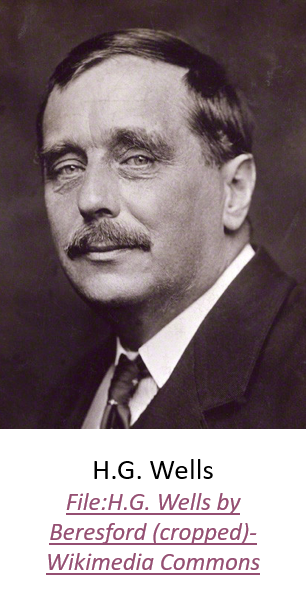
Wells’ book was not a literary fiction but a futurist’s blueprint describing the agenda of the British Fabian Society to construct a one world culture positioning humans in the place of their Creator, and the United States in submission to planners of a global economy. It is an agenda in which individuals no longer dream of unrealized possibilities, but are subjects of the state that demands attitudes, values, and mindsets conform to accepted standards in order to maintain the desired social climate and, ultimately, utopian world peace.
Phyllis Schlafly read and understood the signs of the times when she began an information campaign to expose the entities and processes changing K-12 public schools from transmission centers of our country’s founding ideas and constitution in service of preserving individual liberty, to propaganda distribution centers reconstructed to prepare American children to accept and participate in one world government serving the collective. One of the entities she exposed was the National Education Association (NEA).
In August 2005, the Phyllis Schlafly Report published, “Follies and Failures of the National Education Assn.” Excerpts of the original article were republished as “How Public Schools Have Changed.”4,5, The original article includes a section titled “How the NEA Has Changed.” Under that section, Phyllis described conflicting content between the NEA’s 2005 resolutions and a 1951 NEA-published civics book — The American Citizens Handbook6. The copy gifted to her was the fourth edition of a series of six that ended with the last edition published in 1968.
Phyllis suggested that the radicalization of public schools over the 50 years between the publication of her book and 2005 was linked to the radicalization of the NEA, but she did not elaborate on how the NEA was radicalized or how this resulted in the radicalization of American K-12 public education. Regardless of whether readers have students enrolled in public schools, they should be concerned about what is being taught because the original purpose of publicly funded education is the preparation of a free people to exercise their right of individual liberty, thereby preserving our Republic — not to create a competitive workforce for the global economy.7,8
How the NEA Handbook Has Changed
A comparison of changes in the first through sixth editions of the NEA’s Handbook offers clues explaining how the NEA gradually changed (nudged) American culture from the sovereignty of individuals to the sovereignty of the collective; from civics grounded in debate and deliberation associated with the biblical worldview of government to civics grounded in criticism and “reform” associated with the secular humanist worldview of human evolution; and from citizens governed by the U.S. constitution and their state constitutions to global citizens governed by the United Nations Charter.
First and Second Editions
The first and second editions of the Handbook were both published in 1941 — the year the United States entered WWII. Both editions were copyrighted to the Hugh Birch-Horace Mann Fund National Education Association of the United States10. The copyright page began as follows:
- America is great (emphasis added) because of the ideals which the pioneers established for its homes, for its schools, and for its democratic community life … The future of America depends simply on our being ourselves; on our standing by the ideas that have made us great; on magnifying the home; on building up our schools; and on keeping alive among our citizens the spirit of reform and social advance (emphasis added). (p. 4)11
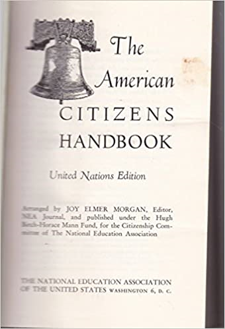
The Table of Contents contained sections with Patriotic Selections, Poetry, and Song, including America First, America, I Love You, and The American Way; Historical Selections including Columbus, The Star-Spangled Banner, and God Bless America; Heroes of American Democracy including Preachers and Theologians along with Authors, Educators, and Statesmen; entire sections on the Flag of the United States, and Charters of American Democracy.
The dedication page of the Handbook states that it was produced for distribution on “Citizenship Recognition Day to be observed by appropriate public ceremonies.” Citizenship Recognition Day was the brainchild of newspaper mogul William Randolph Hearst who in 1939 called for a day to celebrate United States Citizenship. Congress created “I Am an American Day” in 194012. In response to that Act, the Handbook was published for distribution to students who came of age to vote and to newly naturalized citizens, “In order that there may be an impressive public occasion for the induction of these new voters to the responsibilities which go with their new status in our self-governing Republic…(emphasis added).” (p. 1)13,14
In the original editions, the United States is identified as a self-governing Republic consistent with Article IV. Section 4 of the U.S. Constitution which guarantees “to every State in this Union a Republican Form of Government.”15 Republican does not refer to a political party but to polity — a form of civic government. When asked what kind of government the delegates of the 1787 Constitutional Convention created, Benjamin Franklin replied, “A republic, Madam, if you can keep it.”16 The Pledge of Allegiance to the American flag also affirms the United States of America is a republic with the words, “To the republic for which it stands….”17 By the sixth edition of the Handbook, preservation of a self-governing republic is no longer a focus; instead, the focus in on living in a democracy.
Third and Fourth Editions
WWII ended in September of 1945. In a campaign promoted as an effort to establish world peace, the NEA helped formulate plans for the United Nations Educational, Scientific, and Cultural Organization (UNESCO).18 It was in this context that the NEA published the third edition of the Handbook (1946) as The United Nations Edition.19 The Preamble of the United Nation’s Charter, “We the peoples” suggests the transformation of the sovereign U.S. citizens as expressed in the U.S. Constitution’s “We the people”, to global citizens governed by the United Nations. In January of 1946, the Handbook editor, J.E. Morgan, wrote an editorial in the NEA Journal entitled “The Teacher and World Government”:
- [The teachers of the NEA have] had an important part in seeing that a place for education was written into the UNO charter. They have taken a leading part in the London Conference which drafted the charter for the United Nations Educational, Scientific and Cultural Organization…. We now have the obligation to follow thru, to see that the UNESCO charter is ratified and put into effective operation. In the struggle to establish an adequate world government, the teacher…can do much to prepare the hearts of and minds children for global understanding and cooperation…. At the very top of the agencies which will assure the coming of world government must stand the school, the teacher, and the organized profession (emphasis added).20
The vision of world government was proposed as the solution to the manufactured crisis of WWII, but prior to the WWs, the British Fabian Society envisioned a new world order.21,22
In 1951, the NEA published the fourth edition of the Handbook — the edition Phyllis featured in her article. According to the “Note on the Fourth Edition” page, “The principal differences between this and the third edition [1946] are:… The inclusion of the Universal Declaration of Human Rights along with the United Nations Charter and the Constitution for UNESCO…” (p. 6) The additions nearly doubled the size of the book.23 Morgan hailed the NEA’s Handbook as a cultural icon, “Like the Bible, dictionary and atlas, The American Citizens Handbook is becoming a part of the living room library in many homes and is looked upon as indispensable for daily reference and reading” (p. 6).
Phyllis applauded the fourth edition’s pro-American content preserved from previous editions:
- … this nearly-600-page book was intended to promote good citizenship among Public school students. It includes essays on citizenship, brief biographies of “heroes and heroines of American democracy,” and reprints of historical documents that are the “great charters of American democracy.” …The book unabashedly celebrates old-fashioned virtue and patriotism. …This NEA civics handbook embraces “the creation of national unity” and “Americanization” as explicit tasks for the public schools. The book states, “It is important that people who are to live and work together shall have a common mind — a like heritage of purpose, religious ideals, love of country, beauty, and wisdom to guide and inspire them.” …Numerous Old and New Testament selections are included, including the Ten Commandments and the Lord’s Prayer. The Golden Rule, the Boy Scout oath, national songs and uplifting poems appear along with geography facts and a household budget.
While applauding the Handbook’s pro-American, traditional content, she qualified her endorsement stating,
- I don’t approve of everything in the book. It contains a large chapter to promoting the United Nations and a rather embarrassing endorsement of eugenics as a goal of education, so that “highly gifted young people” are encouraged to bear children to “greatly improve our national stock.” Nevertheless, The American Citizens Handbook is a stunning contrast to the radical resolutions adopted by the NEA at its convention this year.24
Phyllis objected to a section of the book containing chapters with titles such as “United Nations Flag of Authority” as well as Sir Julian Huxley’s selective breeding agenda which he promoted through UNESCO (see NEA and UNESCO below).
Fifth and Sixth Editions
The Handbook’s fourth edition was the last edition copyrighted by The Hugh Birch-Horace Mann Fund of the NEA. In 1960, Senior Citizens of America published The American Citizens Handbook: Special 4-H Club Edition.25 Then, Dr. Morgan, approached the National Council for Social Studies (NCSS) for publication of the sixth edition (1968). At that time NCSS was officially a department of the NEA (1925 to 1969).26 According to the Foreword,
- Believing the Handbook to be a useful reference in introducing citizens to the ideals that have inspired the goals and continued development of a democracy (emphasis added) of liberty, equal opportunity, and personal growth, Dr. Morgan generously offered it to the National Council for the Social Studies and contributed his services in preparing this edition. (emphasis added)
On the sixth edition’s page iv is a passage from a co-founder of the Fabian Society — Irish-born British playwright George Bernard Shaw. Shaw indicated that in his role as a thought leader, his responsibility was the transmission of “life” to future generations. Shaw and his wife had no children, suggesting that Shaw was referring to the passing of his “life” to other people’s children.27 Life, as Shaw knew it, was shaped by the British think tank he helped establish — the Fabian Society, a militant, political body of English Socialists influenced by the study of Karl Marx.28
The sixth edition contrasts with the first editions in that it no longer identifies the United States as a self-governing Republic but rather, “the goals and continued development of a democracy.” Though the terms are often confused as synonyms, they refer to very different forms of government and the commonly understood word “democracy” takes on an uncommon meaning.
Footnotes:
1 https://obamawhitehouse.archives.gov/issues/education/k-12/race-to-the-top
2 https://www.achieve.org/files/BenchmarkingforSuccess.pdf
3 http://gutenberg.net.au/ebooks04/0400671h.html
4 https://www.phyllisschlafly.com/family/education/the-phyllis-schlafly-report-august-2005/
5 https://www.phyllisschlafly.com/family/how-public-schools-have-changed-568/
6 https://archive.org/details/americancitizens00morg
7 https://www.monticello.org/the-art-of-citizenship/the-role-of-education/
8 https://eagleforum.org/psr/1997/apr97/psrapr97.html
10 https://archive.org/details/dli.ernet.18262/page/n1/mode/2up
11 http://www.shipofstate.com/books/AmericanCitizensHandbook/AmericanCitizensHandbook.htm
12 https://www.calendar-365.com/holidays/citizenship-day.html
13 https://archive.org/details/dli.ernet.18262/page/n1/mode/2up
14 On February 29, 1952, President Harry Truman signed into law “Citizenship Day” that replaced “I am an American Day”. On August 2, 1956, the Congress requested that the president proclaim the week beginning September 17 and ending September 23 of each year as “Constitution Week” — September 17, 1787 being the date delegates signed-in the Constitution of the United States. Almost 50 years later, in December 2004 a federal law was enacted and designated September 17 as “Constitution Day and Citizenship Day”.
15 https://constitution.congress.gov/browse/article-4/section-4/
16 https://blogs.loc.gov/manuscripts/2022/01/a-republic-if-you-can-keep-it-elizabeth-willing-powel-benjamin-franklin-and-the-james-mchenry-journal/
17 https://www.ushistory.org/documents/pledge.htm
18 https://library.gwu.edu/timeline-national-education-association-nea
19 https://www.worthpoint.com/worthopedia/american-citizens-handbook-1946-3rd-1726393729
20 https://archive.org/details/sim_todays-education_1946-01_35_1/page/n3/mode/2up
21 https://history.unc.edu/wp-content/uploads/sites/804/2022/08/4-NCGS-Fall-2022-Knobloch-Flyer-22-8-2022.pdf
22 https://www.eiu.edu/historia/Carswell3.pdf
23 https://archive.org/details/dli.ernet.18262/page/n1/mode/2up
24 https://www.phyllisschlafly.com/family/education/the-phyllis-schlafly-report-august-2005/
25 https://www.amazon.com/American-Citizens-Handbook-Special-Club
26 https://www.socialstudies.org/social-education/59/7/early-years-1921-1937
27 https://web.english.upenn.edu/~cmazer/mis1.html
28 https://digital.library.lse.ac.uk/objects/lse:viy479sic/read/single#page/10/mode/2up
A Fabian Wolf Disguised in Sheep’s Clothing — Hidden Meanings in Common Words
One of the iconic symbols of the British Fabian Society is a wolf with a sheep skin tied to its torso, which represents one of the Fabian Society’s tactics of deception, shrouding true intentions with benevolent rhetoric. One such tactic is linguistic confusion. The deceivers use words interchangeably that actually have incompatible meanings, or they use words in public discourse that are understood by the naive public to have a commonly shared meaning but members in the know understand the words’ hidden meanings. Examples of these deceptive tactics are the hidden meaning of the word progress and the replacement of the word republic with the word democracy.

Roger Baldwin, a member of the League for Industrial Democracy (an American satellite of the British Fabian Society) and founder of the American Civil Liberties Union (ACLU), explained the hidden meanings of these words as used by socialists in the know.29 Progressive meant “The forces working for the democratizing of industry by extending public ownership and control”; democracy meant “strong trade unions, government regulation of business, ownership by the people of industries that serve the public.”30 “Notes” on p. vi described the NCSS’s “substantial revision and reproduction and editing” in the Handbook’s sixth edition, suggesting that the choice of the word democracy to replace republic was deliberate.
Replacing the word republic with democracy is a clever tactic for rewriting history and nudging each generation of Americans away from the country’s founding ideas. Delegates to the Constitutional Convention of 1787 deliberately rejected democracy (majority rule) as our country’s form of government.31 The delegates chose representative governance in a bicameral structure for the legislature to diffuse power of densely populated states so they couldn’t lord over less populated rural states.32
Columbia University professor George S. Counts distinguished the Progressives’ meaning of democracy from the common meaning generally assumed by the American public:
- The democracy of the past was the chance fruit of a strange conjunction of forces on the new continent; the democracy of the future can only be the intended offspring of the union of human reason, purpose, and will….
- Democracy of course should not be identified with political forms and functions-with the federal constitution, the popular election of officials, or the practice of universal suffrage…it is a sentiment with respect to the moral equality of men:… A society fashioned in harmony with the American democratic tradition would combat all forces-tending to produce social distinctions and classes [equity]; repress every form of privilege and economic parasitism [private property]; manifest a tender regard for the weak, the ignorant, and the unfortunate [oppressed]; place the heavier and more onerous social burdens on the backs of the strong [oppressors]; glory in every triumph of man in his timeless urge to express himself and to make the world more habitable [climate controlled]; exalt human labor of hand and brain as the creator of all wealth and culture [rather than transmitted through tradition]; provide adequate material and spiritual rewards for every kind of socially useful work [behavior modification]; strive for genuine equality of opportunity among all races, sects, and occupations [abolition of meritocracy]; regard as paramount the abiding interests of the great masses of the people [collective]; direct the powers of government to the elevation and the refinement of the life of the common man [centralization]; transform or destroy all conventions, institutions, and special groups inimical to the underlying principles of democracy [discrimination against and suppression of opposition]; and finally, be prepared as a last resort, in either the defense or the realization of this purpose, to follow the method of revolution [violent demonstration]. (Emphasis added). (pp. 41-42)33
Education historian Samuel Blumenfeld commented that Progressives use the terms democracy and socialism interchangeably for deceptive purposes, that is to create confusion in the minds of many intelligent people who favor democracy but oppose socialism.34
Purpose, Philosophy, and People of the British Fabian Society
The Fabian Society was founded early in 1884 as an offshoot of a weaker socialist organization that later folded. Its purpose was to “reconstruct society (emphasis added) in such a manner as to secure the general welfare and happiness,”35 defined of course by the Society, not by the American Declaration of Independence.36
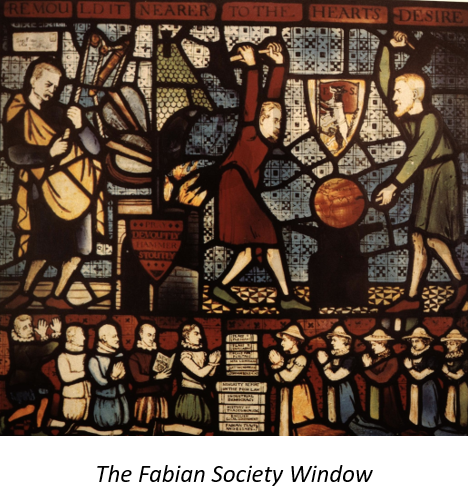
The Fabian Society’s mission is illustrated in the stained-glass Fabian Window on display at the Shaw Library at the London School of Economics and Political Science (LSE).37 The window’s design is attributed to Shaw, who is depicted wearing a green tunic with his right hand wielding a hammer while his left hand steadies a globe on an anvil. Shaw and another founder of the society “mould” a new world. The depiction represents an elite class of humans as re-creators of the world through “scientific reconstruction” rather than natural selection using technology (including medicine) as its tool. On the lower section of the window are two groups of intellectual elites, men on one side and women on the other side of a stack of books symbolizing Fabians’ focus on academic influence as the most important mechanism of power.
The Fabian Society’s LSE, together with the Frankfurt School, gave rise to critical theory (grounded in Marxism) and pedagogy. Critical Race Theory (CRT) in American education is rooted in their foundational work.38 The thought leaders from these institutions continue to influence the NEA resolutions, such as NEA’s 2021 resolution to support the teaching of CRT in K-12 classrooms.39
Diversity, Equity, & Inclusion in Fabian Society Leadership
The Fabian Society became influential because it attracted into its ranks men and women who were leaders or who would become leaders in a variety of intellectual fields.40 British Fabians penetrated political parties, labor unions, government offices, schools, and the press by securing key positions in these institutions. As with economics, morality formed a key component of the Fabians’ reconstruction program from the outset — criticizing the biblical worldview of morality to promote sexual liberation, abolition of the nuclear family, and global governance.41
For example, Fabian Society co-founder Edward Carpenter, Walt Whitman’s homosexual lover and an early gay rights advocate, wrote The Intermediate Sex (1908) which became a foundational text of the LGBT movements of the 20th century.42, 43, 44 Fabian co-founder and sexologist Dr. Havelock Ellis authored The Task of Social Hygiene which promoted birth control for sexual freedom and for training teachers to give sexual instruction to children.45 G. Bernard Shaw, also a co-founder, who is rated among British dramatists as second only to Shakespeare, is recognized for his extensive influence on generations of English-language playwrights.46 Shaw’s 1903 stage play “Man and Superman” posits that humanity is evolving through positive eugenics and reproductive technology towards “superman”.47 His 1911 play “Getting Married” presents monogamous marriage as an oppressive legal institution.48
Fabian eugenicist Julian Huxley (eugenics meaning artificial selection) became the first president of the British Humanist Association and first director-general of the U.N.’s education arm, UNESCO, and wrote its founding document.49 Annie Besant became one of the thought leaders who formulated the principles of English Socialism.50 The most significant of the socialist theosophists, Besant eventually became a worldwide leader of the Theosophical Society after abandoning scientific secularism.
Footnotes:
29 https://www.thecrimson.com/article/1921/12/14/mr-baldwin-to-address-liberal-club/
30 https://avalonlibrary.net/ebooks/Dr%20John%20Coleman%20-%20One%20World%20Order%20-%20Socialist%20Dictatorship.pdf
31 https://www.youtube.com/watch?v=wbsfpeMELGE
32 https://constitution.congress.gov/browse/essay/artI-S1-3-4/ALDE_00013293/
33 http://www.curezone.org/upload/PDF/Counts_George_Dare_the_School_Build_a_New_Social_Order_1932_.pdf
34 https://archive.org/details/NEA–TrojanHorseInAmericanEducationSamuelL.Blumenfeld1984
35 https://digital.library.lse.ac.uk/collections/fabiansociety
36 https://www.archives.gov/founding-docs/declaration-transcript
37 https://blogs.lse.ac.uk/lsehistory/2017/09/13/hammering-out-a-new-world-the-fabian-window-at-lse/
38 https://www.tandfonline.com/doi/abs/10.1080/00071005.2013.824947
39 https://www.heritage.org/education/commentary/unions-double-down-inserting-critical-race-theory-education
40 https://fee.org/articles/the-rise-and-fall-of-england-11-the-fabian-thrust-to-socialism/
41 https://www.jstor.org/stable/1050282
42 https://www.themarginalian.org/2020/06/09/edward-carpenter-walt-whitman/
43 https://www.oxforddnb.com/display/10.1093/ref:odnb/9780198614128.001.0001/odnb-9780198614128-e-32300
44 https://www.gutenberg.org/files/53763/53763-h/53763-h.htm
45 https://www.gutenberg.org/cache/epub/22090/pg22090.txt
46 https://blogs.lse.ac.uk/lsehistory/2020/10/21/the-reluctant-founder-g-bernard-shaw-1856-1950/
47 https://www.forgottenbooks.com/en/download/ManandSuperman_10099452.pdf
48 https://www.gutenberg.org/files/5604/5604-h/5604-h.htm
48 https://atom.archives.unesco.org/director-general-of-unesco
50 https://spartacus-educational.com/Wbesant.htm
The Sixth Edition and Acceleration of Social Reconstruction in American Schools
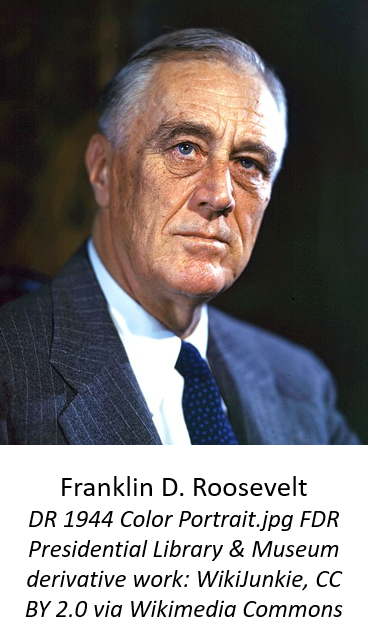
Recall that J.E. Morgan, long-time NEA Journal editor and editor of the original American Citizens Handbook copyrighted to the NEA, also edited the sixth edition of the Handbook that was copyrighted to the NCSS. Harold Ordway Rugg, a member of the faculty at Teachers College, Columbia University, is recognized as one of the “Founding Fathers of the National Council for the Social Studies” which early on became a department of the NEA.51 Rugg was influenced by Fabian Society ideas and promoted “progress” toward America’s social reconstruction and a planned economy. Similar Progressive ideas are seeded in the content of the sixth edition through entries titled “Democracy as a Great Social Faith” and President Franklin D. Roosevelt’s “Four Freedoms,” in addition to the previously included section on the United Nations.
Writing during the Great Depression (1929-1939), Rugg believed that the American economy was flawed because it was “utterly undersigned and uncontrolled.” According to a 1941 TIME magazine article, his awakening began on Jan.1, 1920 when he went to Teachers College’s new, progressive Lincoln School. Rugg encountered the Fabian Society and Progressive thought leaders on the Columbia faculty including John Dewey. Rugg decided to organize a Teachers College group famously known as Frontier Thinkers. The group held bimonthly discussions on “reconstructing” U. S. education and teaching teachers a new jargon.52
The name Frontier Thinkers was likely a nod to Fabian socialist Henry A. Wallace’s book New Frontiers.53, 54 Wallace said that Americans must abandon the frugality, competitive spirit, and individualism of the Old Frontier, where men, whether Protestant or Catholic, accepted implicitly the Protestant work ethic. In the 1990s, Diversity, Equity, and Inclusion consultant Judith Katz disparaged individualism and the Protestant work ethic in a chart entitled “Some Aspects and Assumptions of White Culture in the United States.”55 Her chart was stylized as a poster on the Smithsonian National Museum of African American History and Culture’s website, but was removed in 2020 after vigorous public criticism.56
In his book The Great Technology, Social Chaos and the Public Mind (1933), Rugg called for the “social reconstruction” and “scientific design” of the economy in order to teach “acceptable values” and improve the mental health of Americans.57 Rugg proposed,
- “…through schools of the world we shall disseminate a new conception of government — one that will embrace all of the collective activities of men; one that will postulate the need for scientific control and operation of economic activities in the interests of all people; and one that will successfully adjust the psychological relations among men. Political government in a new connotation, then, including economic government and social government” (emphasis added). (p. 271)
- A new public mind is to be created. How? Only by creating tens of millions of new individual minds and wielding them into a new social mind. Old stereotypes which lack foundation in scientifically established facts and in driving humane attitudes must be uprooted. New ones … must be erected in their place. But this is the task of education … The postulate follows that the economic system can be operated efficiently and humanely only by the elimination re-education and assignment to productive work of the parasitical members of this group of middlemen. (p.179)
Rugg proposed what contemporary leaders in education refer to as acceptable “attitudes, values, and mindsets.” He proposed “new materials of instruction” and produced the first-ever series of school textbooks from 1929 until the early 1940s.58 In one of his books, An Introduction to Problems of American Culture (1931), a social studies textbook for junior high school students, Rugg pointed to Soviet Russia as an example of the comprehensive government control that America needed.59

During the 1930s, over five million American students used Rugg’s social studies textbooks. Rugg’s advocacy of a planned cooperative economy and society caused the American Legion to campaign against Rugg’s work as un-American.60 Though Rugg’s textbooks fell out of favor and ceased to be published, they were replaced with texts written by like-minded disciples.61 They understood the role of K-12 teachers in bringing about the New World Order. Rugg’s Frontier Thinkers colleague George Counts wrote,
- …the teachers should deliberately reach for power and then make the most of their conquest…to fashion the curriculum and the procedures of the school they will…influence the social attitudes, [social-emotional learning] ideals and behavior of the coming generation (emphasis added). (pp. 28-29)
- Today we are witnessing the rise of a civilization quite without precedent in human history — a civilization founded on science, technology, and machinery, possessing the most extraordinary power, and rapidly making of the entire world a single great society. (p. 31)
- …The growth of science and technology has carried us into a new age [of scientism] where ignorance must be replaced by knowledge, competition by cooperation, trust in Providence [biblical worldview] by careful planning [technocracy] and private capitalism by some form of social economy [socialism]. (p. 48)
Counts practiced what he preached. He assumed positions of leadership among the academic elite to steer American education toward socialism. Counts became president of the American Federation of Teachers and a member of the Commission on the Social Studies of the American Historical Association. He was also the first editor of the Progressive journal Social Frontier which advocated enlisting teachers in the reconstruction of society.62
The year after NCSS published the Handbook’s sixth edition, NCSS was no longer a department of the NEA and no subsequent editions were published; however, the implications of the changes to the Handbook from the first to the sixth editions are important because they indicate that the NEA’s long-time commitment and trajectory of the social reconstruction of the United States is aligned to the agenda of the intellectual elite associated with the British Fabian Society.
Footnotes:
51 https://www.socialstudies.org/social-education/59/7/social-studies-and-birth-ncss-1783-1921
52 https://content.time.com/time/subscriber/article/0,33009,765433,00.html
53 https://content.time.com/time/subscriber/article/0,33009,765433,00.html
54 https://archive.org/details/newfrontiers0000henr/page/n5/mode/2up
55 https://www.cascadia.edu/discover/about/diversity/documents.pdf
56 https://www.newsweek.com/smithsonian-race-guidelines-rational-thinking-hard-work-are-white-values-1518333
57 https://books.google.com/books/about/The_Great_Technology.html?id=nyNBAAAAIAAJ
58 https://education.stateuniversity.com/pages/2381/Rugg-Harold-1886-1960.html
59 https://archive.org/details/introductiontopr05rugg
60 https://raunerlibrary.blogspot.com/2019/04/pulling-out-rugg-curriculum.html
61 https://www.city-journal.org/html/abolish-social-studies-13508.html
62 https://education.stateuniversity.com/pages/1891/Counts-George-S-1889-1974.html
American Teachers’ Unions and Fabian Society Influence
Leo Casey, writing for the Albert Shanker Institute, explained how Fabian Society ideas infiltrated the ranks of teachers in the United States through organized labor and the formation of teachers’ unions:
- In the early twentieth century, there was a great deal of trans-Atlantic cross-fertilization between British and American leftists, with London and New York as the two intellectual centers in this exchange of ideas. From the Women’s Trade Union League and the settlement house movement to Fabian Society proposals for reform and the idea of labor party…and campaigns for birth control, sex education and the decriminalization of gay sex, New Yorkers often drew inspiration from their British counterparts. The American Teacher [magazine] followed the development of the National Union of Teachers in the United Kingdom, and New York teachers on the left increasingly looked to it as a model of what could be done in the United States.63
Columbia University philosopher John Dewey was instrumental in this trans-Atlantic cross-fertilization of Fabian socialist ideas and teachers’ unions in the United States.
John Dewey — Bridging the NEA & British Fabian Society

In 1894, philosopher John Dewey became the chairman of the Rockefeller-funded education department at the University of Chicago. Influenced by Darwin’s theory of evolution, Dewey’s evolutionary theory of knowledge was the “scientific” foundation of his ideas about social reconstruction. Dewey established the university’s Laboratory School where he tested his philosophical and psychological ideas on live children.64 The school’s ultimate ideal was the transformation of society by nurturing socially minded individuals. However, the school closed in 1904, when Dewey resigned from the university following a dispute over his appointment of his wife as principal. This ended his laboratory experimentation in education, and Dewey moved to Columbia University in New York.65
Dewey in New York City
In 1929, John Dewey and Fabian Society founder Julian Huxley joined the advisory board of Charles Francis Potter’s First Humanist Society of New York.66 Potter, a former Unitarian minister, made the first move to institutionalize humanism outside Unitarianism. His philosophy openly rejected traditional Christian beliefs and replaced them with a humanist philosophy that incorporated various aspects of naturalism, materialism, rationalism, and socialism.67
In 1933, Dewey co-authored and was a co-signer of the Humanist Manifesto I.68 Consistent with the Fabians’ evolutionary humanist belief system, the first and second statements of the manifesto are “Religious humanists (emphasis added) regard the universe as self-existing and not created” and “Humanism believes that man is a part of nature and that he has emerged as a result of a continuous process.” Though later humanists (who reformed Potter’s organization as the American Humanist Society in 1941) de-emphasized American Humanism as a religion and emphasized the nontheistic and secular nature of humanism, the U.S. Supreme Court recognized secular humanism as a religion in Torcaso v. Watkins, 367 U S 488 (1961).69 In his Terry Lectures at Yale in 1934, Dewey authored what became the single most enduring philosophical statement of religious humanism, published as A Common Faith.70 For Dewey, religion does not involve the supernatural, but is the formation of social intelligence as morality.71
Humanists view schools and teachers as planned agents of social and cultural reform by addressing and solving real-world social problems.72 In other words, schools are viewed as training sites for activists — a kind of non-theistic missionary. Dewey’s book, Education for A Changing Social Order (1934), identifies classroom teachers as the agents of social reconstruction of the United States.73 The mission of teachers as change agents is creating the “new social order.” The NEA adopted this mission when it made academics secondary to its purpose to address social issues.74
In his 1907 essay, “Religion and Our Schools,” Dewey described the missionary role of public schools to teach social unity in a single non-theistic faith, and the counterproductivity of releasing students from school to learn the teachings of “rival faiths”:
- Our schools…are performing an infinitely significant religious work. They are promoting the social unity out of which in the end genuine religious unity must grow…shall we interfere with this work? shall [sic] we run the risk of undoing it by introducing into education a subject which can be taught only by segregating pupils and turning them over at special hours to separate representatives of rival faiths? This would be deliberately to adopt a scheme which is predicated upon the maintenance of social divisions in just the matter, religion, which is empty and futile save as it expresses the basic unities of life…the American people is conscious that its schools serve best the cause of religion in serving the cause of social unification, and that under certain conditions schools are more religious in substance and in promise without any of the conventional badges and machinery of religious instruction than they could be in cultivating these forms at the expense of a state consciousness.75 (p. 807)
Aligned with Dewey’s position, Charles Potter, a co-signer of Dewey’s Humanist Manifesto and author of Humanism, A New Religion, described the role of public schools in the proselytizing of Humanism. Quoting from a colleague’s sermon, Potter wrote,
- Our nation…disestablished the church…In place of the church that it had disestablished, it established the school…. Education is thus a most powerful ally of Humanism, and every American public school is a school of Humanism. What can the theistic Sunday schools, meeting for an hour once a week, and teaching only a fraction of the children, do to stem the tide of a five-day program of humanistic teaching?” (pp. 127-128)76
The anti-Christian messaging permeating American culture today is at least in-part attributable to the Humanists’ view of public schools as their “churches.” Despite Dewey’s claim that democracy is serviced by replacing religious pluralism with a common humanist faith, Dewey and Potter’s statements expose humanism’s state-consciousness in public schools as a government-established religion in violation of the First Amendment.
In 1935, Dewey, served as vice-president of the League for Industrial Democracy (LID); and then as its president in 1941.77, 78 The overlap of Dewey’s years in leadership in the NEA and leadership in the LID indicate the direct link between the NEA and the Fabian socialist agenda. In 1929 Dewey was awarded a Life Membership in the NEA in honor of his 70th birthday. In 1949, at the age of 90, Dewey — the Father of Progressive Education — was made honorary president of the NEA.79 80 Dr. Sam Blumenfeld described the NEA’s relationship with Dewey as one of idolatry stating, “From 1857 to the present, the NEA has worshiped two gods: Horace Mann, a statist, and John Dewey, a socialist.” (p. 181)81
Evidence of the NEA’s Fabian socialist agenda is provided by the most frequent writer in the NEA Journal throughout the 1930s and 1940s — Fabian socialist Stuart Chase — who for some years was treasurer of the League for Industrial Democracy. His book, A New Deal (1932), became identified with the economic programs of American President Franklin Roosevelt.82 Chase wrote in the NEA’s Journal, “It is no longer a question of collectivism versus individualism, but of what kind of collectivism,” after calling for the U.S. government to take over agriculture, banking, credit, and more. Stuart Chase was also affiliated with the NEA’s brainchild UNESCO, advocating for “Some kind of organized world community, probably as an outgrowth of the United Nations…to administer and safeguard a steady state society.”83
Rockefellers’ Support of British Fabian Socialism Abroad and in the U.S.
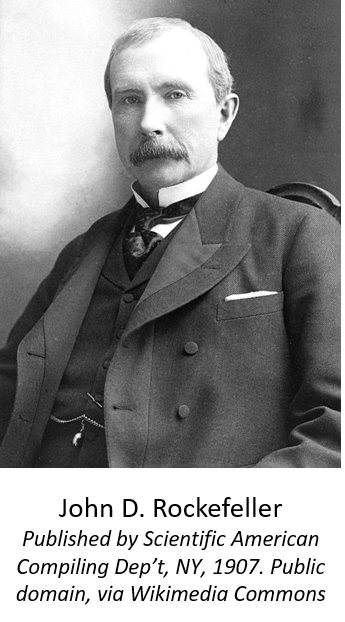
Just as the Fabian Society played a large part in shaping the major teacher unions in the United States as instruments of their agenda, including the NEA, American elites played a large part in supporting the Fabian Society’s agenda. The Fabian Society’s LSE received sizable grants from the Laura Spelman Rockefeller Memorial and the Rockefeller Foundation (RF).84 LSE pioneered the teaching of the social sciences and remains one of the world’s exclusive educational establishments.85
LSE Director John Ashworth stated in 1995, “This is now the institution in which the elite who will lead Europe in the 21st Century are being educated.”86 Indeed, David Rockefeller wrote his senior thesis at Harvard about Fabian Socialism and completed a year of graduate work at LSE.87 The Rockefeller family’s support of LSE was not shared by U.S. Senator Daniel Patrick Moynihan (D-NY). Moynihan identified LSE as the training site of the leaders of many nations “and had propagated the ideals of British socialism that had made these leaders hostile to the U.S.”88 The senator’s accusation of hostility toward the United States did not deter David Rockefeller who later wrote in his book Memoirs,
- Some even believe we are part of a secret cabal working against the best interests of the United States, characterizing my family and me as “internationalists” and of conspiring with others around the world to build a more integrated global political and economic structure—one world, if you will. If that’s the charge, I stand guilty, and I am proud of it. (p. 405)89
In addition, the Rockefellers supported projects aligned to the Fabian Society agenda of scientific progressivism. John D. Rockefeller, Jr., was an outspoken supporter of the eugenics movement as a scientific solution to social problems.90 The Rockefeller Foundation gave considerable funding to the United States Social Science Research Council (SSRC) founded in 1923. It was the first national social science institution in the world and is said to represent the creation of a “science of society.” In his book Fundamental Development of the Social Sciences, Donald Fischer described a Rockefeller committee report recommending the goals of the Rockefeller philanthropy’s scientific social research program:
- Increase the body of knowledge which in the hands of competent technicians [experts] may be expected in time to result in substantial social control;
- Enlarge the general stock of ideas which should be in the common possession of all intelligent members of civilized society; and…
- Spread the appreciation of [propaganda campaign] the appropriateness and value of scientific methods in the simplification and solution of modern social problems.91
One of the Rockefellers’ beneficiaries who exerted substantial social control and spread the appreciation of the value of scientific methods in the solution of modern social problems was birth control advocate Margaret Sanger. Sanger initiated the Negro Project.92 Though her proponents deny any racist intent in controlling the number of births to women of color, the British eugenicists (described in the following article) remove all doubt.
David Rockefeller’s father John D. Rockefeller, Jr. donated funding for the Manhattan site on which the United Nations is built.93 Also supporting the Fabian Society’s goal of a one world government, Nelson Rockefeller wrote in The Future of Federalism,
- …the nation-state is becoming less and less competent to perform its international political tasks (p. 67)…. [These] are some of the reasons pressing us to lead vigorously toward the true building of a new world order. And it urgently requires, I believe, that the United States take the leadership among all free peoples to make…national sovereignty truly meaningful through the [transnational] federal approach. (p. 74)94
The Rockefeller family’s public statements and actions supporting the agenda of the British Fabian Society suggest that the American financial elite promoted the cross-fertilization of socialist ideas generated by the British intellectual elite. This model of tax-exempt foundations infringing on the jurisdiction of local districts over curricular content to implement a globalist agenda in K-12 classrooms with NEA’s cooperation is still practiced today. For example, the Bill & Melinda Gates Foundation heavily funded and promoted the development and implementation of Common Core State Standards and social emotional learning assessments and materials — a practice that the Rockefellers perfected a century earlier.
Footnotes:
63 https://www.shankerinstitute.org/blog/early-years-new-york-city-teachers-union
64 https://www.ucls.uchicago.edu/about-lab
65 https://www.crf-usa.org/bill-of-rights-in-action/bria-24-1-c-john-dewey-and-the-reconstruction-of-american-democracy
66 https://dbpedia.org/page/First_Humanist_Society_of_New_York
67 https://americanhumanist.org/about/our-history/
68 https://www.academia.edu/25524992/Humanist_Manifesto_I
69 https://supreme.justia.com/cases/federal/us/367/488/
70 https://archive.org/details/in.ernet.dli.2015.90386
71 https://books.google.com/books?hl=en
72 https://www.tandfonline.com/doi/abs/10.1080/00071005.2013.824947
73 https://www.journals.uchicago.edu/doi/10.1086/589195
74 https://www.nea.org/about-nea/mission-vision-values
75 https://archive.org/details/hibbertjournal06londuoft/page/n3/mode/2up?q=schools
76 https://archive.org/details/humanismnewrelig0000pott
77 http://fau.digital.flvc.org/islandora/object/fau%3A4824
78 https://archive.org/details/Thirty-fiveYearsOfEducationalPioneeringL.i.d.CelebratesPast_86
79 https://c250.columbia.edu/c250_celebrates/remarkable_columbians/john_dewey.html
80 https://www.researchgate.net/publication/294103277_The_influence_of_Darwin_on_philosophy
81 https://archive.org/details/NEA–TrojanHorseInAmericanEducationSamuelL.Blumenfeld1984
82 https://www.nytimes.com/1985/11/17/nyregion/stuart-chase-97-coined-phrase-a-new-dea.html
83 https://www.nytimes.com/1972/06/24/archives/green-money-or-green-earth.html
84 https://www.jstor.org/stable/community.28146705
85 https://www.chicagotribune.com/news/ct-xpm-1995-07-24-9507240127-story.html
86 https://www.chicagotribune.com/news/ct-xpm-1995-07-24-9507240127-story.html
87 https://archive.org/details/DavidRockefellerMemoirs2003RandomHouse/mode/2up?q=Fabian
88 https://www.chicagotribune.com/news/ct-xpm-1995-07-24-9507240127-story.html
89 https://archive.org/details/memoirs0000rock/page/404/mode/2up?q=guilty
90 https://www.thenewatlantis.com/publications/philanthropys-original-sin
91 https://archive.org/details/fundamentaldevel0000fish
92 https://www.supremecourt.gov/opinions/URLs_Cited/OT2018/18-483/18-483-1.pdf
93 https://americanprofile.com/articles/john-d-rockefeller-jr-donated-land-for-united-nations-headquarters/
94 https://archive.org/details/futureoffederali00rock
Mallard

Fabians and Faith
Fabian Society founder Edward Pease wrote in The History of The Fabian Society,
- It must be added that though the tradition that Socialism excludes the established creeds was overthrown by the Fabians …, the Fabian leaders did not break the tradition in their own practice …, no leading Fabian found a refuge for his soul in the temples of any established denomination…. The work that came to our hands in our first two decades was materialistic work … the materialistic atmosphere gave way, and the Society began to retain recruits of a kind that it always lost in the earlier years as it lost Mrs. [Annie] Besant.95
Pease’s comment about losing Besant highlights her importance to members of the Fabian Society. G. Bernard Shaw nominated Annie Besant to the Fabian Society very shortly after its creation.96 Pease described Besant “as an advocate of Atheism and Malthusianism” and as one of seven authors of the “Fabian Essays” but Besant did not remain materialistic.
Shaw and Annie Besant were among the leading early members of Helena Petrovna Blavatsky’s Theosophical Society. Blavatsky became known as the mother of the New Age movement.97 Theosophy, derived from ancient Hindu, Tibetan, and Egyptian sources, provided one of the earliest introductions of spiritual evolution. Theosophists envision the universe as composed of a series of discrete yet continuous dimensions, or “planes of nature,” and individuals are perfected as they ascend the planes, a concept that appears to be essentially identical to the world divisions found in Hinduism.98 Besant helped transform Blavatsky’s second book, The Secret Doctrine, into an orthodoxy. She left the Fabian Society as her interest in Theosophy deepened and she later became International President of the Theosophical Society.99
In 1927, Besant established the Happy Valley Foundation in Ojai, California.100 Fabian Socialist Sir Aldous Huxley, author of Brave New World and younger brother of Julian Huxley, served as a trustee of Happy Valley School for fifteen years and was instrumental in developing the school’s educational philosophy.101 By the 1970s, as occult groups abandoned Theosophical ideas for older or newer teachings, the New Age movement stepped in and adopted Theosophy wholesale.
The Legacy of Besant’s Theosophy to American K-12 Education
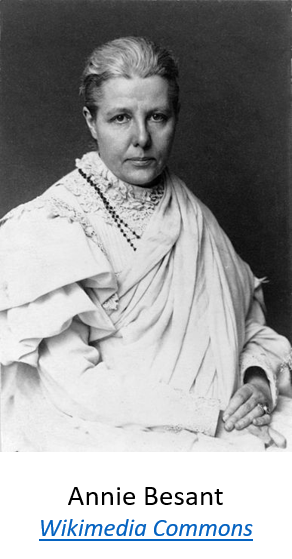
One of Besant’s followers, Alice Bailey, after rising to leadership in Besant’s organization, broke away to author the Tibetan Books dictated by her own spiritual master identified as the Tibetan Djwhal Khul. Bailey established her own Arcane School and established the Lucifer Publishing Company, later renamed Lucis Trust.102, 103
Dr. Robert Muller, UN Under Secretary General for 40 years — known as the “father of global education” — created a “World Core Curriculum.”104, 105 The Preface of the curriculum manual states, “The underlying philosophy upon which The Robert Muller School is based will be found in the teachings set forth in the books of Alice A. Bailey by the Tibetan teacher, Djwhal Khul (published by Lucis Publishing Company …).106 The first Robert Muller school was started in Arlington, Texas in 1979.107
Radio and television executive John Fetzer, best known as owner of the Detroit Tigers and founder of the Fetzer Institute, studied Alice Bailey’s writings and practiced Theosophy.108 The Fetzer Institute provided a grant to Eileen Rockefeller Growold (David Rockefeller’s daughter) to establish the Collaborative for Advancement of Social Emotional Learning (CASEL) — now known as the Collaborative for Academic, Social, Emotional Learning. CASEL is the premiere non-governmental organization that lobbies for federal funding to support the social-emotional learning (SEL) agenda in public schools.109, 110 Linda Darling Hammond, a long-time member of CASEL’s board of directors, was the education leader on Obama’s and Biden’s transition team.
Julian Huxley’s Religion without Revelation
British Fabian and zoologist Julian Huxley had no affiliation with Christianity or any other religion. He viewed all religions as evolutionary products of human culture and thinking, and suggested how to develop the role and function of religion in harmony with modern knowledge and needs. Concern that modern science could be misused for destructive purposes was part of the motivation for Huxley to create a bridge between rational science and spiritual life. Huxley called it “evolutionary humanism” (later called transhumanism) and even spoke of “evolutionary humanism” as a “developed religion.”111 In his book Religion Without Revelation, Huxley wrote,
- The moment does indeed seem to be approaching when man can and should begin constructing a new common outlook, a new habitation for his spirit, new from the foundations up, on the basis of a scientific humanism. (p. 9) … a new orientation of religious thought will be needful. Meanwhile the one main step that can be taken now, in the light of the present development of thought and knowledge, I have already laboured: it is the reform of theology on the three-fold basis of agnosticism, of evolutionary natural science, and of psychology. (emphasis added) (p. 58)112
Eugenics: A Pseudo-Science Disguised As Compassionate Religion
Evolutionary theories were particularly important to socialists because they could be interpreted to give the impression that everything was changing, that nothing was fixed or absolute, and human progress toward perfection was achievable.113 In a chapter titled “Re-definition of Progress” in New Bottles for New Wine, Julian Huxley wrote the following,
- … the patient labours of the students of evolution, whether stellar evolution, biological evolution or social evolution, have revealed that progress is not myth but science … progress as a scientific doctrine…. The scientific doctrine of progress is destined to … inevitably become one of the cornerstones of man’s theology, or whatever may be the future substitute for theology, and the most important external support for human ethics. There has not yet been time to work it out in detail…. (emphasis added) (p. 21)
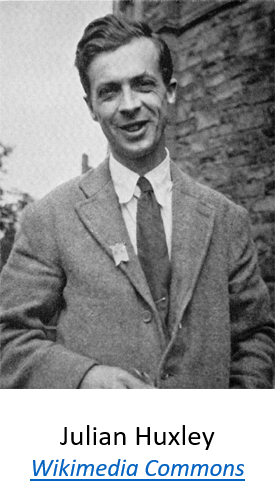
As an apostle of evolutionary spirituality, Huxley believed humans have the potential to evolve into superbeings, called the New Man or the transhuman.114 This evolutionary process is scientifically directed by positive and negative eugenics.
Eugenics is a pseudo-science/religion launched by Francis Galton (Charles Darwin’s cousin) in 1883 that promotes artificial selection of people to advance the evolution of humans. Scientists would be the priests of this new religion, measuring and quantifying the value of humans through psychometric and biometric tests to sort the superior from the inferior. These scientist-priests would guide human evolution by encouraging the ‘fittest’ to breed more and with each other (positive eugenics) and discouraging those ‘unfit’ from breeding at all (negative eugenics) through voluntary or involuntary sterilization, segregation, racial miscegenation laws and, at its most extreme, euthanasia, or mass murder. The reality, however, is that prominent members of the Fabian Society promoted eugenics because they believed Britons were a superior race of people.
Fabian Society co-founder Havelock Ellis put it this way, “The superficially sympathetic man flings a coin to the beggar; the more deeply sympathetic man builds an almshouse for him so that he need no longer beg; but perhaps the most radically sympathetic of all is the man who arranges that the beggar shall not be born.”115 Today, our knowledge of the human genome and our growing capacity to manipulate it present unparalleled opportunities to see to it that “undesirables” of any sort shall not be born. Havelock’s interest in transgender psychology suggests that the crude forced sterilization of the early 20th century has morphed into today’s voluntary transition surgeries that result in sterilization and make it all the more tempting to view as a scientific act of “radical sympathy.”116 But the cloak of radical sympathy is ripped away by the flagrant racism in the writings of early British Fabians.
In the October 1927 Vanity Fair article titled “A Note on Eugenics, The Battle Between Inferior and Superior People for the Possession of the Earth,” Aldous Huxley lays bare the radical truth of the eugenics movement.117 Huxley made his case for creating, “a society compelled by law to breed more and more exclusively from its most gifted and socially most successful members.”118 He elaborated,
- In societies like our own the inferior are in a very strong position because they are technically trained…. When the masses of the coloured races are as well trained and highly industrialized as our own, we shall have little or nothing on our side to outweigh their numbers…. The white races will be at the mercy of the coloured races and the superior whites will be at the mercy of their white inferiors…. The reaction to manifest deterioration will be a policy of eugenics…. whatever means of racial improvement are adapted, I take it that the criterion of human excellence and with it the eugenic goal will remain more or less the same.
Aldous Huxley’s distain for people of color and “white inferiors” is evident in his concern that educating them puts them in a “very strong position” and thus his recommendation for a policy of eugenics to make “racial improvement.”
Huxley’s article was not just an expression of his personal views. Contempt for ordinary people and outright racism were two of the defining creeds of British Socialism. The Lord Douglas Jay, Economic Secretary to the Treasury wrote in The Socialist Case, “… in the case of nutrition and health, just as in the case of education, the gentleman in Whitehall really does know better what is good for people than the people know themselves.”119
Aldous Huxley’s mentor, Fabian Society co-founder H.G. Wells, said the quiet part out loud when he wrote:
- We cannot go on making power for you to spend upon international conflict…. You must organize the Peace of the World; you must subdue yourselves to the Federation of all mankind. And we cannot go on giving you health, freedom, enlargement, limitless wealth, if all our gifts to you are to be swamped by an indiscriminate torrent of progeny. We want fewer and better children who can be reared up to their full possibilities in unencumbered homes, and we cannot make the social life and the world-peace we are determined to make, with the ill-bred, ill-trained swarms of inferior citizens that you inflict upon us.120
In a June 1907 article published in The Free Thinker, Shaw is quoted as saying,
- The only fundamental and possible Socialism is the socialisation of the selective breeding of Man: in other terms of human evolution. We must eliminate the Yahoo, or his vote will wreck the commonwealth. If … the Superman is to come, he must be born of Woman by Man’s intentional and well-considered contrivance…. I do not mean natural selection as popularized by Charles Darwin … on the contrary.121
The Free Thinker writer suggested that Shaw was talking “amazing nonsense” and had it not been for zoologist Julian Huxley, also a Fabian Society founder, the populace would hardly have known that Darwin existed. Julian Huxley’s Darwinian ideas would become international education policy when Huxley became the first president of UNESCO, the education body that the NEA worked to establish in the U.N.
Fabian Eugenics as International Education Policy
Julian Huxley immediately wrote a manifesto imagining UNESCO as the vehicle to spread the gospel of scientific planning, birth control and eugenics.122 Actually, Julian Huxley was more ruthless than his brother in describing how the healthcare system should be used for negative eugenics. Writing for the Eugenics Review in 1936, Julian Huxley proposed,
- We must plan our eugenic policy along some such lines as the following: … The upper economic classes are presumably slightly better endowed with ability to succeed in our social system — yet are not reproducing fast enough to replace themselves…. We must therefore try to remedy this state of affairs by pious exhortation and appeals to patriotism, or by the more tangible methods of family allowance, cheaper education, or income-tax rebates for children [positive eugenics]. The lowest strata, allegedly less well-endowed genetically … must not have too easy access to relief or hospital treatment lest the removal of the last check on natural selection should make it too easy for children to be produced or to survive; long unemployment should be a ground for sterilization, or at least relief [welfare] should be contingent upon no further children being brought into the world; and so on [negative eugenics]. That is to say, much of our eugenic programme will be curative and remedial merely, instead of preventive and constructive.123
The UNESCO plan Huxley put in place in 1946 continues to this day with UNESCO partnering with organizations such as the World Health Organization, SIECUS, and Planned Parenthood.124 Selective administration of health care as recommended by Julian Huxley is a hallmark of Obamacare architect Ezekiel Emanuel’s proposal for healthcare rationing. His vision is depicted in the Wall Street Journal as “The Reaper Curve.”125 Since 2019, Emanuel has been a Special Advisor to the Director General of the World Health Organization.126
The Fabians’ deceptive tactics symbolized by the wolf in sheep’s clothing protects their eugenics agenda with the illusion of altruism. Many reforms admired by today’s leftists were not born of a desire to improve the lot of the poor, but to guarantee Briton’s survival as one of the globe’s foremost races.127 For example, Access to Reproductive Technology (ART) is limited to candidates with certain financial qualifications.128 British writer and broadcaster and contributing editor to The Spectator, Dennis Sewell wrote,
- Beneath their seemingly compassionate rhetoric … the founders of the Fabian Society were snobbish, elitist and harboured a savage contempt for the poorest of the poor …. For the Fabians, eugenics was not merely some eccentric hobby or sideline, but central to their social thinking…. As late as 1946 [economist and philosopher Lord John Maynard] Keynes was still describing eugenics as ‘the most important and significant branch of sociology.129
Footnotes:
94https://archive.org/details/futureoffederali00rock
95https://www.gutenberg.org/files/13715/13715-h/13715-h.htm
96https://www.theosophical.org/publications/quest-magazine/1366-confounding-or-amazing-the-multiple-deconversions-of-annie-besant
97https://www.nytimes.com/2009/02/15/nyregion/15society.html
98https://digitalcommons.ciis.edu/cgi/viewcontent.cgi?article=1285
99https://www.theosophy.world/encyclopedia/besant-annie
100 https://www.happyvalleyfdn.org/history.html
101https://www.besanthill.org/about/history-heritage/aldous-huxley/
102https://www.encyclopedia.com/science/encyclopedias-almanacs-transcripts-and-maps/bailey-alice-anne-latrobe-bateman-1880-1949
103https://openlibrary.org/works/OL2465760W/Letters_on_occult_meditation
104http://robertmuller.org/rm/R1/World_Core_Curriculum.html
105http://www.theschoolofagelesswisdom.org/rms/wcc.html
106https://openlibrary.org/works/OL16799107W/World_Core_Curriculum_Manual
107http://www.theschoolofagelesswisdom.org/rms/
108https://www.freep.com/story/sports/mlb/tigers/2018/12/30/john-fetzer-detroit-tigers-ouija-board/2135404002/
109https://fetzer.org/about/history
110https://casel.org/
111https://www.amazon.com/Evolutionary-Humanism-Great-Julian-Huxley/dp/0879757787
112https://archive.org/details/in.ernet.dli.2015.90330/page/n57/mode/2up?q=evolutionary
113https://fee.org/articles/the-rise-and-fall-of-england-11-the-fabian-thrust-to-socialism/
114https://www.frontiersin.org/articles/10.3389/fpsyg.2023.1103847/full
115https://www.goodreads.com/review/show/650635556
116https://www.digitaltransgenderarchive.net/catalog?f%5Bdta_other_subject_ssim%5D%5B%5D=Havelock+Ellis
117https://archive.vanityfair.com/article/1927/10/01/a-note-on-eugenics
118https://voegelinview.com/aldous-huxley-political-thought-man-letters/
119https://ore.exeter.ac.uk/repository/bitstream/handle/10036/18172/LHR%20article%20on%20Jay.pdf?sequence=2 https://www.researchgate.net/publication/29810639_%27The_Gentleman_in_Whitehall%27_Reconsidered_The_Evolution_of_Douglas_Jay%27s_Views_on_Economic_Planning_and_Consumer_Choice_1937-47
120https://groups.csail.mit.edu/mac/users/rauch/abortion_eugenics/sanger/introduction.html
121https://archive.org/details/freethinker01unkngoog/page/n2/mode/2up
122https://www.britannica.com/biography/Thomas-Malthus
123https://dnalc.cshl.edu/view/11751–Eugenics-and-Society-The-Galton-Lecture-given-to-the-Eugenics-Society-by-Julian-S-Huxley-Eugenics-Review-vol-28-1-1
124https://cdn.plannedparenthood.org/uploads/filer_public/da/67/da67fd5d-631d-438a-85e8-a446d90fd1e3/20170209_sexed_d04_1.pdf
125https://www.wsj.com/articles/SB10001424052970203706604574374463280098676
126https://www.linkedin.com/in/zeke-emanuel-6ab78a1b0
127https://www.theguardian.com/politics/from-the-archive-blog/2019/may/01/eugenics-founding-fathers-british-socialism-archive-1997
128https://www.ncbi.nlm.nih.gov/pmc/articles/PMC5965496/
129https://www.spectator.co.uk/article/how-eugenics-poisoned-the-welfare-state/
Fabian Socialism: A Cousin of Marxist Communism
As a kind of creed, G. Bernard Shaw wrote the Fabian Society’s Manifesto which includes the tenet, “That the state should compete with private individuals—especially with parents—in providing happy homes for children, so that every child may have a refuge from the tyranny or neglect of its natural custodians.”130 Shaw, whose own childhood was unstable, was influenced by the ideas of Karl Marx (he socialized with Marx’s daughter).131 Marx’s Communist Manifesto called for “abolition of the family.”132 Similarly, Shaw’s Fabian Manifesto called for the “emancipating” of children, placing the authority of the state over the authority of parents.133
Shaw contributed many tracts to the Society including Fabian Tract No. 233 which advocates for socialism defined as,
- … the complete discarding of the institution of private property by Transforming it into public property and the division of the resultant public income equally and indiscriminately among the entire population …. In Socialism, private property is anathema and equal distribution of income the first consideration. (p.3)134
In other words, Shaw advocated for the redistribution of private individuals’ wealth but rather than confiscate private property through large-scale political upheaval (revolution), Fabians execute small-scale actions linking reformism by government action with socialism (evolution).135
Founder Edward Pease described how the Fabian Society was influenced by Karl Marx’s writings as interpreted by John Stuart Mill.136 Fabians promote the gradual evolution of society through the shaping of politics, education, and the printed word (media).137 One of the Fabian Society’s logos representing their slow march through institutions is the Fabian turtle.138 Fabian deceptive tactics, such as creating new word meanings unknown to the general public when promoting socialist policies, are described as “intellectual guerrilla warfare” against free market societies.139
Fabian Socialism Moves to America and the NEA

The Fabians did not introduce socialism to the United States. Rather, Scotsman Robert Owen introduced the first socialist experiment to the United States in 1825. His commune, New Harmony, Indiana, failed after two years, but Owen was convinced that the problem was not socialism but the fact that children were not primed to be socialists through education.
In 1895, Christian Socialist W.D.P. Bliss established the American Fabian Society and was editor of the American Fabian Magazine. American Fabians maintained the political doctrine of “progress” as:
- … the indefinite improvability of mankind, but it was the social state, not the individual, who was thus improvable (emphasis added). It was “a living organism, a social state [collective] capable of indefinite improvement.” Moreover, it was held that the state must have the power to institute the socialist program. Nationalization, efficient planning, and the other concomitants of socialism were seen to require unquestioned authority [totalitarianism]. (p. 118)140
For Fabians, “equality of condition,” or equity, required “that the state, by “the first interference” with private lives, assure to all persons the same start in life, and also that the state measure achievement in terms of unequal individual competence.” (p. 118)141 The American Fabian Society endured less than a decade, but the demise of the Christian Socialist organization did not end the permeation of British Fabian Socialism into America.
Rather than establish a working model of a socialist community, a loosely organized group spearheaded by British Fabian socialists established a kind of colony for an American society of intellectuals on Turtle Bay in Manhattan.142 The intellectuals then infiltrated positions of influence in American organizations and universities.
On September 12, 1905 a group of prominent American intellectuals met together in lower Manhattan, including Harry Laidler, Upton Sinclair, Clarence Darrow, and Jack London.143 They established the Intercollegiate Socialist Society (ISS) to promote “an intelligent interest in Socialism among college men and women, graduate and undergraduate, through the formation of study clubs ….”144, 145 The ISS was not formally associated with but in the orbit of the Socialist Party and in close intellectual contact with the British Fabian Societies.146
By 1921, the organization’s name changed to the League for Industrial Democracy (LID), organized for the specific purpose of “education for a new social order based on production for use and not for profit.”147, 148 Industrial Democracy is the title of a book written by British Fabian Society founders Sidney and Beatrice Webb.149 The Fabian Society’s Forty-ninth Annual Report directly links the British Fabian Society and the American LID stating, “ …we continue active association … with the League for Industrial Democracy of New York which carries on active propaganda in the United States on very similar lines to our own work here ….” LID began to function as an educational arm of the broad Socialist Party milieu.150
In 1908, the ISS established permanent headquarters in the Rand School of Social Science. The Rand School was founded as the intellectual center of American socialism. Established in 1906, its governing body was the American Socialist Society (ASS). Board members of the ASS included Harry Laidler, who became LID’s executive director. The ASS directors closed the Rand School in 1956. Its library of socialist, communist, and organized labor literature is housed at New York University.151
How Schools Have Been Changed
The early history of British socialism suggests that socialism — with its unshakable faith in science, central planning and the cold rationality of the intellectual elite — contained the seeds of the atrocities associated with management of the world’s population through abortion, sterilization, chemical birth control, and restricted access to health care. Intellectual elites funded by business elites had only contempt for ordinary people, who were regarded as “sub-men” to be tended and looked after by the welfare state. In Anticipations, H.G. Wells described a shadow government headed by wealthy elites who find themselves running the world by using education to nudge the world’s population to accept their plan. Wells wrote,
- [The] New [World] Republic may begin visibly to shape itself out and appear. It will appear first, I believe, as a conscious organization of intelligent and quite possibly in some cases wealthy men, as a movement having distinct social and political aims, confessedly ignoring most of the existing apparatus of political control, or using it only as an incidental implement in the attainment of these aims. It will be very loosely organized in its earlier stages, a mere movement of a number of people in a certain direction, who will presently discover with a sort of surprise the common object towards which they are all moving.152
Wells described a different set of anticipations in his book The Open Conspiracy: Blueprints for a World Revolution153. He described his anticipation of resistance from patriots, especially American patriots, and his plan for how to eliminate their resistance:

We are coming to see more and more plainly that certain established traditions which have made up the frame of human relationships for ages are not merely no longer as convenient as they were but are positively injurious and dangerous. And yet at present we do not know how to shake off these traditions, these habits of social behaviour which rule us. Still less are we able to state, and still less bring into operation, the new conceptions of conduct and obligation that must replace them.
- —and until recently that was a quite tolerable system of frame-works into which a general way of living could be fitted…. The young were trained to be loyal, law-regarding, patriotic, and a defined system of crimes and misdemeanours with properly associated pains, penalties, and repressions, kept the social body together. Everyone was taught a history glorifying his own state, and patriotism was chief among the Virtues….
- Socially and politically we want a revised system of ideas about conduct, a view of social and political life brought up to date.
- The fundamental organization of contemporary states is plainly still military, and that is exactly what a world organization cannot be. Flags, uniforms, national anthems, patriotism sedulously cultivated in church and school, the brag, blare, and bluster of our competing sovereignties, belong to the phase of development the Open Conspiracy will supersede. We have to get clear of that clutter.
- As new world controls develop, it becomes the supreme business of the Open Conspiracy to keep them worldwide and impartial, to save them by an incessant critical educational and propagandist activity from entanglement with the old traditional rivalries and feuds of states and nations.
- A majority of people in Europe, and a still larger majority in the United States and the other American Republics, could become citizens of the world without any serious hindrance to their present occupations, and with an incalculably vast increase of their present security.
- But there remains a net of special classes in every community, from kings to custom-house officers, far more deeply involved in patriotism because it is their trade and their source of honour, and prepared in consequence with an instinctive resistance to any reorientation of ideas towards a broader outlook. In the case of such people no mental sanitation is possible without dangerous and alarming changes in their way of living. For the majority of these patriots by metier, the Open Conspiracy unlocks the gates leading from a fussy paradise of eminence, respect, and privilege—and motions them towards an austere wilderness which does not present even the faintest promise of a congenial, distinguished life for them.
Phyllis Schlafly was among the special class of American patriots with an instinctive resistance to any reorientation to Wells’ socialist ideas and who Wells hoped to banish to “an austere wilderness.” As beneficiaries of her courage and fortitude, her legacy to us is to continue the resistance she modeled.
Conclusion
A close study of the slow and deliberate changes throughout the six editions of the NEA’s American Citizens Handbook and probe into the philosophical and ideological origins of those changes serve to explain how current issues in American K-12 education were planted and cultivated over the past century.
Footnotes:
130 https://digital.library.lse.ac.uk/objects/lse:roq877juk
131 https://jacobin.com/2017/01/eleanor-marx-legacy-labor-rights-socialist-feminism
132 https://jacobin.com/2017/01/eleanor-marx-legacy-labor-rights-socialist-feminism
133 https://www.marxists.org/archive/marx/works/1848/communist-manifesto/
134 https://digital.library.lse.ac.uk/objects/lse:viy479sic
135 https://www.cato.org/blog/fundamental-fallacy-redistribution
136 https://www.gutenberg.org/files/13715/13715-h/13715-h.htm#FNanchor_1
137 https://library.fes.de/libalt/journals/swetsfulltext/7379556.pdf
138 https://twitter.com/thefabians/status/948879416150683650
139 https://oll.libertyfund.org/page/george-bernard-shaw-1856-1950-and-the-fabian-society
140 https://www.jstor.org/stable/442213?read-now=1
141 https://www.jstor.org/stable/442213
142 https://cdn.mises.org/Fabian%20Freeway%20High%20Road%20to%20Socialism%20in%20the%20USA%20-Digital%20Book_3.pdf
143 https://www.scribd.com/read/372558373/The-Turning-of-the-Tides#
144 https://books.google.com/books?id=s18MAAAAYAAJ
145 https://www.jstor.org/stable/27671382
146 https://www.marxists.org/history/usa/index.htm
147 https://snaccooperative.org/view/34987161
148 https://www.scribd.com/read/372558373/The-Turning-of-the-Tides#
149 https://archive.org/details/industrialdemocr00webbuoft/page/n7/mode/2up
150 https://www.shankerinstitute.org/blog/early-years-new-york-city-teachers-union
151 http://dlib.nyu.edu/findingaids/html/tamwag/tam_007/bioghist.html
152 http://www.online-literature.com/wellshg/anticipations/8/
153 https://gutenberg.net.au/ebooks13/1303661h.html
Stolen Youth: How Radicals are Erasing Innocence and Indoctrinating a Generation
By Bethany Mandel and Karol Markowicz, DW Books™, a division of The Daily Wire ® 2023
In a nutshell, this book is a comprehensive study of all the ways the Left is poisoning the minds of schoolchildren and making their lives miserable. Mandel and Markowicz do a masterful job in covering all the bases, from the blatantly political dictates of the education establishment and teachers’ unions during the pandemic to the clandestine promotion of the transgender agenda.
During their research for the book, the authors interviewed parents, teachers, school administrators, and medical personnel, including physicians, therapists, psychiatrists, and others. They reviewed numerous news articles and reports.
Many parents they spoke to admitted they were “clueless” about what their children were learning before the pandemic. One parent reported she had no idea what her then-seventh-grade daughter was learning in health class. “[The course] gave these kids highly sexualized labels. It was nonsense: polyamorous, bi-gender, etc., a whole list of made-up words. And the eleven- and twelve-year-old girls picked a label; it became cool. Nobody wanted to be the cis-basic kid. That is boring. And not only is it boring. For a white, affluent kid who wants for nothing, [she didn’t] want to be the oppressor, which is what they’re being taught in school. They have to pick something that marginalizes them.”
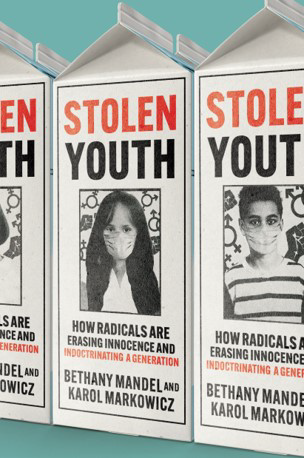 In that health class, nearly half the girls “came out” as something other than what they were, starting off as lesbian, then non-binary, and finally deciding they were transgender. This particular child went down the rabbit hole — running the gamut of the transgender experience, from the school affirming her new name and pronouns to therapists who reinforced her whim that she was transgender. But she was fortunate to have a mother who refused to go along with the charade and successfully fought to bring her child back.
Stolen Youth is divided into chapters written by each author. Bethany Mandel wrote the Introduction, along with Chapters 4 through 7 and Chapter 9. Karol Markowicz penned Chapters 1 through 3, as well as Chapter 8. Both authors contributed to the Conclusion, and in general the book is surprisingly seamless and easy to read.
Markowicz was born in Soviet Russia and came to America with her family in 1978. Her family’s history is fraught with harrowing experiences under totalitarianism, which makes her uniquely qualified to recognize the parallels in today’s America. In Chapter 1, she shows how the manipulation of our schoolchildren is similar to the tactics used one hundred years ago in Stalin’s Russia, and today in Communist China. She contends that while we are not to that point yet, we are drawing perilously close to the precipice.
“In totalitarian societies, parents have to pretend to believe the lies that kids are taught at school, lest they make themselves or their children a target,” Markowicz writes. “In a free country, you don’t have to do that. You can and should explain to children that life isn’t black and white and that American history is complicated. You can and should reassert the morals that matter in your family. You can and should teach your child to be himself or herself and not be coerced into other people’s opinions. Whose kid is this? In the home, you provide the answer: mine.”
Mandel is an author, journalist, and homeschooling mom. She is editor of the Heroes of Liberty book series, which Education Reporter reviewed in 2021. While the Left describes “woke” ideology as an awareness “of social issues such as racial prejudice and discrimination,” Mandel asserts that the reality “is much more complex—and much more ominous. The reality is that conformist, woke ideology is taking over our institutions, and this takeover of every aspect of our lives, from medical and mental healthcare to our media and entertainment, touches every single American—those who buy into the ideology and the many of us who don’t.”
She describes in detail the woke takeover of libraries, and the perversion of Scholastic, one of the nation’s largest publishing houses, with a magazine that was a fixture in schools, libraries, and home mailboxes for decades. Now, writes Mandel, Scholastic “has an entire featured section on their website devoted to ‘LGBTQIA+’ topics.” But hypersexualizing children is not enough, she writes. “The other main focus is on making kids hyperaware of race, often through a critical race theory (CRT) lens.”
Perhaps the most sobering of Mandel’s chapters is “The Peril of Woke Medicine” (Chapter 5) in which she covers the politicization of the medical field. Especially troubling is her demonstrably provable point that, led by the American Academy of Pediatrics (AAP), the specialty of pediatrics “is among the most Left-leaning medical specialties, along with psychiatry and epidemiology.” This section alone should give every reader pause.
She further describes how medical research has become more like activism, and shows how medical professionals’ terror of “being offensive to patients doesn’t just impact healthcare outcomes in the short term but also changes how children and teenagers optimize their behavior for their own health.” Instead of being encouraged to make healthy choices through diet and exercise, for example, they are given external excuses for their bad health outcomes; i.e., they are victims of racism, poverty, or some other cultural offense beyond their control.
This wokeness extends to the field of surgery, with the American College of Surgeons (ACS) doing such things as sponsoring a lecture that “made no mention of excellence” but instead “was filled with buzzwords like diversity, inclusion, equity, biases of various sorts, and microaggressions” as problems facing surgery training and the ACS. But as Mandel observes: “When your child suffers from a condition requiring the expertise of a surgeon, the knowledge that the person holding the knife in the operating room was trained in this kind of environment is terrifying.”
Another chapter worthy of note is “Child Soldiers” (Chapter 8), in which Markowicz shows how children are being used to further the Marxist goals of adults. Two examples include the grooming of school shooting survivors to push for gun control, and the emphasis of climate change propaganda to scare children and turn them into climate activists. Markowicz tells the familiar story of Greta Thunberg’s rise to fame and how her story has been used to influence countless schoolchildren in the name of “science.”
Markowicz writes: “What went ignored about the actual Greta is how deeply scarred she was because of her obsession with climate change. Greta had detailed her deep depression before starting her movement. It’s no surprise that her followers exhibit the same struggles with mental health. But, like everything else, this fact was used to further support the woke cause rather than as a sign to examine whether political activism is good for children’s wellbeing.”
Both Mandel and Markowicz provide encouragement in the final chapter and the Conclusion, along with personal advice and perspective from their own lives. Their message is that human beings are resilient and the future hopeful, despite the efforts of current trends and influences to discourage independent thought and promote eternal victimhood.
While most of the high-profile topics of CRT, transgenderism, and other woke items contained in Stolen Youth have been well covered in Education Reporter and elsewhere, this reviewer found the book to be highly informative and filled with insights that only these two authors could supply. It is a perfect resource for readers seeking a comprehensive overview of the evil forces stacked against ordinary kids, parents, and citizens today, and the authors finish by offering a blueprint for pulling out of the rat race.
To read the entire book, go here to order!