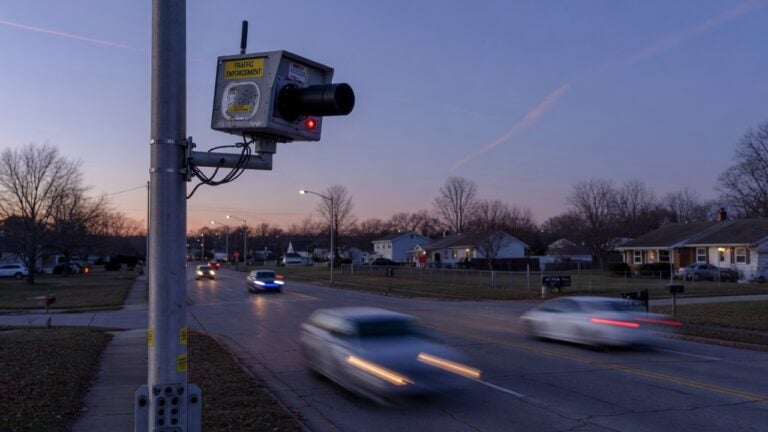
On Saturday night, October 4, a federal district judge blocked President Trump from deploying the National Guard to restore order in Portland, Oregon, which is notorious for the Antifa riots there in 2020 that shut down much of the city. Portland is one of the most Left-wing large cities in the United States, comprised overwhelmingly of white liberals.
Violent protesters in Portland, probably funded by radical groups from elsewhere, have spat at Immigration and Customs Enforcement (ICE) agents, obstructed their vehicles, and even started a fire outside of an ICE facility. More recently additional protesters against ICE have shown up naked as part of their bike ride, which locals defend as a longstanding Portland tradition.
On October 8, the White House posted that “for years, an Antifa-led hellfire has turned Portland into a wasteland of firebombs, beatings, and brazen attacks on federal officers and property – yet the Fake News remains in shameful denial about the Radical Left’s reign of terror.”
President Trump has posted quotes from many in Portland about the violence they face and fear. “Yesterday morning, I was broken into again for the tenth time,” said one downtown Portland business owner. “We need help here and something needs to be done, so if [the National Guard] is what we need to do to get our leaders paying attention to what’s happening in Portland, then I think it’s a good thing.”
“Since early June, Antifa militants have laid siege to the ICE field office in south Portland,” the White House points out. “The terrorists have violently breached the facility by using a stop sign as a battering ram, hurled explosives and projectiles, burned American flags, viciously assaulted, attacked, and injured officers, doxed officers, berated neighbors, and even rolled out a guillotine.”
In a recent op-ed for TheHill.com, renowned law professor Jonathan Turley decried Democrats who have responded by denying the existence of Antifa. “Antifa was first created in the 1920s, associated with the Weimar-era German communist group Antifaschistische Aktion,” Turley observes, and “it is very real.”
Trump’s Attorney General Pam Bondi declared that “Just like we did with cartels, we are going to take the same approach, President Trump, with Antifa – destroy the entire organization from top to bottom. We’re going to take them apart.”
At first the federal judge blocked President Trump from using the Oregon National Guard. No problem for Trump, as he then directed the California National Guard to restore order in Portland, but the judge issued a temporary restraining order (TRO) against them, too.
In an expedited appeal to the Ninth Circuit, where the Republicans comprise about 40% of that court, a fortunate draw of two Trump-appointed judges was randomly assigned to the three-judge panel for this case. Their questioning was critical of a district court judge preventing a president from restoring law and order.
Some of the Portland protesters “are violent people,” the Department of Justice attorney Eric McArthur informed the appellate judges. “The president is entitled to say enough is enough and bring in the National Guard to reinforce the regular forces,” he argued.
Ninth Circuit judges Ryan Nelson and Bridget Bade, both previously appointed by Trump, seemed to agree. Their questions emphasized that the president has broad authority to establish law and order.
“It just seems a little counterintuitive to me that the City of Portland can come in and say no, you need to do it differently,” commented Judge Ryan Nelson during the oral argument. He was unpersuaded by Oregon’s attorney, Stacy Chaffin, who argued that presidential deference “has a limit, and that limit is this case.”
Oregon’s attorney insisted that the rationale given by Trump for sending in the National Guard is “untethered to the facts,” as the district court judge had held. The only appellate panel judge likely to agree with that assessment is Susan Graber, a law school classmate of Bill and Hillary Clinton who was appointed by Bill to this court.
Meanwhile, a similar standoff between local officials and the Trump Administration is occurring in Chicago. Its Mayor Brandon Johnson has only a 6.6% approval rating among Chicago voters according to one poll, while 79.9% disapprove of his performance.
As in Portland, a district court judge granted a request by Democrats to block Trump’s use of the National Guard to restore law and order in violence-ridden Chicago. But on an expedited appeal, the Seventh Circuit has already ruled in favor of Trump by partly staying that injunction against him and allowing the troops to remain in northern Illinois.
The No Kings protest on Saturday, October 18 was co-sponsored by MoveOn.org, which was founded in 1998 with funding from the flying toaster screen saver. Its original slogan in 1998 was “Censure President Clinton and move on to pressing issues facing the nation.”
Haul Jack Smith before a Florida Grand Jury
Eight months of all talk and no action in prosecuting Leftists has left President Trump frustrated. On the night of September 20, Trump publicly criticized his Attorney General, Pam Bondi, for achieving so little so far.
“Pam: I have reviewed over 30 statements and posts saying that, essentially, ‘same old story as last time, all talk, no action. Nothing is being done,’” Trump posted. He added that the Left “impeached me twice, and indicted me (5 times!), OVER NOTHING.”
In mid-September Trump posted, “Why was the wonderful Turning Point under INVESTIGATION by ‘Deranged’ Jack Smith and the Corrupt & Incompetent Biden Administration. They tried to force Charlie, and many other people and movements, out of business.”
And yet the response has been radio silence from Trump’s top advisors in holding Trump-haters responsible for their weaponization of government. Rep. Marjorie Taylor Greene recently pointed out that when Democrats return to power, they will continue where they left off by weaponizing government further against Republicans.
The man who wrongly indicted Trump more than anyone, Jack Smith, is an apparatchik of the Deep State, and he may be impossible to indict in the anti-Trump swamp of Washington, D.C. The grand jury pool in that venue, where 95% of the residents voted against Trump in 2020, has already refused to deliver indictments in multiple smaller prosecutions there.
Jack Smith’s principal wrongdoing was committed not in D.C., but in the Southern District of Florida, where the federal court is based in Miami. It was in that judicial district where Trump’s Mar-a-Lago home was wrongfully raided, and where an unjustified indictment was filed against Trump to try to derail his reelection campaign.
Ultimately, federal Judge Aileen Cannon tossed out the indictment because Jack Smith was acting in violation of the Constitution. In other words, it was Jack Smith who violated the law by indicting Trump, and it does not matter whether then-Attorney General Merrick Garland authorized it because the Constitution is supreme.
Under federal law, 18 U.S.C. § 371, the crime of conspiracy is when two or more persons agree to do an unlawful act against the United States. Jack Smith agreed with others in his office to indict Trump, contrary to the Constitution as later held by Judge Cannon.
Neither Jack Smith nor anyone associated with the Deep State in D.C. would obtain the favoritism in Miami that they have been receiving from judges and juries in D.C. Miami-Dade County voted 55-44% for Trump in 2024, and Trump enjoys enthusiastic support from Cuban immigrants who are leaders in that community.
It is difficult to view Jack Smith’s actions against candidate Trump last year as anything other than election interference, as Trump said in his winning campaign. By re-electing Trump, American voters agreed with him that he was innocent and the prosecutions of him were improper.
On September 20 Trump replaced the U.S. Attorney for the all-important Eastern District of Virginia, where federal workers have commonly been prosecuted in the past. This district includes the federal court in Alexandria, just across the Potomac from Washington, D.C., with a reputation of convicting nearly every time.
That is the pro-conviction venue where liberals prosecuted Trump advisor Paul Manafort, but the charges were so bogus that the jury deadlocked on most of them such that complete verdicts could not be reached. Ultimately President Trump pardoned Manafort for everything.
Contrast the ferocity with which the DOJ went after Trump, Manafort, and many other advisors to Trump with the inaction by the DOJ in investigating and prosecuting liberals. Trump’s newly appointed U.S. Attorney for eastern Virginia, which includes D.C. suburbs, is hopeful.
Historians should notice the similarity with President Abraham Lincoln’s frustration over the inaction by his first Commanding General during the Civil War, George B. McClellan. Lincoln finally quipped in a letter, “If General McClellan does not want to use the army, I would like to borrow it for a time.”
Ultimately Lincoln found an outsider from Missouri, Ulysses S. Grant, to replace McClellan to lead the Union Army. As an outcast, Grant was what Lincoln needed to win the Civil War as Grant then fully used all available resources to accomplish the mission at hand.
Neither Jack Smith nor others on his team who indicted Trump in Florida were pardoned by President Biden’s autopen. And while a doctrine of immunity protects prosecutors in their advocacy role, immunity does not protect them from accountability for their investigative and administrative work, as the Supreme Court held in Buckley v. Fitzsimmons (1993), and the Court could likewise deny immunity to Smith.
Prosecutors are the first to declare that “ignorance of the law is no excuse.” Jack Smith’s team insisted that no one is above the law, and neither are they.
Trump’s 18-0 Winning Streak in SCOTUS
No NFL team in the last 50 years has attained perfection without a loss, but this is Trump’s record in the U.S. Supreme Court: 18-0. His splendid Solicitor General, John Sauer, has racked up 18 wins this year, in staying lower court decisions against Trump and thereby allowing the President to exercise the full “executive power” granted by Article II of the Constitution.
These victories have been on emergency applications to the Supreme Court, where it is difficult to obtain the Justices’ attention and even more challenging to prevail. Also called the “shadow docket,” these wins by Trump have come quickly, without oral argument, and often by a 6-3 or greater margin.
Seven of these wins have been on deporting illegal aliens, five on firing unnecessary federal workers, four on terminating wasteful federal spending, one on ending transgender personnel in the military, and one on stopping the epidemic of nationwide injunctions by district court judges.
On September 8, Chief Justice Roberts granted a stay to Trump, as requested by Sauer, of a D.C. Circuit ruling that had blocked Trump from removing a Commissioner of the Federal Trade Commission. Despite being on the Court’s traditional summer vacation until it returned later that month, Roberts granted Trump’s request on the second business day after it was filed.
An even bigger victory for Trump came on September 8 from the Supreme Court when it stayed a Ninth Circuit ruling that had blocked Trump’s deportation campaign in Los Angeles County, where an estimated 10 percent of its 10 million residents are illegal. Justice Kavanaugh wrote a concurrence agreeing with Sauer’s argument that ethnicity can be relevant in deciding whether to investigate someone’s immigration status.
Kavanaugh explained that Supreme Court precedent and common sense allow “apparent ethnicity” to be a “relevant factor” to be considered by immigration officials, not alone but in conjunction with other relevant factors, in forming a “reasonable suspicion” sufficient to justify a so-called Terry stop. Further investigation is then required before arresting or deporting a suspect.
This does not mean that Hispanics or any other group can be deported based on their ethnicity, but merely that ethnicity can be one of several factors justifying further investigation. “Importantly, reasonable suspicion means only that immigration officers may briefly stop the individual and inquire about immigration status,” Kavanaugh explained.
Indeed, a recent immigration raid occurred at a Hyundai electric vehicle plant in Georgia, where illegal aliens from South Korea were caught, identified, and detained. Congress should investigate how hundreds of these Asian illegal aliens migrated here illegally.
The Hyundai raid also cast doubt on the premise that foreign car manufacturers are helping Americans by locating a few plants here. In this case, the manufacturing jobs were going to illegal aliens from the country of the foreign competitor.
Trump has been winning in federal appellate courts, too. On September 8 a 2-1 Republican majority on a panel in the Fourth Circuit ruled in favor of Trump on his authority “to lay off thousands of probationary employees across multiple federal agencies.” The Democrat on the panel dissented, in Maryland v. USDA.
Many more lawsuits against Trump are percolating through the federal court system on the road to ultimate review by the Supreme Court. There are signs that justices on the High Court are growing impatient with the defiance by liberal lower court judges of precedents in favor of Trump, which has burdened the Supreme Court throughout the summer months to stay the anti-Trump decisions.
Supreme Court Justice Neil Gorsuch, one of the less conservative justices, expressed his exasperation on August 21 while the justices were on summer vacation. “So this is now the third time in a matter of weeks this Court has had to intercede in a case squarely controlled by one of its precedents.”
“All these interventions should have been unnecessary, but together they underscore a basic tenet of our judicial system: Whatever their own views, judges are duty-bound to respect the hierarchy of the federal court system created by the Constitution and Congress,” Gorsuch wrote while quoting precedent, in this victory for Trump in NIH v. American Public Health Association to allow him to terminate research grants.
After being forced to work all summer to block anti-Trump rulings by federal judges in district and appellate courts, mostly in the First and D.C. Circuits where liberals have forum-shopped their cases to obtain Democrat-appointed judges, the Supreme Court returned on Monday, September 29 for its traditional “long conference” to dispose of hundreds of petitions for certiorari that accumulated while they were away.
The following week, the Supreme Court began hearing oral arguments for its “2025 Term” that will last until the end of June next year. Trump can expect to win many more reversals of flawed lower court rulings that liberal judges are rendering against him.
Prediction Markets are Gambling on Steroids
Prediction markets have rapidly become a mega-billion-dollar industry of nationwide gambling through cell phones. These are online platforms where people bet on outcomes of almost any event, such as whether a team will win the Super Bowl, whereby the cost of the event contract is less than the amount paid out to those who guessed correctly.
This is gambling, and 20 red and blue states prohibit these bets on sports. Betting on elections has long been banned everywhere in the U.S. and, until 2005, in England, while nearly every state prohibits wagering by anyone under 21.
But new prediction markets bypass all of these sensible limitations, by accepting these bets on websites over the internet. On October 7 the Wall Street Journal reported that the owner of the New York Stock Exchange, Intercontinental Exchange, has agreed to invest up to $2 billion in Polymarket, which is not even the largest company in this emerging market.
High school students, typically boys, are suddenly spending their time and their family’s money by wagering in this manner and through “sportsbooks,” which are apps on their phones. DraftKings and FanDuel, whose ads are pervasive, are two sportsbooks that pepper teenagers and everyone else with promotions and other enticements to gamble.
More than 2 million young men today are “NEET,” which means Not in Employment, Education, or Training. Instead, many of them are betting weekly or daily on their favorite sports teams.
Once addicted, a gambler then wants to bet on any sporting event. Illustrating how powerful this addiction is, $31.7 million was wagered in Colorado on ping pong matches earlier this year, in January alone.
The New York Times reported on October 5 that companies, most notably Kalshi, are accepting billions of dollars in bets while bypassing state regulations that protect teenagers and athletes against this vice. Congress has failed to hold any hearings on this frenzied activity that seems likely to erupt in a major scandal between now and the midterm elections next year.
Online sports gambling is illegal in California and Texas, but Kalshi circumvents their state laws in taking bets from residents there. With millions wagered on individual performances in a game, known as prop bets, the incentive for corruption or intimidation of players by gamblers is severe.
Scandals have already appeared, signaling something worse that is yet to come. Major League Baseball has for three months been investigating two errant throws by a Cleveland Guardians starting pitcher that opened early innings this past summer, as a spike in bets on whether those pitches would be a “ball” or a “strike” was flagged.
Kalshi and other companies rushing into prediction markets insist that states cannot regulate it as states have long regulated sportsbooks and traditional gambling. Instead, Kalshi and others accept only the Commodity Futures Trading Commission (CFTC) as having authority over it.
But currently the CFTC has only one out of the five commissioners it is supposed to have: the Biden-appointed Caroline D. Pham. The traditional expertise of the CFTC is in regulating corn or wheat futures for farmers, not gambling on the Super Bowl and on individual performances within games.
In states that allow sports gambling, there are important limits such as New Jersey’s ban on bets on college games played within the State, and wagers on NJ college teams playing anywhere. This helps protect local college players against being pressured by gamblers to underperform.
Prediction markets ignore the 21-year-old age limit imposed by states on gambling. Litigation over the legality of prediction markets is pending in the U.S. Court of Appeals for the Third and Fourth Circuits, and in district court in Nevada, but changes are unfolding faster than courts are keeping up.
A Pew Research poll found 43% of adult Americans oppose sports betting for being harmful, while only 7% praise it. Allowing wagers on elections makes even less sense, particularly in the current climate of political violence.
Some Republicans fret about possible political repercussions from the ongoing partial government shutdown, but negative fallout from a corruption scandal or violence resulting from this gambling crisis could be worse. Twice before in American history there has been a public backlash against gambling such that it was prohibited after being allowed to flourish.
The ease of gambling on phones and the use of AI to exploit gambling proclivities make this vice more dangerous than ever before. Already in September $2.5 billion was wagered on NFL games in the prediction markets, while more than $10 billion in additional bets were processed by sportsbooks.
Unlike sportsbooks and casinos, prediction markets do not pay any state gambling taxes, and there is no redeeming value to this activity. An estimated 90% of gamblers never seek any help for their addiction, so this is pure exploitation without any guardrail.