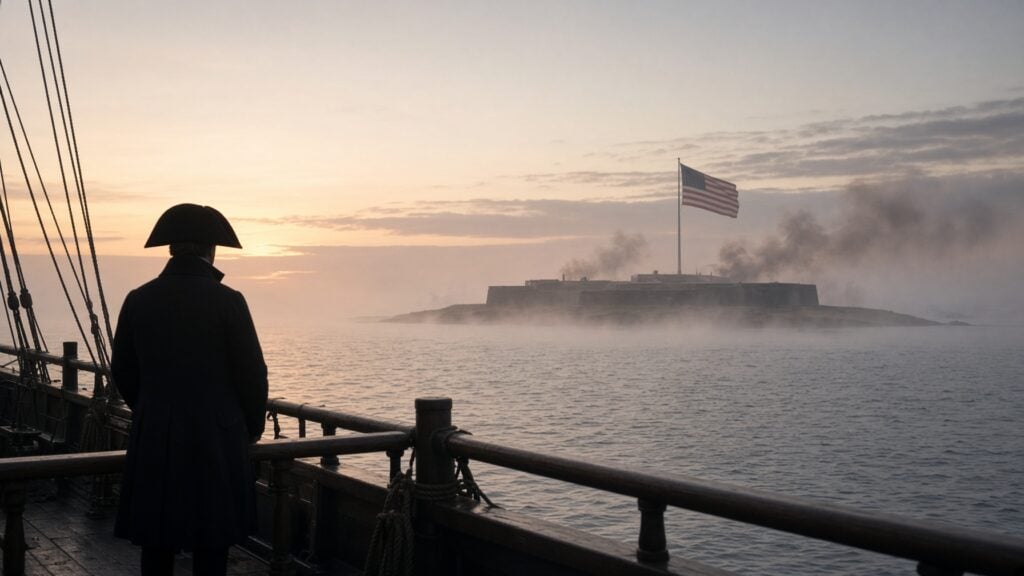
AI-generated with Grok
Two hundred and twelve years ago today, a thirty-five-year-old American lawyer stood on the deck of a British ship in Baltimore Harbor and watched through the night as enemy forces bombarded Fort McHenry. His name was Francis Scott Key. He had sailed under a flag of truce to negotiate the release of an American prisoner of war, and the British allowed him to complete his mission — but refused to let him leave while the attack was underway. He had no choice but to watch and wait.
The bombardment lasted twenty-five hours. Somewhere between fifteen hundred and eighteen hundred rockets and mortar shells were fired at the fort. Key had no way of knowing, as night fell and the smoke thickened, whether the fort was holding — or whether the banner he had last seen flying above it was still there.
When dawn broke on September 14th, 1814, he saw it. The flag was still there.
Key immediately began writing on the back of a letter he had in his pocket. The words came quickly because he had already been composing them in his mind through the long night of watching and waiting and praying. By the time he reached shore, the first draft of what would become our National Anthem was complete.
Most Americans know the first verse. But there is a fourth verse that our children almost never hear anymore — and it may be the most important of all. Key was a devout Christian, and his faith is unmistakable in every line of that final verse. It contains the words that would eventually become our national motto. Let me read it for you:
" O thus be it ever when freemen shall stand, Between their lov’d home and the war’s desolation! Blest with vict’ry and peace may the heav’n rescued land, Praise the power that hath made and preserv’d us a nation!
Then conquer we must, when our cause it is just, and this be our motto: In God is our trust. And the star-spangled banner in triumph shall wave, o'er the land of the free and the home of the brave."
Our trust lies in God. Not in government, not in the size of our economy, or even the power of our technology. In God is our trust.
That was the conviction of Francis Scott Key who wrote our anthem on this very morning in 1814. The flag that refused to fall — our flag — is worth celebrating today. May it always wave.
Honor history with us at PhyllisSchlafly.com. Sign up for our emails, and follow us on social media — find it all at PhyllisSchlafly.com, and join us again for the Phyllis Schlafly Report.